In-Depth Analysis of Consumer Behavior in the Housing Sector 2022: TERRAHINT Brand Series 2022 Reveals Consumer Insights Post-COVID Based on the Concept of GOOD HEALTH AND WELL-BEING
This document compiles the results of an in-depth survey on consumer behavior in the housing sector. For those who missed the live event, you can catch up here. The TERRAHINT Brand Series by TERRA BKK, a media outlet focused on real estate and marketing research, returned this year under the theme TERRAHINT Brand Series 2022: Think, Accelerate Brands for the Future.
The event featured numerous activities, including the presentation of research findings on consumer behavior based on the concept of GOOD HEALTH AND WELL-BEING, the awarding of Real Estate: The Most Powerful Brand 2022 to three real estate companies, and discussions on the vision for real estate development to drive Thailand's future. Additionally, there was a Creative Talk Room focusing on the design concept for the future, titled DESIGN FOR THE FUTURE, featuring seven distinguished speakers from various fields.
This article highlights the most anticipated segment: the presentation of in-depth research findings on consumer behavior based on the concept of GOOD HEALTH AND WELL-BEING. This research will reflect the movements of consumers and property buyers in the housing sector, providing real estate developers with insights to better understand and connect with the overall consumer landscape. This understanding will guide them in adapting to changing consumer needs and market conditions, leading to enhanced product development and brand elevation.
The findings from the 2022 consumer behavior analysis in the housing sector, based on the concept of GOOD HEALTH AND WELL-BEING, presented by Sumitra Wongphakdee, Managing Director of Terra Media and Consulting Co., Ltd., indicate that despite some fluctuations due to COVID-19, the easing of the situation has led to changes in consumer and buyer behavior regarding housing compared to the pandemic period.
This year's research collected data using two methods: 1. Focus Group (Qualitative Research: Focus Group aged 22-53, data collected from September 5-8, 2022). This year, the focus groups were divided into nine segments: 1. Gen X: Condo Intenders 2. Gen Y: Condo Intenders 3. Gen X: Detached House Intenders 4. Gen Y: Detached House Intenders 5. Gen X: Townhome Intenders 6. Gen Y: Townhome Intenders 7. Gen Z: Mix Types Intenders 8. Luxury Segment 9. Gen Z: Metaverse; and 2. Quantitative Data Collection from a sample of 2,100 sets (Quantitative Research: Online Survey from September 20 to November 10, 2022). This year, the sample included consumers with a monthly income of 9,000-15,000 THB, as the market for housing priced under one million THB remains strong. This inclusion allows for a clearer understanding of the consumer landscape, with a confidence interval of 95% and a standard error of 0.05.
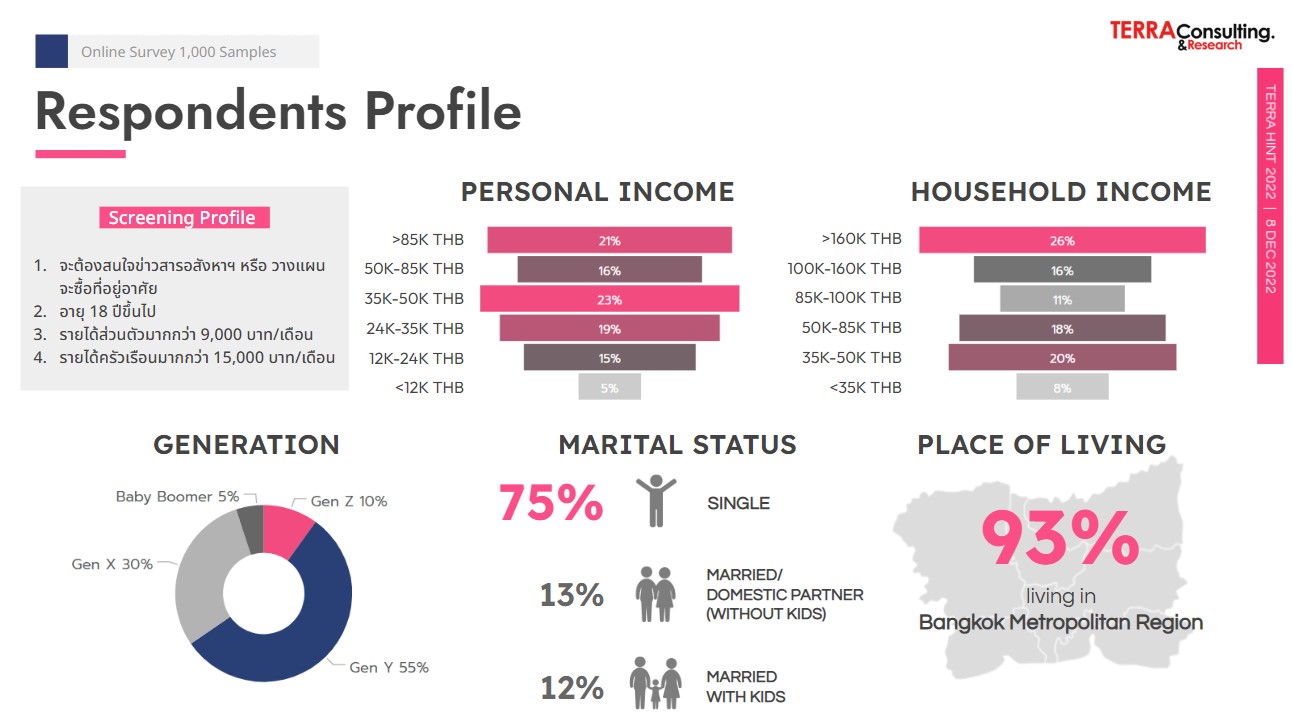
The sample indicates that 75% are single, 12% are married with children, and 13% are married without children, divided into GEN Z 10%, Gen X 30%, Gen Y 55%, Baby Boomer 5%. Most reside in areas such as Chatuchak, Prachachuen, Rattanathibet, and the inner ring, working in Chidlom, Thonglor, Sukhumvit, Chatuchak, and Prachachuen.
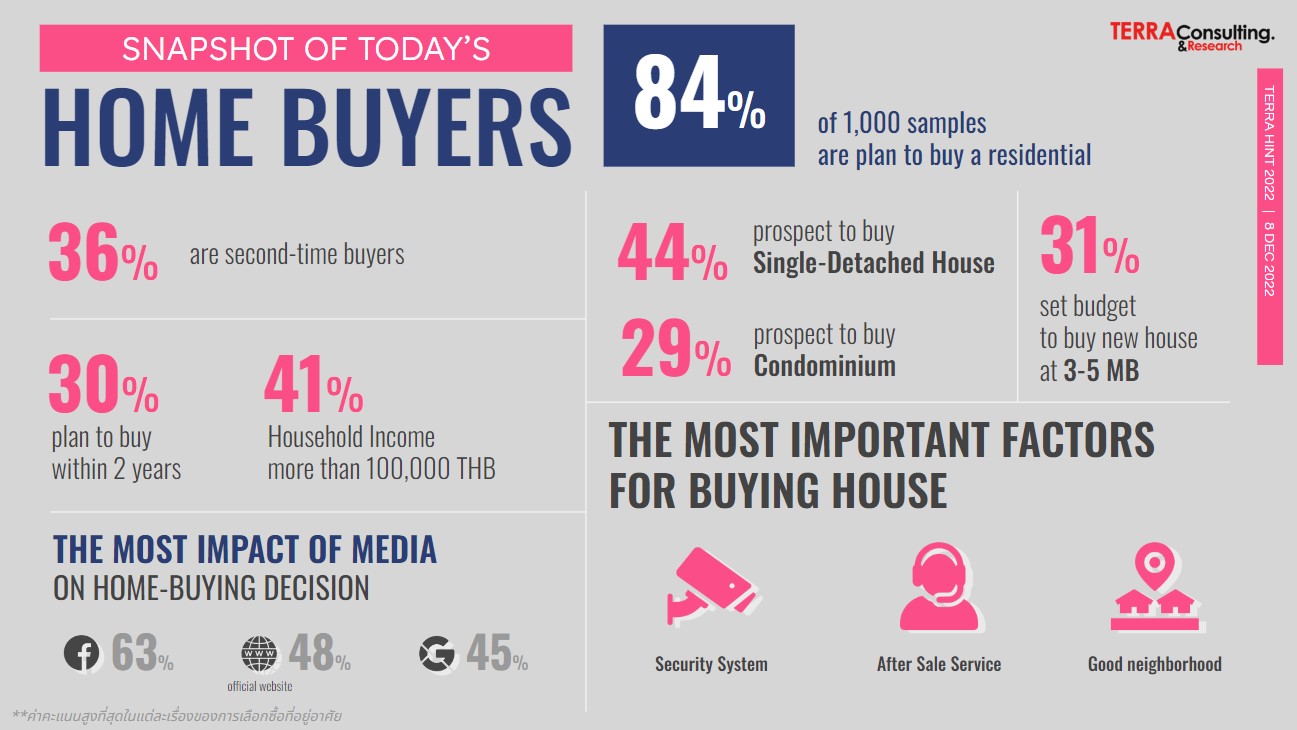
Survey results show that 84% of 1,000 respondents plan to purchase housing, with over 44% intending to buy single-family homes and 29% planning to buy condos, with a budget of 3-5 million THB. The key factors influencing their decision to purchase housing are the project's security system, after-sales service, and a good neighborhood.
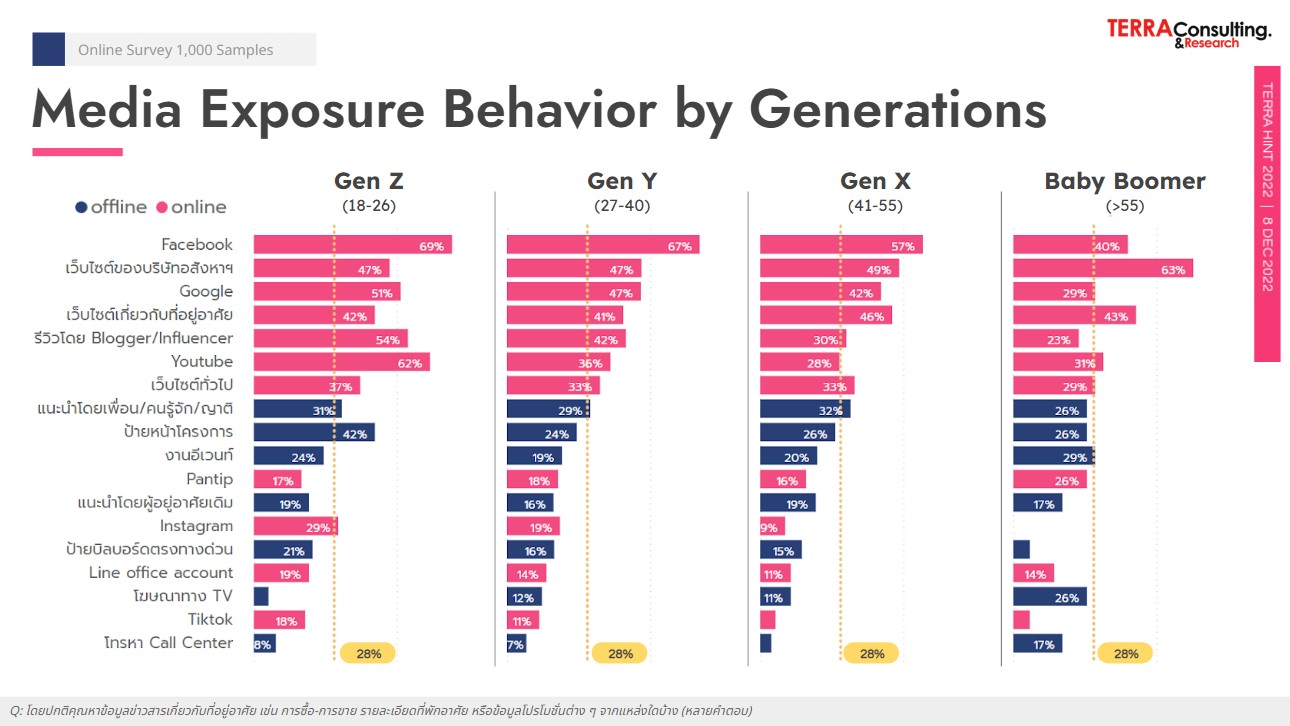
The top five media consumption behaviors remain online platforms: Facebook, websites, and Google search engines. Gen Z prefers watching reviews on YouTube and TikTok, as they have less knowledge about real estate compared to other generations, resulting in fewer brand names in mind compared to others who are already familiar with certain brands and can search for information.
Housing Purchase Behavior: All segments prioritize security systems, good utility management, and green spaces.
The sample indicates that consumers are interested in housing priced between 3-7 million THB. The top three popular locations for single-family homes are Rangsit-Lamlukka, Bang Yai-Bang Bua Thong, and Bang Phli, while the top three popular locations for condos are Chatuchak-Prachachuen, On Nut-Bang Na, and Phaya Thai-Ari.
Key factors in purchasing homes or condos include security systems, good after-sales service, a good neighborhood, construction materials, and price. When delving deeper into consumer preferences for single-family homes, most desire homes with comprehensive functions, such as smart home features for safety, air quality management innovations, age-friendly designs, EV charging stations, and double volume spaces. In contrast, condo buyers prioritize features that enhance privacy, such as bedroom doors and partitions, large windows, closed kitchens, and bedrooms that can accommodate a 6-foot bed.
Most consumers are not first-time homebuyers; they are on their second purchase and plan to buy a home within two years. The primary source for researching information remains the brand's website, but they do not fully trust everything the brand claims, still relying on mainstream media and various reviews.
Furthermore, the survey reveals that regardless of income group or generation, the top three features that buyers believe will enhance their quality of life are: 1. A robust security system 2. Good utility management in the project (underground wiring, drainage systems, waste management) 3. Increased green spaces in the project.
“For consumers, they define well-being as starting with oneself; one must be physically and mentally comfortable. They define a home as a good environment, not just a place to sleep or a house purchase, but rather a design for a good living environment. Many factors that consumers cannot choose, such as neighbors, are what they expect developers to select for them.”
When discussing homes or residences, it means choosing a good environment for life. Therefore, what consumers expect from a home can be divided into three main functions: 1. Comfort, meaning spaciousness 2. Safety and comfort 3. Design that reflects identity.
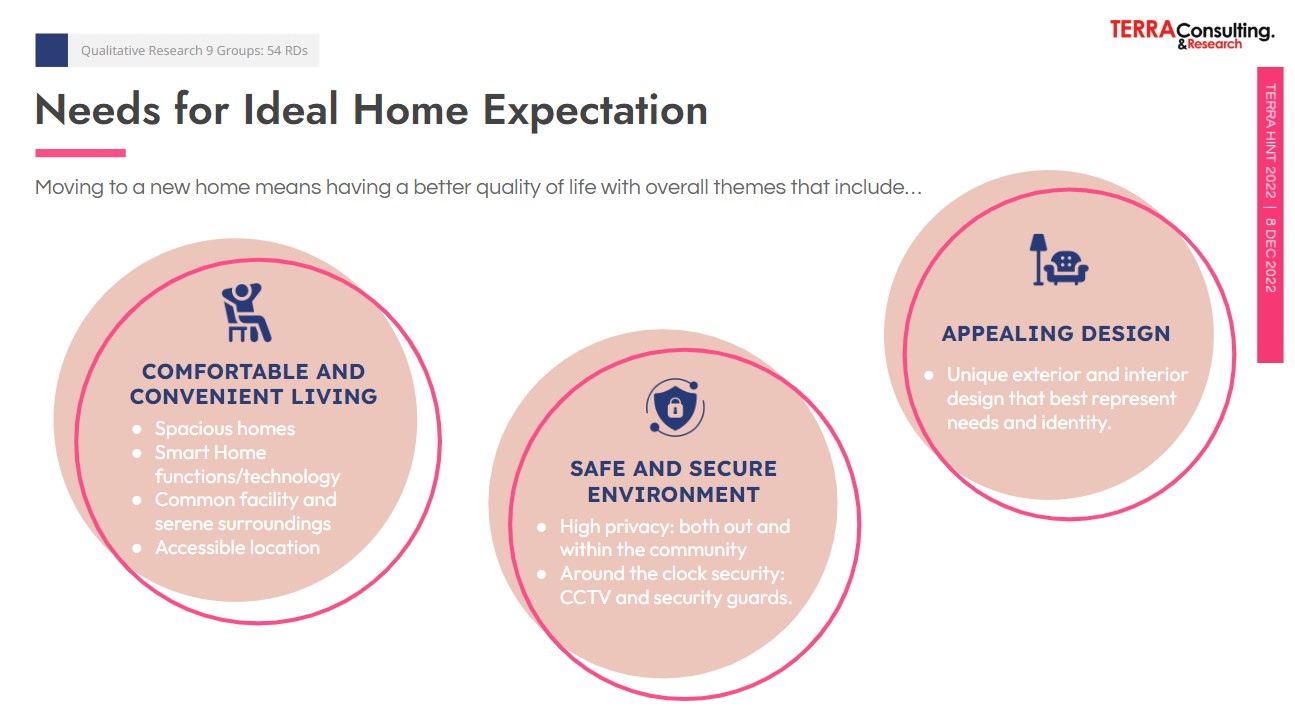
“The meaning of safety includes the desire for technology to support safety, such as CCTV. The design choice does not necessarily have to be modern but should reflect personal identity, which varies by generation and individual. For example, if someone likes modern style, loft is modern for Gen Y, while colonial is modern for another generation. This means developers must first understand which target group they want to reach.”
“Especially regarding the smart home concept, consumers divide it into two functions: 1. Smart home for safety, such as safe utility systems embedded in pipes, which is what consumers expect from developers because they cannot find it externally, and 2. Smart home for convenience, which consumers can find externally.”
Housing Purchase Behavior by Segment: All segments desire EV charging stations.
When analyzing housing purchase behavior by housing segment, it can be divided into economy (housing under 3 million THB), mass (housing 3-7 million THB), and premium (housing over 7 million THB). In terms of demand across all three segments, consumers still prioritize the same top three features: 1. Security systems 2. Good utility management 3. Increased green spaces in the project, although the proportions differ.
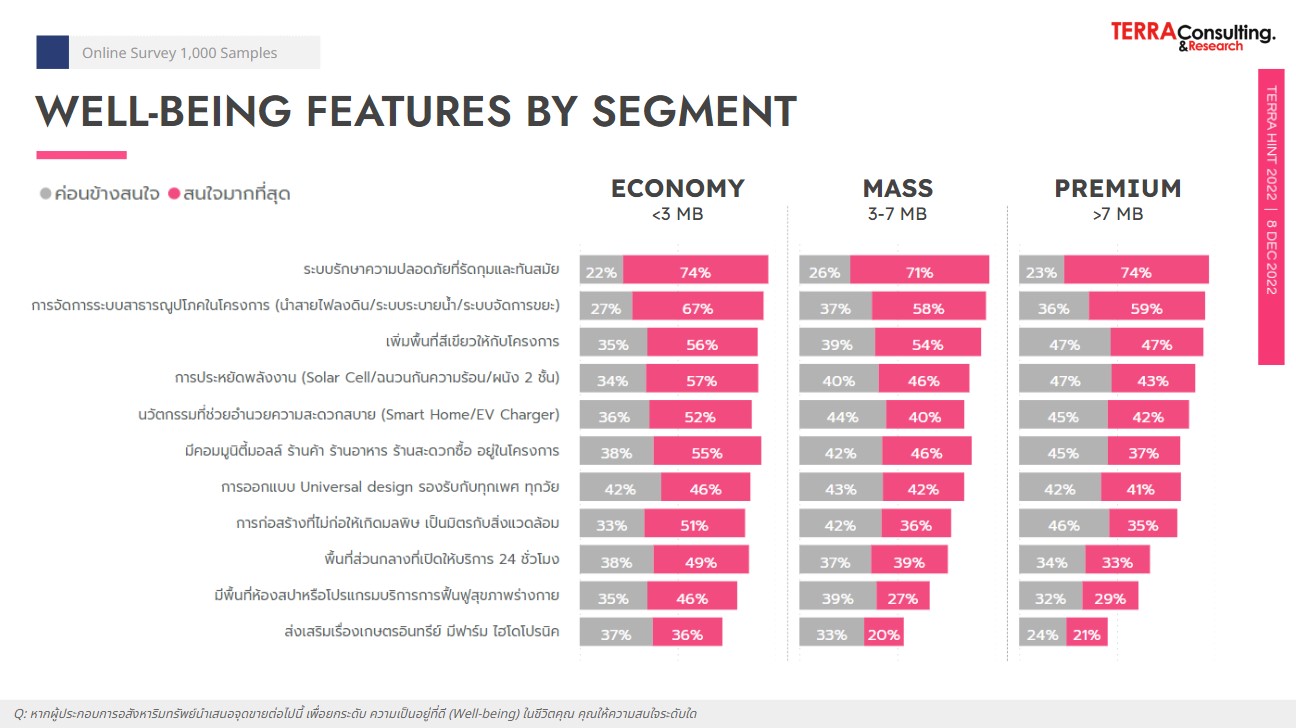
“For example, the economy segment has a high demand for all aspects, but an interesting observation is that regardless of the segment, EV charging stations have become a requirement across all segments, reflecting the growing accessibility of the EV market, which has shifted from being a premium market to becoming more mainstream,” Sumitra from Terra Media noted, further breaking down the factors influencing housing choices by segment:
• Key factors in choosing a home in the premium segment: 1. After-sales service 2. Security systems 3. Good neighborhood 4. Environment 5. Interior space, requiring a Thai kitchen, smart home for safety, and a downstairs bedroom for guests or in case someone in the house is ill.
• Key factors in choosing a home in the mass segment: Similar to the premium group in the first 2-3 points, differing in 4. Interest in construction materials 5. Price. In the condo segment, there is a demand for partitions to create defined spaces and a 6-foot bed, indicating that room sizes in condos may need adjustments to enhance comfort.
• Key factors in choosing a home in the economy segment: Similar to the premium group but differing in details, such as interest in smart home features for safety and a desire for closed kitchens.
Every generation perceives their quality of life positively; Gen Y seeks higher housing purchases, while Baby Boomers are interested in condos.
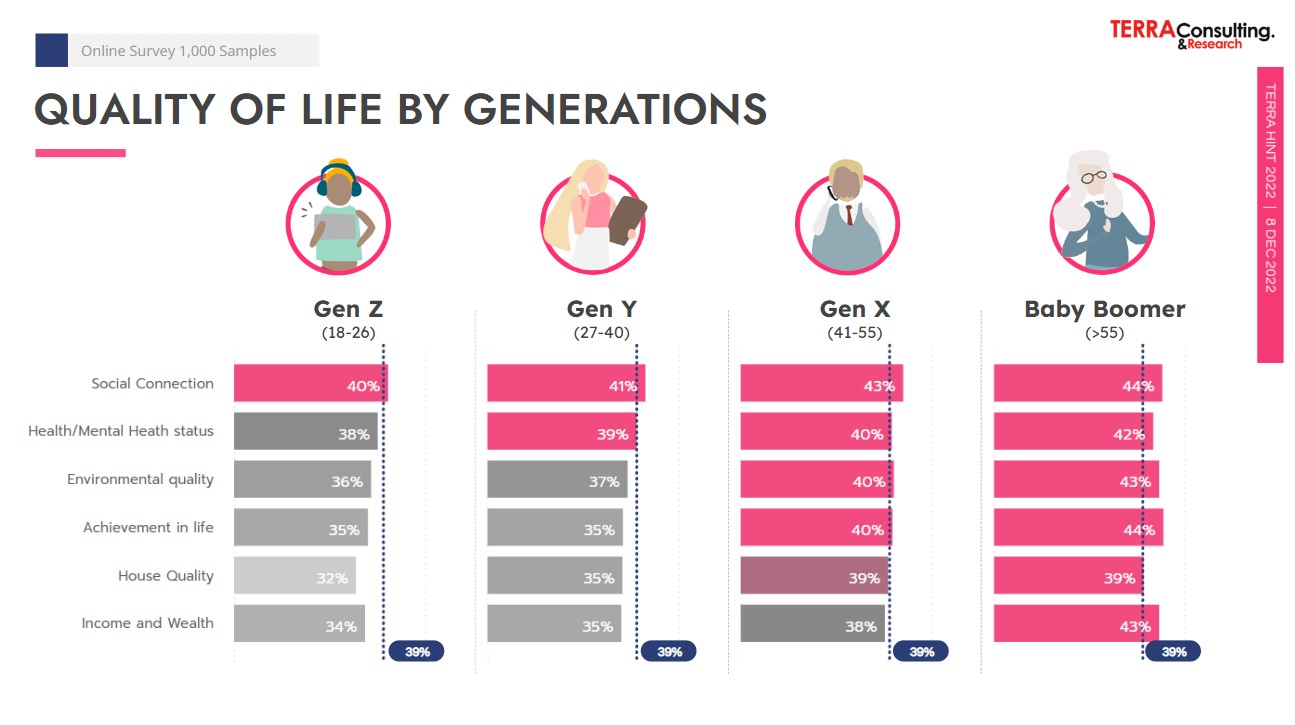
This year, when analyzing behavior by generation, interesting points emerged. Almost every generation perceives their overall quality of life as good, but when compared, Gen Z feels the lowest satisfaction regarding their quality of life compared to others, yet they are satisfied with their social connections. In contrast, Gen Y, Gen X, and Baby Boomers focus on health. When breaking down details by generation:
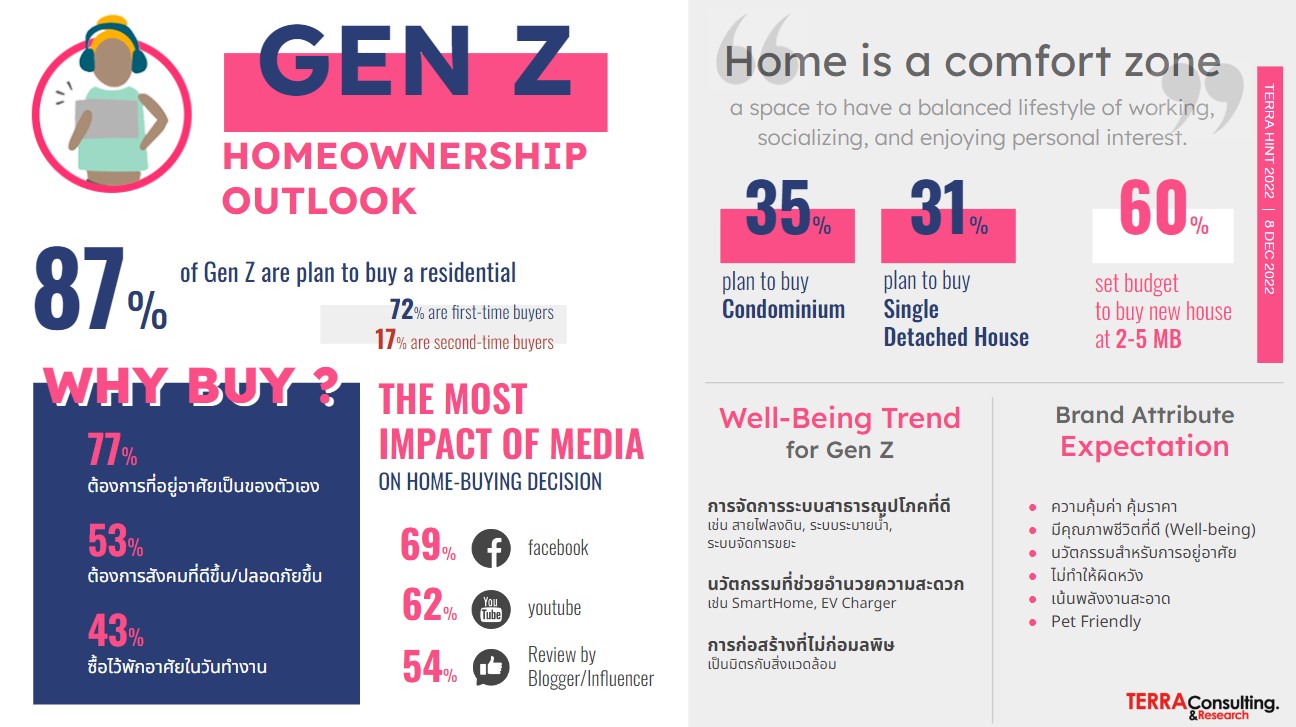
• GEN Z is a first-time buyer group with a desire to purchase homes at 87%, seeking personal space, interested in condominiums, and homes with innovative features that provide convenience. They are concerned about environmentally friendly construction and seek value for money, indicating that if developers are targeting condos, Gen Z is the target audience.
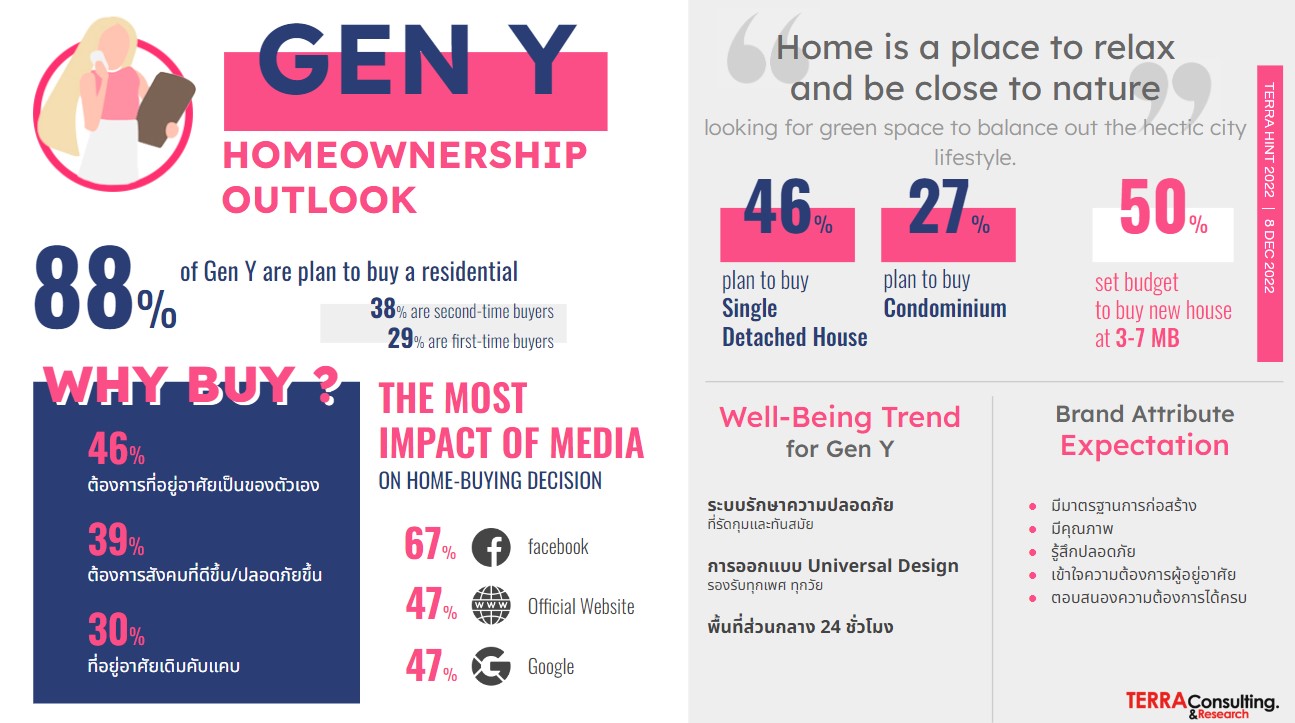
• GEN Y: Not first-time buyers, they prefer single-family homes over other types of housing, seeking modern security systems and universal design with 24-hour common areas, as they value work-life balance and want spaces to enjoy life after work.
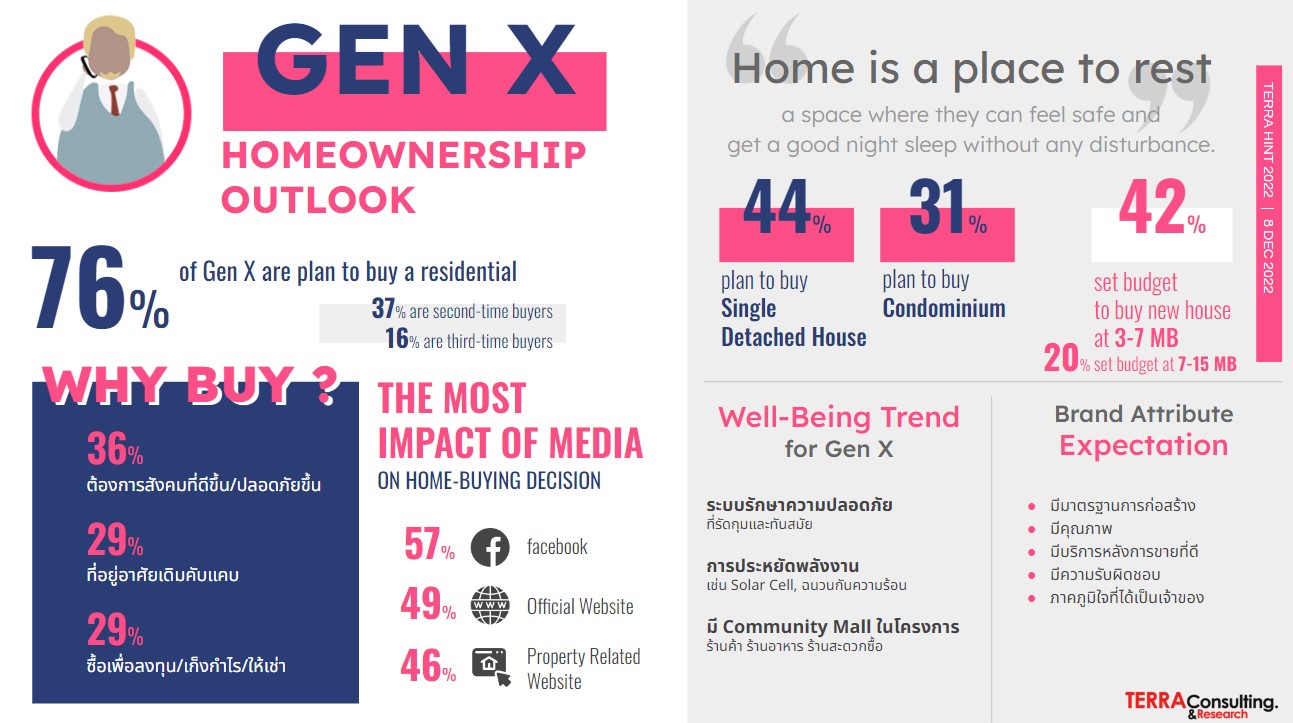
• GEN X: A group that has purchased more than two homes, they prefer single-family homes over other types, seeking modern security systems but also emphasizing energy efficiency and community malls within projects for convenience.
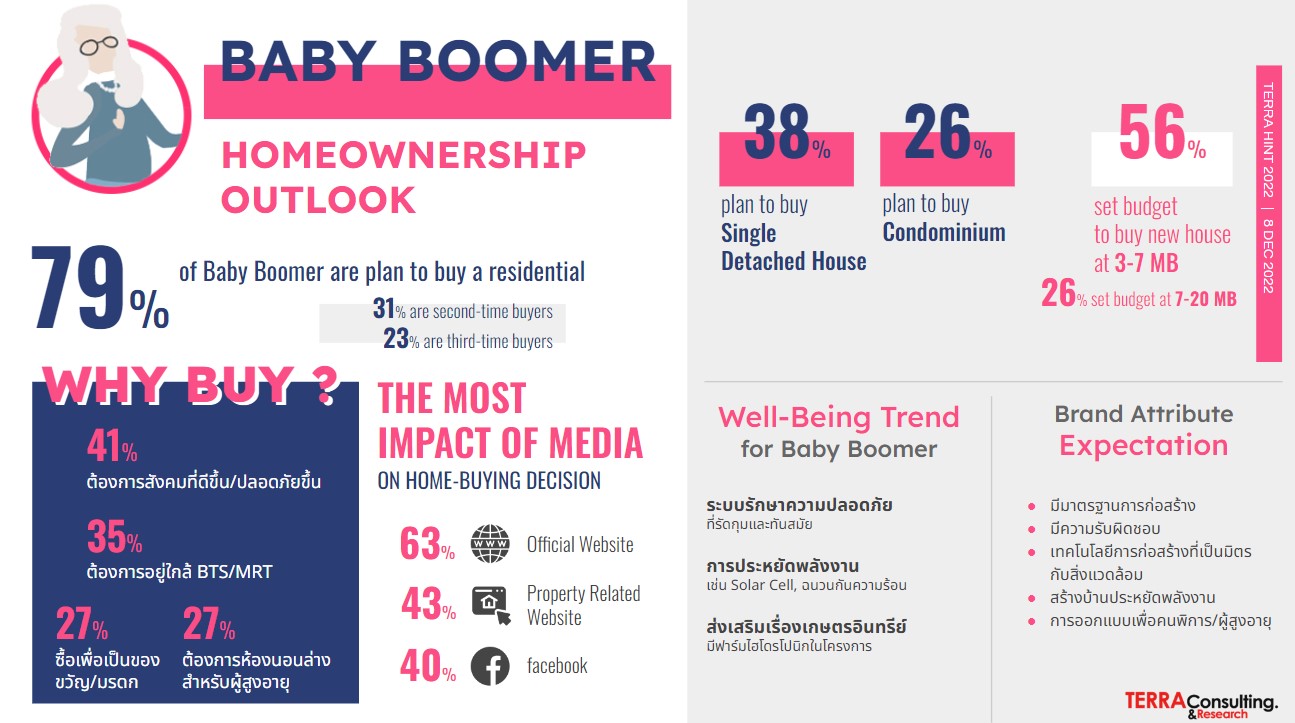
• Baby Boomers: Interested in both houses and condos, the survey revealed that Baby Boomers are increasingly interested in condos for convenience and easier travel, as they crave social interaction and prefer living in accessible condos. They prioritize modern security systems, community spaces, and are interested in organic farming and energy-saving initiatives.
Consumer Behavior by Attitude: 4 Groups, 4 Characters, 4 Needs
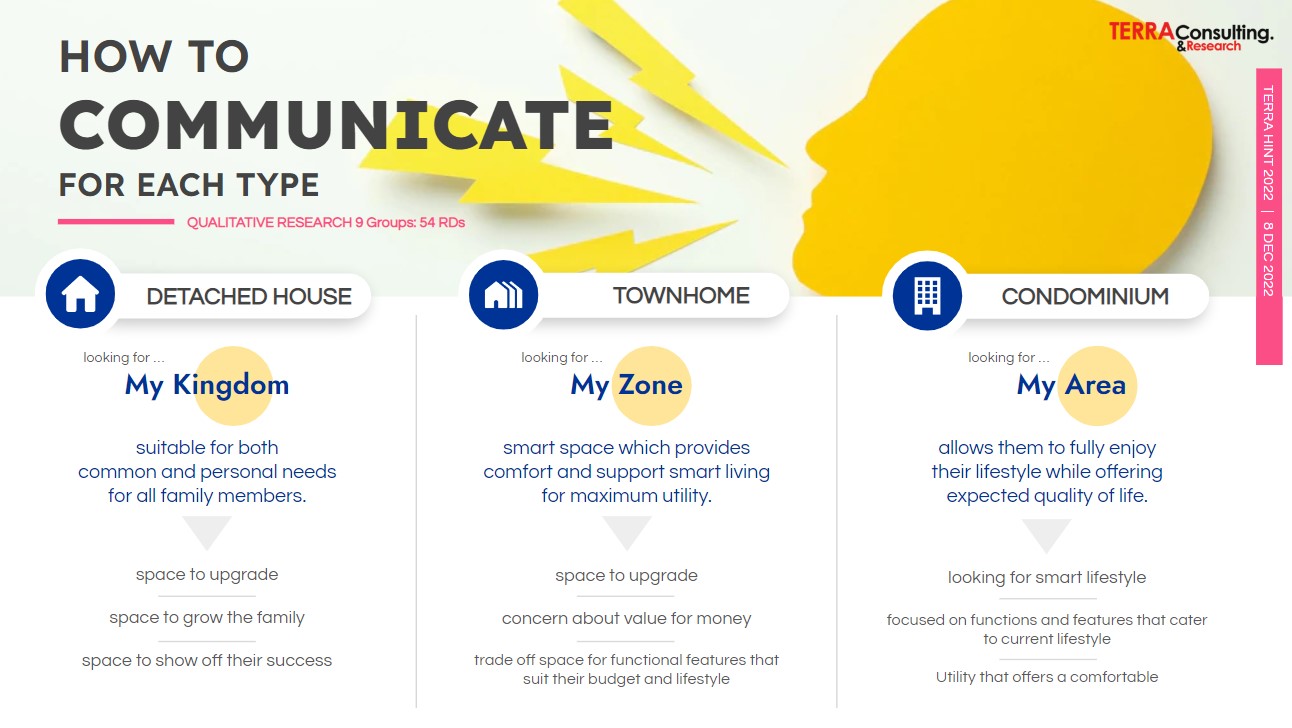
Consumers inclined to buy homes lead different lifestyles and have different mindsets regarding housing, thus seeking different types of residences. Therefore, in terms of communication, real estate developers can position their products according to type, stating that when it comes to homes, they seek My Kingdom, townhomes represent My Zone, and condominiums signify My Area.
As in previous years, the survey results analyzed consumers based on attitudes and lifestyle behaviors to provide a clearer picture of them, which can be categorized into four main behavioral groups:
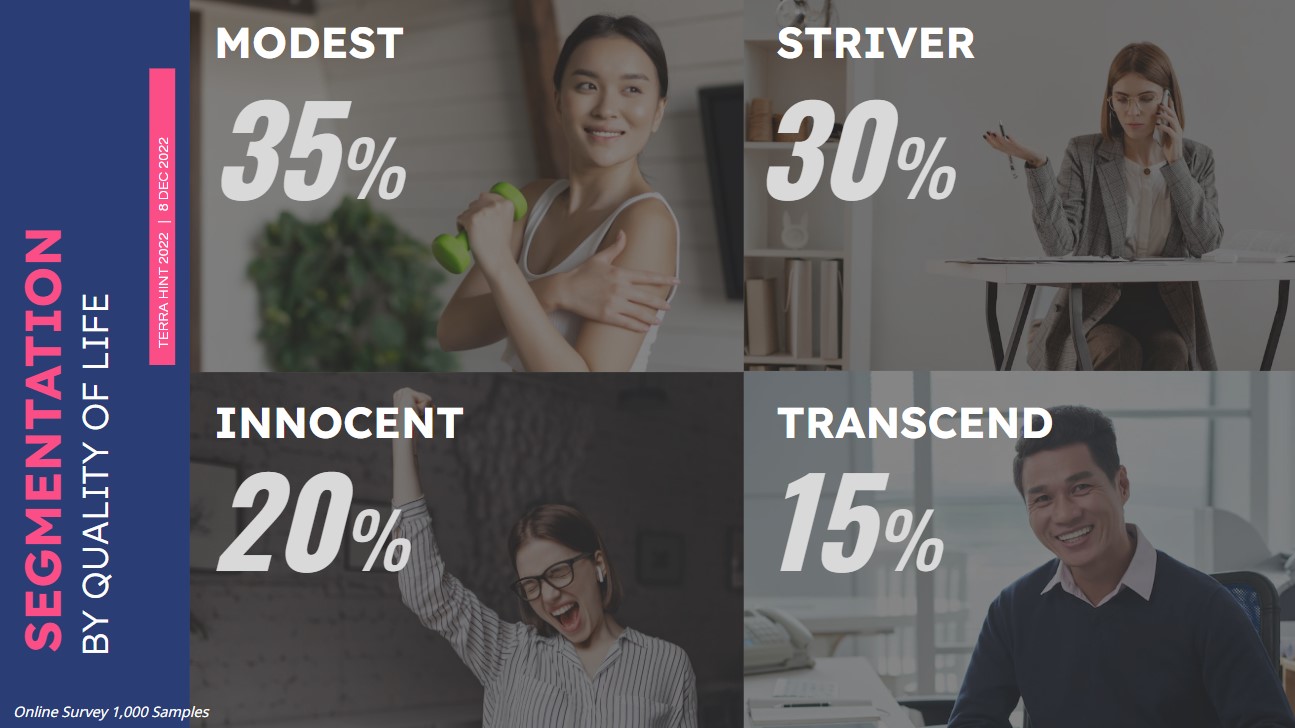
1. Mosest (35%): A group moderately satisfied with their lives, often Gen X and Y, who feel most content with their health, not needing to take medication or visit doctors frequently.
- Essential functions for housing from this group's perspective include air quality management innovations and downstairs bedrooms.
- Essential functions for condominiums include antibacterial and germ-resistant materials, closed kitchens, smart home features for convenience and safety, high ceilings, solar cells, double volume spaces, and designs for the elderly.
2. Striver (30%): A group still driven to pursue changes in their lives, mostly Gen Y and Z, seeking success and not satisfied with their income, loving travel for happiness and new experiences.
- Essential functions for housing from this group's perspective include antibacterial and germ-resistant materials, air quality management innovations, smart home features for safety, and Thai kitchens.
- Essential functions for condominiums include bedroom partitions, closed kitchens, living room balconies, semi-balconies, and smart home features for safety.
3. Innocent (20%): A group open to everything in life, comprising nearly all generations, most satisfied with their lives.
- Essential functions for housing from this group's perspective include air quality management innovations, downstairs bedrooms, smart home features for safety, double volume spaces, and Thai kitchens.
- Essential functions for condominiums include bedroom partitions, closed kitchens, large windows, smart home features for safety, and large bedrooms that can accommodate a 6-foot bed.
4. Transcend (15%): Mostly Baby Boomers and Gen X, this group feels their lives are good but is transitioning to something new, wanting to give something back to themselves or society, feeling satisfied in all aspects of life, especially regarding finances and social life, but concerned about health.
- Essential functions for housing from this group's perspective include downstairs bedrooms, Thai kitchens, EV charging stations, smart home features for safety, and double volume spaces.
- Essential functions for condominiums include large bedrooms, accommodating 6-foot beds, large windows, and high ceilings.
Perspectives on Metaverse Experiences
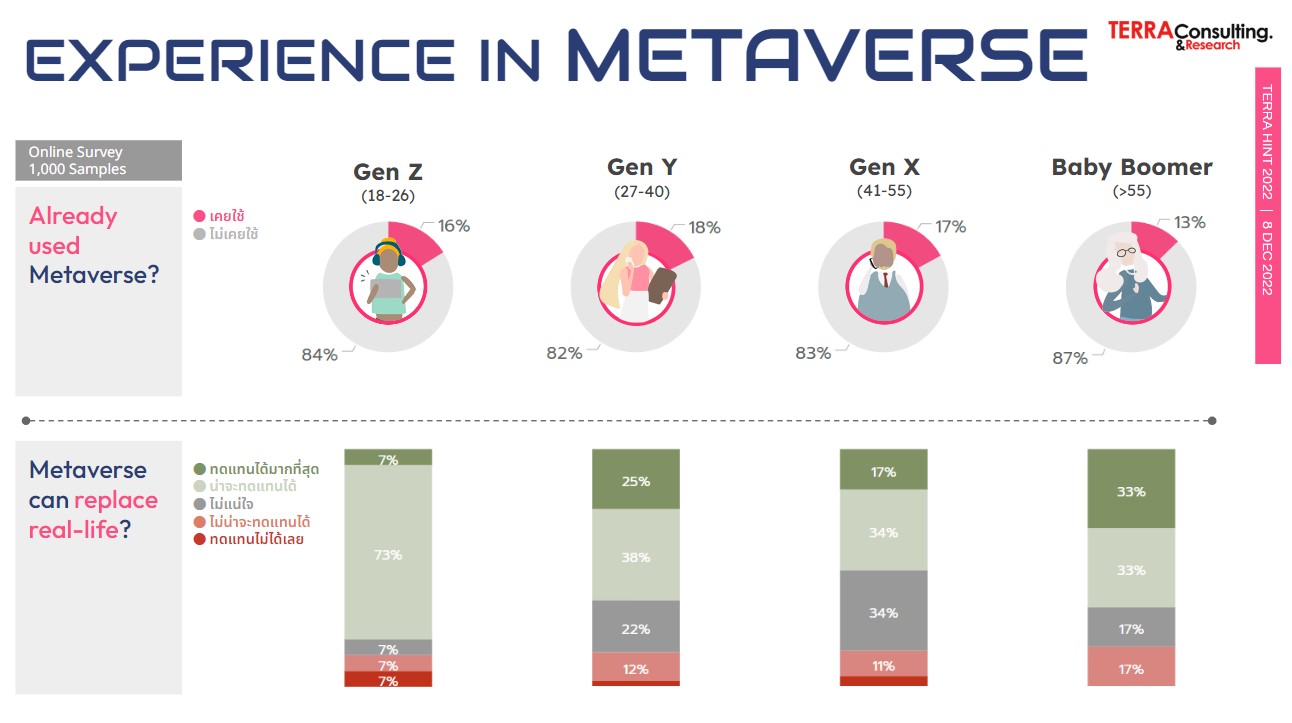
This year, an additional question regarding metaverse experiences was included in the survey, revealing that Gen Z believes the metaverse can replace real life only to a minimal extent (7%), while Baby Boomers see the metaverse as a potential replacement for real life at 33%. This surprising result reflects Baby Boomers' openness to new technologies.
Overall, the sample views the metaverse as a platform where consumers can fulfill their imaginations, do the impossible in reality, and express themselves differently. This indicates that 'consumers are not looking for a virtual world in the metaverse' but rather a 'world beyond imagination' or a world they cannot find in reality within the metaverse.
Additionally, they see the metaverse as a quick way to connect with others from anywhere, bringing the world closer together in various dimensions, including entertainment, work life, and investment. However, it is noted that in terms of investment, the metaverse still garners low interest, as the platform is relatively new and in its early stages, leading consumers to be hesitant to invest significant amounts due to perceived risks.
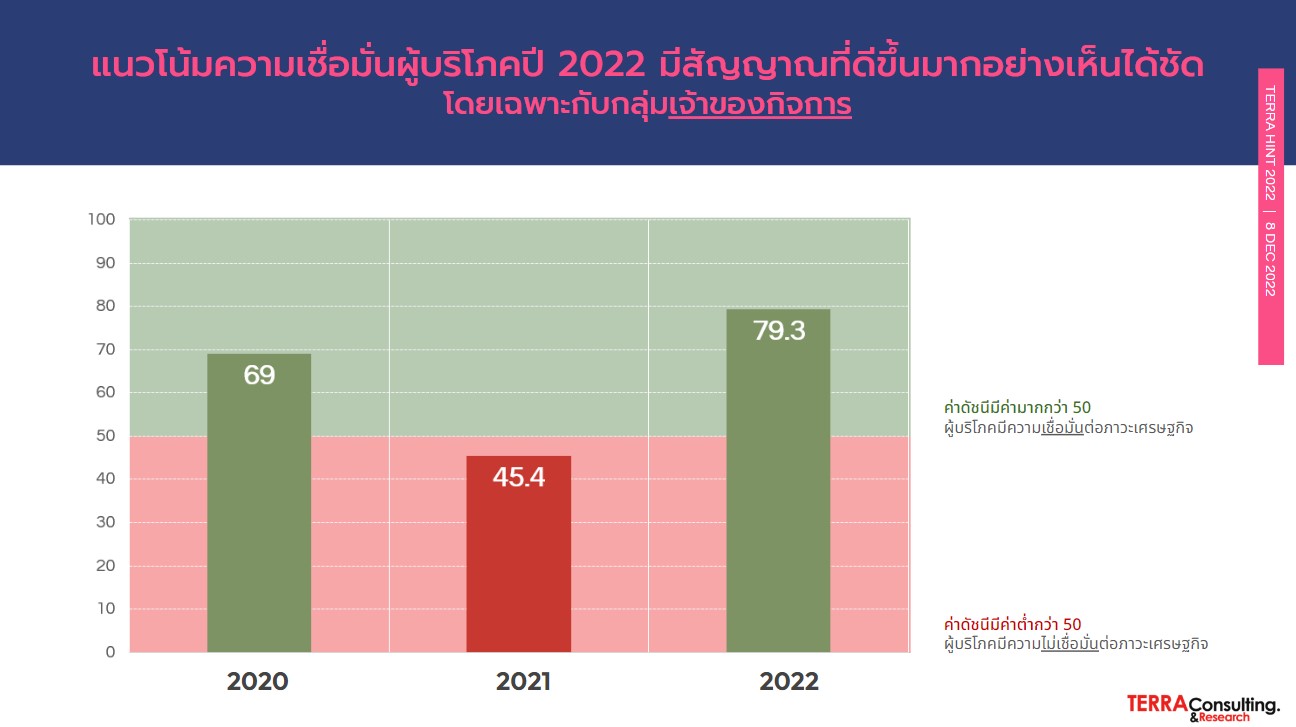
Conversely, when looking at the real world, most consumers perceive the real world positively in relation to the economic trends of 2022, noting a significant improvement in consumer confidence index, which stands at 79.3, up from 45.4 in 2021. Data shows that business owners are increasingly confident, with many stating that their financial status has improved compared to the previous year and believing that the overall Thai economy will be on the rise in the next year, influencing decisions to purchase high-value items such as real estate or vehicles.
This research set is believed to be another useful tool for guiding work and shaping the development of the Thai real estate industry to overcome new challenges.