10 Interesting Questions About APEC
1. What is APEC and why is it important?
The Asia-Pacific Economic Cooperation (APEC) is a multilateral grouping of 21 economies located in the Pacific region, including Russia, the People's Republic of China, South Korea, Japan, Taiwan, Hong Kong, Vietnam, Thailand, the Philippines, Malaysia, Singapore, Indonesia, Brunei, Papua New Guinea, Australia, New Zealand, Canada, the United States, Mexico, Peru, and Chile. Thailand is one of the 12 founding economies and has hosted meetings in 1992 and 2003.
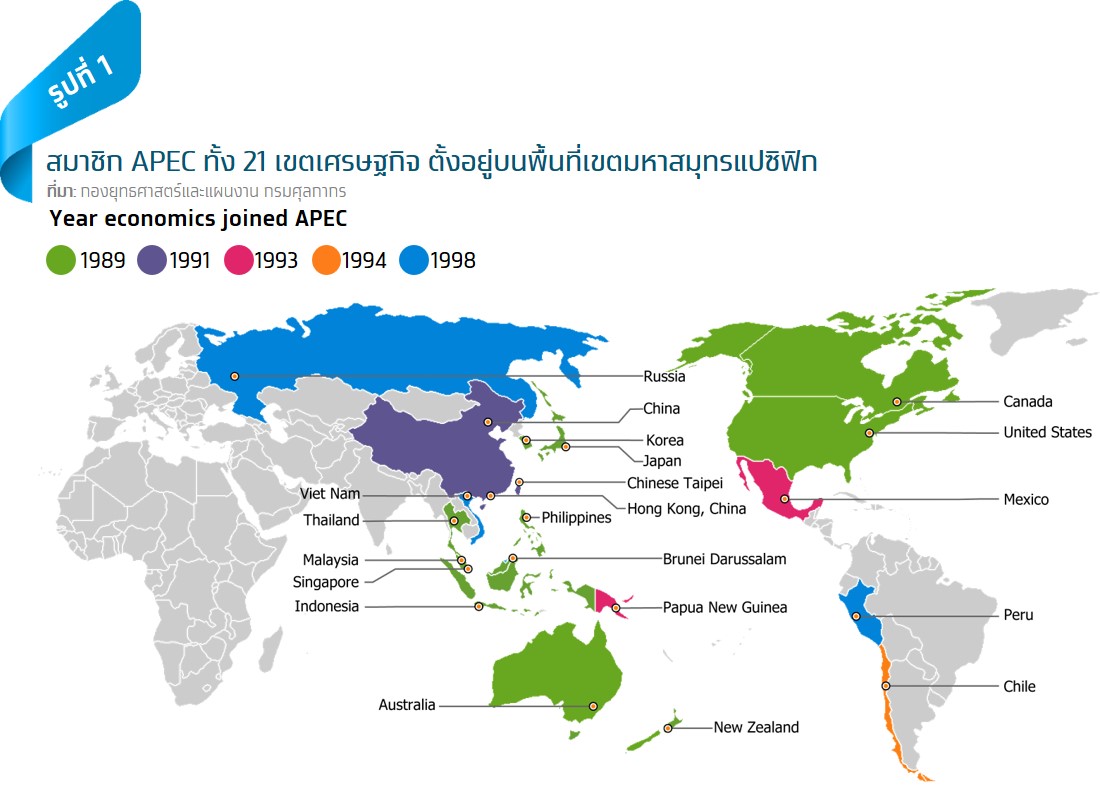
APEC was established in 1989 to serve as a platform for cooperation and dialogue on economic issues, allowing members with different policy orientations to find common ground to achieve goals. It focuses on economic growth, cooperation across all sectors, energy, public health, e-commerce, and the environment to reduce barriers and facilitate trade (goods and services), investment, and international travel.
2. How does APEC differ from other multilateral agreements?
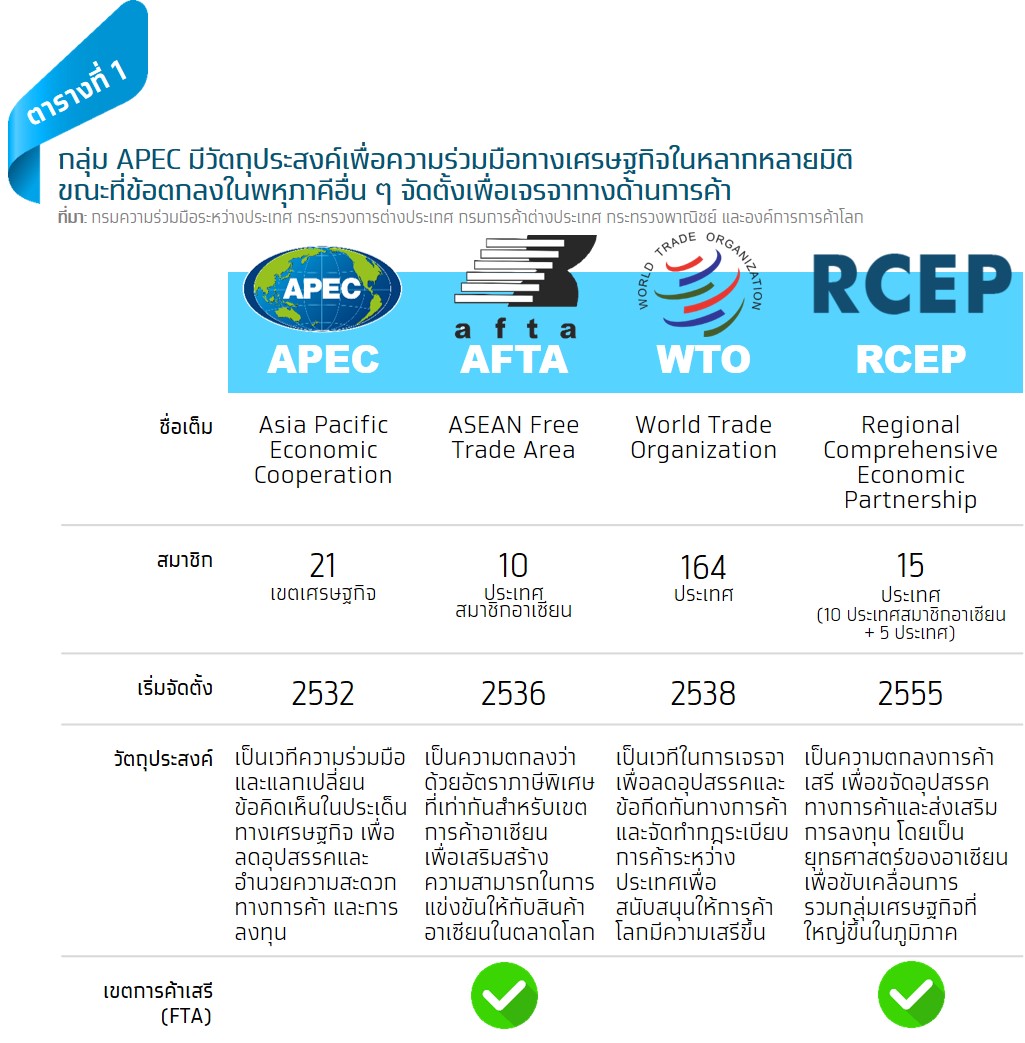
APEC is a forum for consultation and dialogue that encompasses multiple dimensions of economic cooperation, unlike other multilateral agreements that focus on trade negotiations. Cooperation is based on consensus, voluntary participation, and flexibility, and is not legally binding. Members can pursue trade liberalization and investment according to their readiness.
APEC meetings involve not only government cooperation but also private sector collaboration through the APEC Business Advisory Council (ABAC), which convenes annually to discuss and exchange views on business and significant economic challenges, culminating in annual recommendations to APEC economic leaders.
3. Why is APEC important for the global economy?
APEC is a significant multilateral cooperation platform globally, accounting for approximately 61% of the world's GDP and over one-third of the global population. This gives it considerable influence over trade, investment, and international relations. According to the World Bank, in 2021, APEC members' GDP totaled $59.4 trillion, representing 61% of the global GDP. The three largest APEC economies are the United States, China, and Japan, while Thailand ranks 11th (with a GDP of $0.5 trillion), following Taiwan ($0.7 trillion), and is second in ASEAN after Indonesia ($1.2 trillion). In terms of population, APEC had a total of 2.9 billion people in 2021, accounting for 37% of the world's population, with three key member countries ranking among the top five globally: China (1st), the United States (3rd), and Indonesia (4th), while Thailand ranks 9th in APEC and 4th in ASEAN.
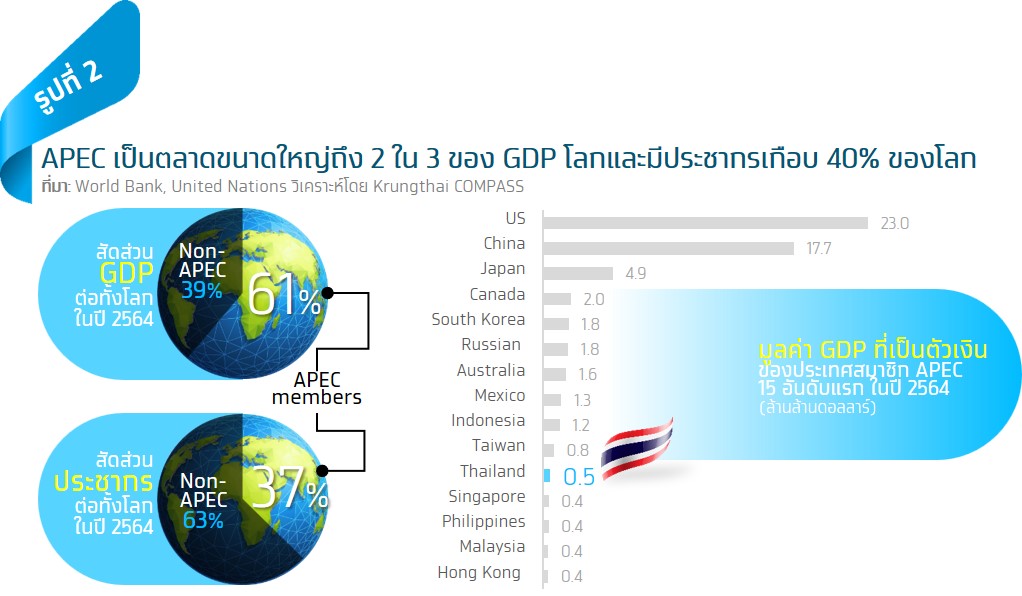
In addition to being a large grouping, APEC is a high-potential economic zone, with a labor force participation rate of 63.6% among APEC members in 2021, indicating that over two-thirds of the population is of working age, higher than the global average (59%). This reflects investment opportunities and access to a growing market. Furthermore, APEC is a highly dynamic market, with many countries transitioning to urbanization. According to the United Nations, APEC has an urban population of 73%, exceeding the global average (56.6%). The migration of people to urban areas in APEC presents significant future market opportunities. Overall, Krungthai COMPASS estimates that APEC cooperation will be a driving force for sustainable global economic growth.
4. What is the economic link between Thailand and APEC?
Thailand's economy is highly dependent on international trade, with the value of international trade (both goods and services) reaching 116.7% of GDP in 2021, highlighting the importance of opening up to promote foreign sectors as a key engine for driving the Thai economy, particularly in exports and imports, which account for 53.4% and 45.4% of Thailand's GDP, respectively. Thailand relies on trade with APEC, with exports to APEC accounting for 72.1% of total exports, while imports from APEC represent 71.9% of total imports worldwide. Major export and import markets include the United States, China, and Japan. Additionally, Thailand has ongoing investment links with APEC member countries, with continuous inflows of direct investment from APEC member countries and increasing Thai investment in APEC member countries.
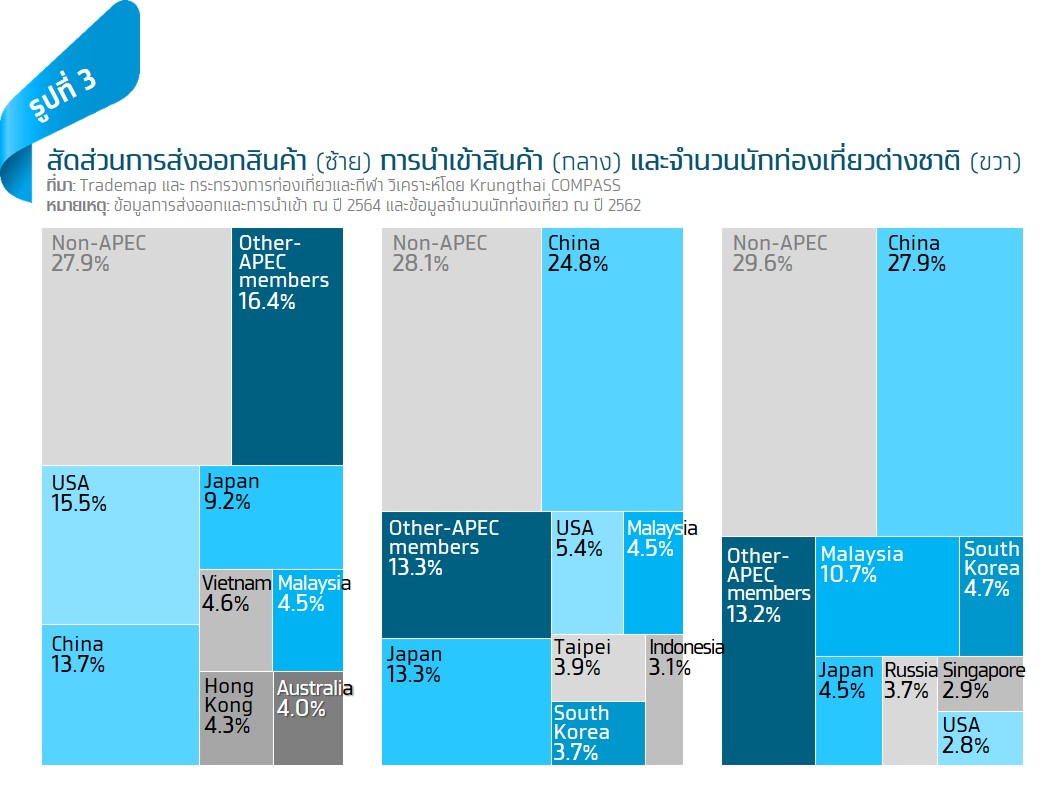
Regarding tourism, before the COVID-19 pandemic, Thailand welcomed 28.1 million foreign tourists from APEC countries, accounting for 70.4% of all tourists visiting Thailand in 2019, with the highest numbers coming from China, Malaysia, South Korea, and Japan.
5. What role does APEC play in Thailand's industrial sector?
Many countries in the APEC region, particularly China, Thailand, and South Korea, rely on industrial production, with the share of manufacturing to GDP being nearly 30%. In 2021, the share of industrial production to GDP for these countries ranked among the top three in APEC at 27.4%, 27.0%, and 25.4%, respectively, which is higher than APEC's average (15.4%) and the global average (17.0%). This indicates that the industrial sector is a crucial driver of the economy for Thailand and many Asian countries known as the world's factory.
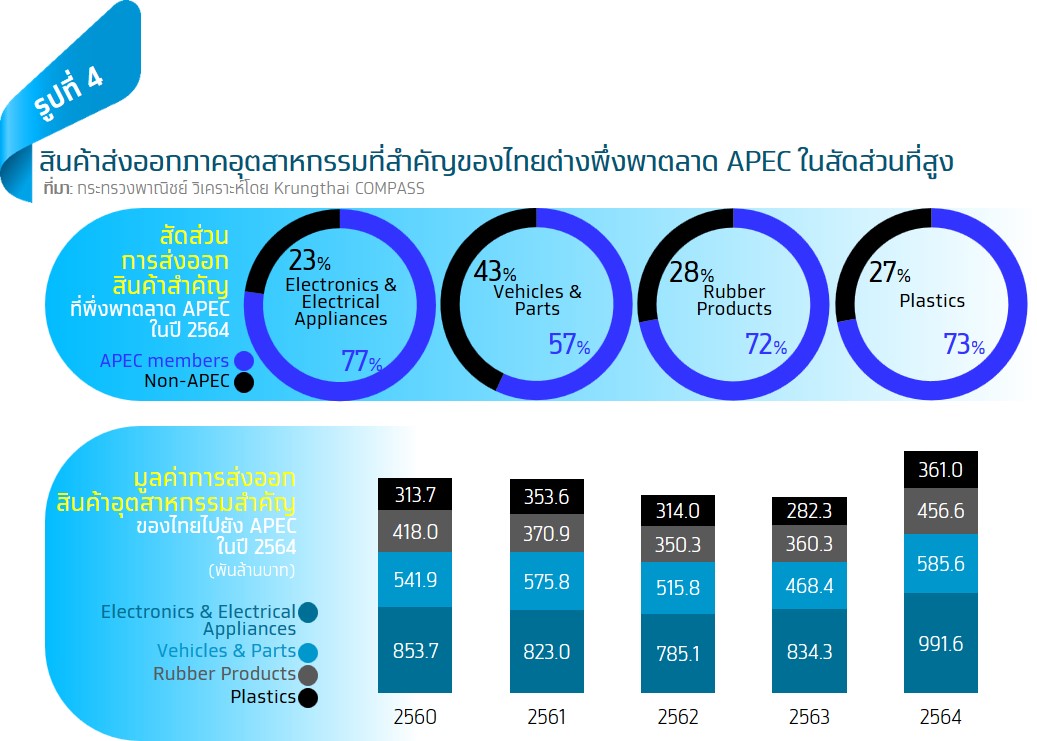
In Thailand's case, Krungthai COMPASS found that the top four export products in 2021 were industrial products, including electronics and electrical appliances (26.2% of total export value), automobiles and parts (14.2%), rubber products (5.8%), and plastics (5.3%). Most of these products are exported to APEC, with electronics accounting for 77.3% of the APEC market, automobiles (57.5%), rubber products (72.5%), and plastics (72.8%). This demonstrates the high inter-trade connectivity among member countries, where both sides benefit from favorable trade and investment conditions under APEC, as well as efforts to reduce trade barriers and adjust regulations to facilitate greater access to APEC markets, ultimately supporting the continuous economic growth of all members.
6. How important are foreign tourists from APEC to Thailand?
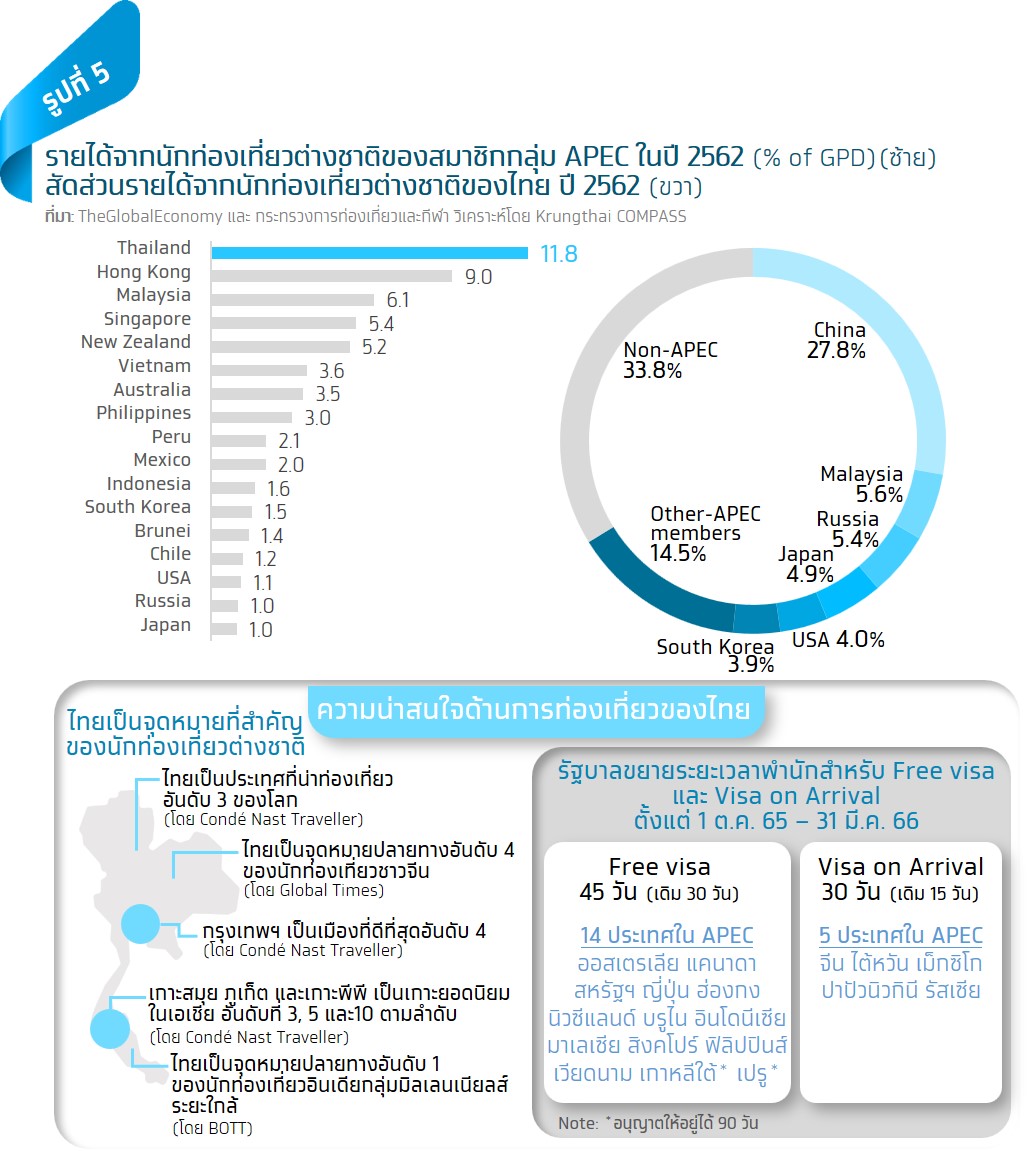
Foreign tourists are the most significant economic driver for Thailand compared to other APEC members, as reflected in Thailand's high dependence on foreign tourist income, which accounted for 11.8% of GDP in 2019 (approximately 1.9 trillion baht). Most of this income came from APEC tourists, who contributed 66.2% of total tourist revenue, with significant contributions from Chinese tourists (accounting for one-fourth of all foreign tourist income), followed by Malaysia (5.6%), Russia (5.4%), and Japan (4.9%).
7. How competitive is Thailand compared to APEC members?
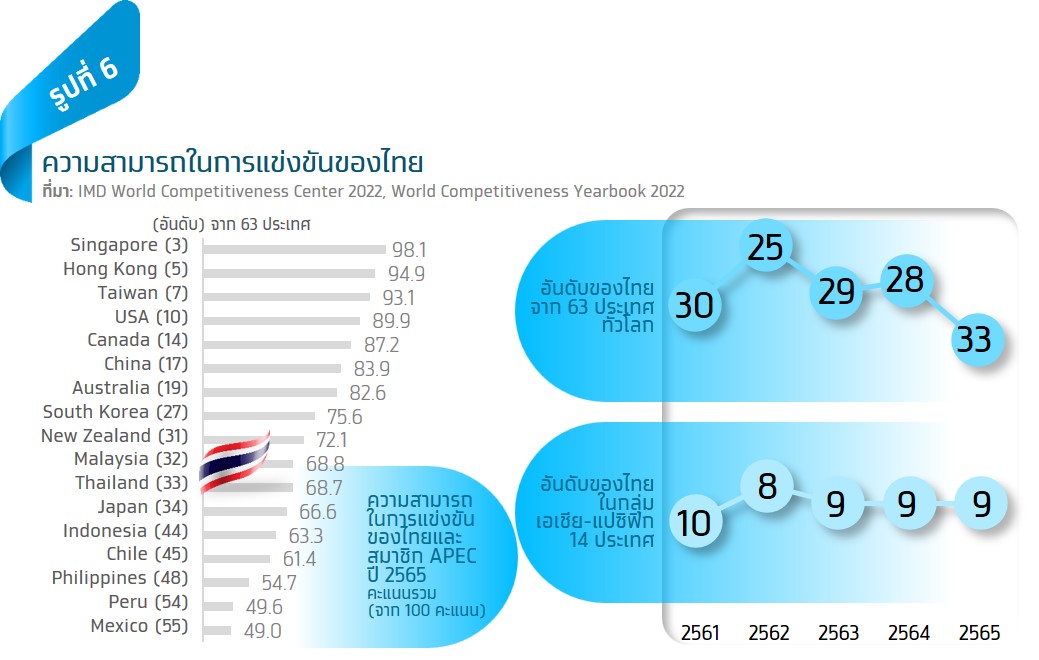
Considering Thailand's competitiveness on a global scale, the International Institute for Management Development (IMD) ranked Thailand with a score of 63.7 out of 100 in 2022, placing it 33rd out of 63 countries worldwide. Thailand's ranking dropped by five places across four main components: economic conditions (34th, down 13 places), domestic economy and international trade; price competitiveness improved; government efficiency (31st, down 11 places) due to declines in fiscal and business law factors; business efficiency (30th, down 9 places) due to declines in productivity and efficiency; while management remained unchanged, and infrastructure (44th, down 1 place) due to health and environmental factors, although technological infrastructure, general infrastructure, and education improved.
However, the most significant factor contributing to the decline in competitiveness was economic conditions due to the COVID-19 pandemic, which caused Thailand's economy to recover more slowly than many countries due to its high dependence on international trade and tourism. Consequently, Thailand's ranking is lower compared to pre-pandemic levels, where it was 25th out of 63 countries in 2019. Additionally, when compared within the Asia-Pacific group, Thailand's competitiveness in 2022 ranked 9th out of 14 countries, maintaining the same position as the previous year and ranking higher than Japan, Indonesia, and the Philippines, which are also APEC members. It is expected that Thailand's economy, currently in recovery, especially in the tourism sector, will support an improvement in its competitiveness ranking in the future, although Thailand remains vulnerable in several areas, particularly in infrastructure, which is still ranked low.
8. How important is APEC for the financial sector and driving the digital economy?
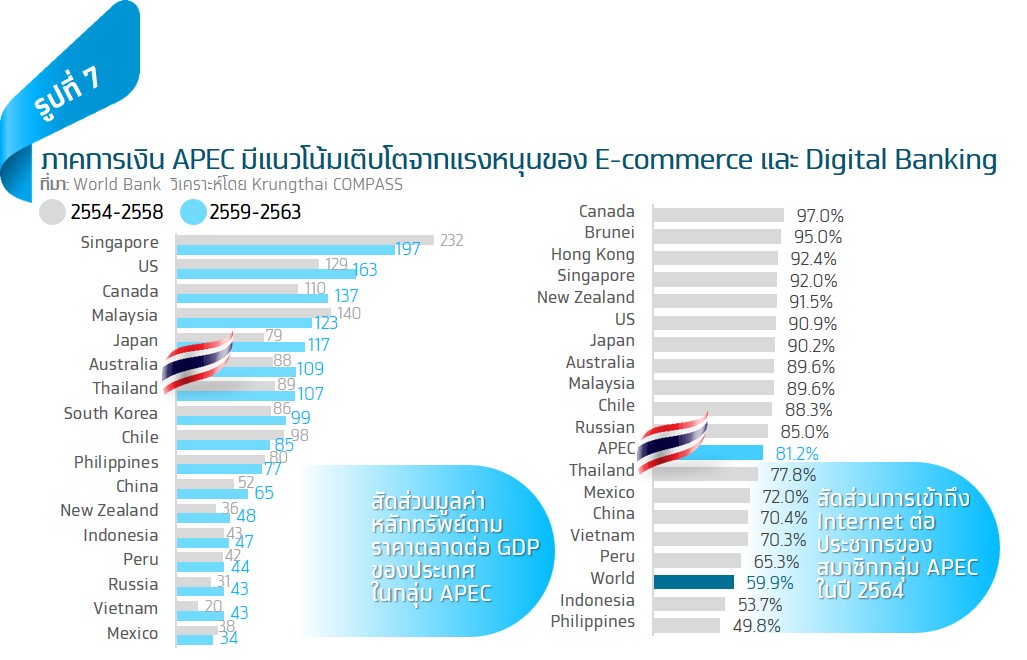
The potential of APEC can be reflected in the growth trends of the financial system and the digital economy, which attract investor interest and present significant opportunities for entrepreneurs to expand their businesses and markets in the region. APEC members' fundraising has shown growth over the past decade, as evidenced by the market capitalization to GDP ratio, which increased for many countries from 2016 to 2020, particularly in emerging markets in Asia, such as Vietnam, Indonesia, China, the Philippines, and Thailand, where this figure reached 107% of GDP, making it the third-largest market among ASEAN countries that are APEC members. The growth of this capital market presents an attractive option for investors seeking returns and diversifying risks. Additionally, APEC's financial system, which serves as infrastructure to support economic expansion, is bolstered by the transition to a digital economy. Deloitte predicts that the digital economy in the Asia-Pacific region is poised for rapid growth, driven by e-commerce and digital banking that stimulate cross-border transactions among APEC members. This aligns with the internet access ratio among the population, which is an indicator of the readiness of the digital ecosystem. In 2021, the internet access rate among APEC members was 81.1%, higher than the global average of 59.9%, with many Asian countries, including Thailand, exceeding the global average. Recent innovations from the development of interoperable open data, which central banks in ASEAN, including Thailand, have jointly promoted to facilitate international payments via QR Payment, represent another tool to drive the digital economy in the region. Krungthai COMPASS anticipates that the APEC market, which has advanced further than many parts of the world, will provide opportunities for Thai entrepreneurs to expand trade and investment channels in this continuously growing market.
9. What significant changes has Thailand experienced since joining APEC?
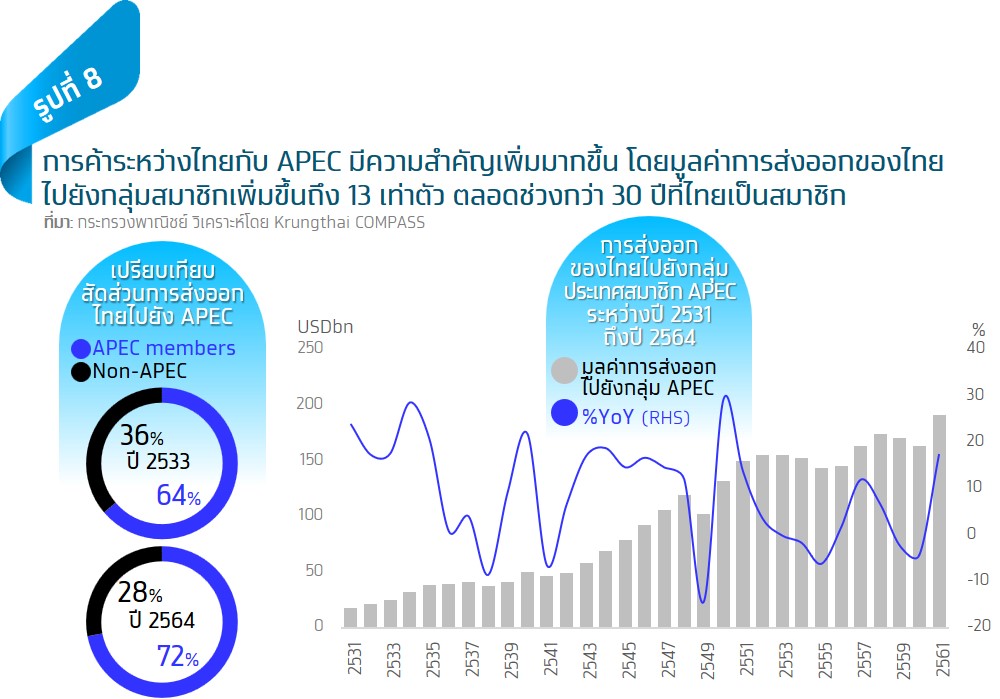
Since Thailand became a founding member of APEC with 11 other economies in 1989, the cooperation that Thailand has undertaken with APEC to support free trade and reduce trade and investment barriers has contributed to a continuous increase in trade between Thailand and member countries. Over the past 30 years, Thailand and member countries have implemented action plans to reduce tariffs and trade restrictions among themselves, as well as seeking ways to facilitate trade, investment, and harmonize regulations, such as customs procedures and product standards. As a result of these efforts, trade relations between Thailand and APEC members have strengthened. Krungthai COMPASS found that Thailand's exports to APEC increased from 63.8% of total trade value in 1990 to 72.1% in 2021, with trade value between them significantly rising from $14.7 billion in 1990 to $192.1 billion in 2021, an increase of 13.1 times. Over the past 30 years, Thai exports to APEC markets have grown at an average annual rate (CAGR) of approximately 9.6%.
Despite delays in establishing a free trade area within APEC, as initiated by the Bogor Declaration in 1994, and the ongoing multilateral trade negotiations under the World Trade Organization (WTO) framework, the continuous efforts to reduce tariffs and trade barriers among APEC members over three decades represent significant progress that facilitates trade among members, benefiting Thailand's exports.
10. What are the key issues of this APEC meeting, and how will they impact Thailand's and the world's economy?
The 29th APEC meeting, hosted by Thailand, marks the first time leaders will meet in person after the pandemic. As APEC members are adjusting their economies to meet new challenges, this meeting is held under the theme “Open Connect Balance.” The main issues Thailand aims to push for tangible outcomes include (1) promoting free trade and investment opportunities through the Free Trade Area of Asia-Pacific (FTAAP), with Thailand presenting a roadmap for advancing FTAAP, aiming for establishment by 2040, and encouraging APEC leaders to issue a joint statement endorsing this plan; (2) establishing the APEC Safe Passage mechanism to promote convenient and safe travel among member countries, which will help boost the tourism sector; and (3) promoting sustainable growth by supporting businesses and enhancing MSMEs to operate responsibly towards the environment through sustainable finance and the digital economy, with Thailand proposing the Bio-Circular-Green Economy (BCG) model as a core concept for this meeting.
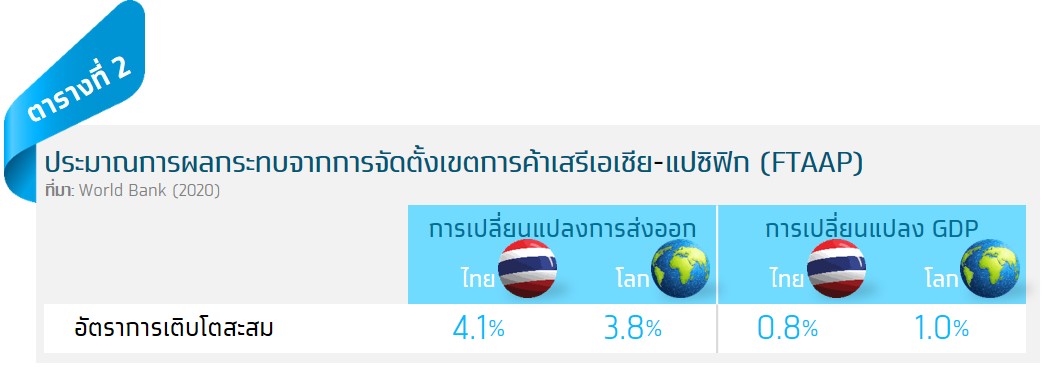
Among Thailand's initiatives, the push for FTAAP is a key issue that has garnered significant interest. If Thailand can advance this issue concretely, it will lead to the establishment of the largest free trade area in the world. This progress will enhance bargaining power with countries outside APEC and may also pressure the stalled WTO trade liberalization negotiations to move forward. According to a World Bank study, FTAAP is expected to contribute to a cumulative growth of approximately 4.1% in exports and 0.8% in GDP for Thailand over the ten years following its establishment. Furthermore, the World Bank found that compared to other trade liberalization frameworks, FTAAP would contribute more to global GDP growth than the Comprehensive and Progressive Agreement for Trans-Pacific Partnership (CPTPP) and the Regional Comprehensive Economic Partnership (RCEP), which would increase by approximately 0.1% and 0.6%, respectively. Krungthai COMPASS anticipates that FTAAP will be a crucial mechanism for eliminating international trade barriers and enhancing supply chain connectivity among members, and that the establishment of FTAAP within a multilateral framework will help reduce confrontations and ease conflicts among major powers in the future, benefiting Thailand in the long term.
Implication:
APEC serves as a forum for consultation and dialogue encompassing various dimensions of economic cooperation. APEC members are 21 economies bordering the Pacific Ocean, representing a large economic and population size. The APEC grouping is highly significant for Thailand's economy, as Thailand relies heavily on international trade, especially in exports and tourism, with most trading partners (approximately two-thirds of export value and foreign tourist income) being APEC members.
The 29th APEC meeting, hosted by Thailand, is held under the theme “Open Connect Balance,” with Thailand aiming to promote free trade and investment, safe and convenient travel, and sustainable growth to align with post-COVID-19 economic recovery. A key initiative from Thailand is the push for the Free Trade Area of Asia-Pacific (FTAAP), which would be the largest free trade area in the world, positively impacting Thailand's exports and GDP. Krungthai COMPASS anticipates that FTAAP will be a crucial mechanism for eliminating international trade barriers and enhancing supply chain connectivity among members, and that the establishment of FTAAP within a multilateral framework will reduce confrontations and ease conflicts among major powers in the future. Additionally, Thailand hosting the meeting during an economic recovery phase will enhance opportunities for Thailand's economy to grow better across various dimensions, especially in services and tourism, and is expected to contribute to improving Thailand's long-term competitiveness.

Krungthai COMPASS suggests that APEC presents opportunities for Thai businesses through member countries' efforts to reduce trade barriers, facilitate investment, and promote international travel to access raw materials, intermediate goods, and high-potential markets for trade and investment expansion, while also helping to diversify risks and complement each other, as APEC members are diverse, supporting sustainable growth in the future.