
Pressure from the Russia-Ukraine War Expected to Boost Thai Exports by 3.4% in 2022
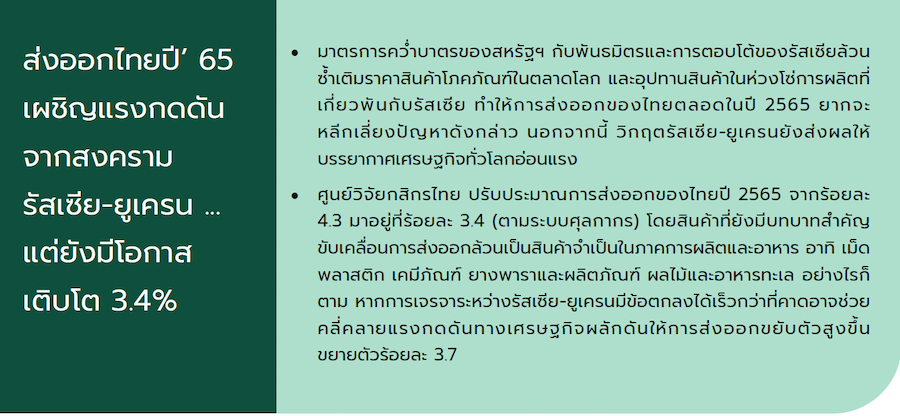
Countermeasures between Western countries and Russia have exacerbated production costs for goods in the global market.
The United States and the European Union's announcement to ban/reduce energy imports from Russia has cut off a significant revenue stream for Russia. In response, Russia has implemented a ban on the export of 200 essential items until the end of 2022, affecting all countries except the Eurasian Economic Union, Abkhazia, and South Ossetia. Initially, the disclosed items include technology, communication equipment, agricultural machinery, electronics, medical supplies, automobiles, trains, containers, turbines, metal and stone cutting machines, projectors, consoles, and wooden products. This situation further drives up prices of related goods and exacerbates the shortage of production materials in the global market throughout 2022.
Among the items that Russia has banned from export, some are intermediate goods that, while not critical to industrial production, could disrupt production reliant on Russian supplies and increase production costs. The uncertainty remains high; if Western nations impose further sanctions on Russia, there is a possibility that Russia will ban the export of essential minerals crucial for production in various industries, such as iron ore, aluminum, nickel, and especially palladium, which is vital in the automotive and electronics industries. Russia is the world's largest exporter of palladium, accounting for one-fifth of global exports, which would further raise production costs for technology products worldwide. Russia plays a significant role in exporting commodities and intermediate goods essential for global manufacturing, such as nickel (12.9% of the global market), fertilizers (12.6%), energy (8.7%), grains (7.8%), timber (6.1%), cement (4.9%), and steel (4.9%).
However, since the Russia-Ukraine war began in February 2022, commodity prices have risen for two reasons:
1) Tight supply of goods due to the war and pressure from Western nations that have announced measures to halt the export of technology and to ban/reduce energy purchases from Russia, causing prices of commodities and intermediate goods related to Russia to surge. For instance, the price of Brent crude oil reached $133.18 per barrel on March 8, 2022, marking a nearly 14-year high.
2) Increased transaction costs due to heightened sanctions against several major Russian banks, which is one way to cut off financial connections with foreign countries. Following this, Western nations are preparing to cut off financial transactions through the SWIFT system, which will further complicate payments for buying and selling goods with Russia globally, raising costs as transactions must be conducted in currencies other than the dollar.
Thai exports in 2022 face pressure from the Russia-Ukraine war.
Thailand is directly affected by the Russia-Ukraine war through trade, albeit to a lesser extent, as the trade value with Russia and Ukraine is relatively low at $3.166 billion, accounting for only 0.6% of Thailand's total trade value in 2021. This includes trade with Russia at $2.78 billion and Ukraine at $386 million, with Thailand running a trade deficit with both countries. The main imports are energy and fertilizers, while Thailand exports consumer goods where it has competitive advantages, such as automobiles and components, electrical appliances, rubber, and seafood.
The Kasikorn Research Center estimates that the ongoing war's uncertainty may impact Thai exports, which should be monitored as follows:
1) The risk of the Russian and Ukrainian economies entering a deeper recession this year combined with the historically weak ruble further diminishes demand for foreign goods. Given that both economies are in a state of war, it will be challenging for Thai products to penetrate these markets this year, particularly exports to Russia, which are expected to contract significantly due to Western sanctions and payment obstacles. Overall, Thailand may lose export opportunities worth about $600-800 million to both countries in 2022, but this impact is relatively limited, accounting for only 0.2-0.3% of Thailand's total exports.
2) The risk of economic slowdown in the U.S. and allied nations due to inflation from tight supply in energy, grains, and other essential raw materials, especially in the European Union, which relies on Russian crude oil for one-third of its imports and 40% of its natural gas. The reduction of energy imports from Russia will, on one hand, affect inflation in these countries, reducing the purchasing power of Europeans. This is particularly concerning for Thailand, as luxury goods, which account for one-third of exports to Europe, may face limited market opportunities this year, including automobiles and components, air conditioning units, rubber products, motorcycles, and jewelry. Meanwhile, essential goods such as food and production factors still have growth opportunities, including rubber, plastic pellets, seafood, rice, processed chicken, canned fruits, and pet food.
3) The exacerbation of bottleneck issues in the supply chain as Russia is a significant global producer of upstream and intermediate production factors, meaning countries with production chains linked to Russia may face higher costs or shortages of raw materials. This applies not only to commodities, grains, and chemical fertilizers, which are showing signs of rising prices, but also to other measures that may follow, potentially affecting the costs of importing goods across all categories, especially those linked to Russian production chains. This could lead to a surge in Thailand's imports this year and the possibility of Thailand experiencing a trade deficit with foreign countries for the first time in nine years.
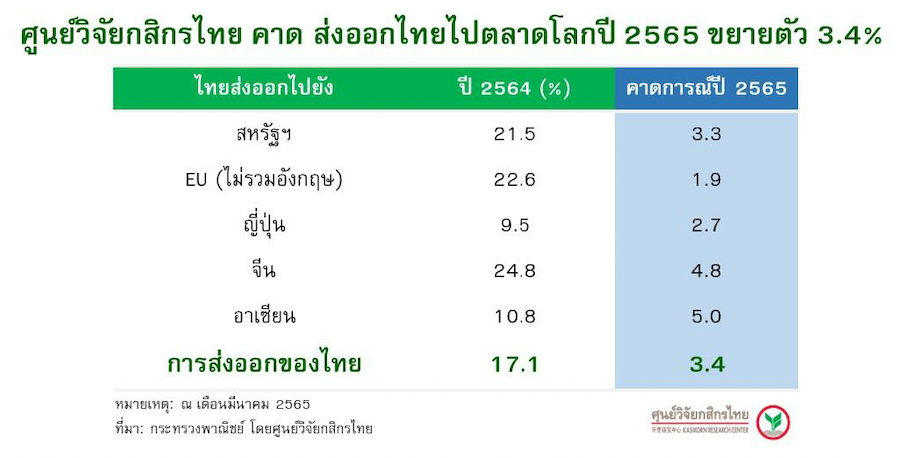
The Kasikorn Research Center has revised its export forecast for 2022 from 4.3% to 3.4% due to the challenges posed by the Russia-Ukraine conflict, which has slowed the global economic atmosphere compared to a scenario without such a crisis. It is expected that the driving force behind exports will primarily be supported by rising prices of production factors related to oil, agricultural products, and purchasing power in essential goods that remain in demand in the global market, such as plastic pellets, chemicals, rubber, and seafood. Exports to the European Union (excluding the UK) are projected to have the lowest growth rate among Thailand's main export markets. However, if negotiations between Russia and Ukraine can reach an agreement sooner than expected, it may help alleviate economic pressures and push exports to grow by 3.7%. This export estimate takes into account the high base effect from the previous year, ongoing high shipping costs, and the depreciating Thai baht. Nonetheless, it is crucial to monitor the COVID-19 situation in China and the zero-COVID measures, as if the outbreak expands significantly, it could pose additional challenges to Thailand's exports in the future, beyond the impacts of the Russia-Ukraine crisis.