REIT Buy-Back: A New Option for Real Estate Businesses and Investors
By Mr. Songyot Banjongmane
Director of Securities Registration Division 3
Securities and Exchange Commission (SEC)
The COVID-19 pandemic has had a widespread impact on the global economy, including Thailand, particularly affecting the tourism sector, which accounted for 16% of the country's GDP in 2019. The number of tourists in 2020 plummeted to 6.7 million from 39.9 million in 2019, a staggering decrease of 83%, leading many businesses to face revenue losses and liquidity issues.
To provide businesses with alternative funding options to enhance liquidity under the current circumstances, aside from seeking loans from banks, issuing bonds, or equity, the Securities and Exchange Commission (SEC) has introduced measures to assist real estate businesses facing liquidity challenges due to the COVID-19 pandemic. This includes allowing real estate businesses to raise funds through a mechanism known as REIT Buy-Back.
Let’s get to know REIT first....
Real Estate Investment Trust (REIT) is essentially a fund that pools money from multiple investors to invest in real estate assets such as factories, warehouses, hotels, shopping centers, and office buildings, which can be in the form of freehold or leasehold investments.
A REIT manager, who is an expert in managing that type of real estate, selects properties with income-generating potential and manages the properties in which the REIT invests. There is also a “Trustee” overseeing the REIT manager's operations. When the REIT generates income from rent, it distributes dividends to investors.
Thus, REIT is a widely used tool for property owners looking to raise funds and provides an option for investors interested in real estate managed by professionals.
A New Option: REIT Buy-Back
The REIT Buy-Back is a new funding option through REITs, where the REIT purchases properties at a discounted price, and property owners can agree to buy back from the REIT under pre-agreed conditions and prices. This buy-back arrangement allows businesses to utilize existing assets (regardless of whether they generate income) to raise funds for liquidity, enabling them to continue operations while retaining ownership of the properties. If the situation improves, they can buy back the properties.
The REIT Buy-Back guidelines issued by the SEC are therefore a direct measure to address the challenges faced by real estate businesses and also provide investors with opportunities to invest in potential properties at discounted prices, thus allowing them to benefit from the difference between the investment price and the buy-back price.
According to the SEC guidelines, REIT Buy-Back is divided into two forms based on risk and complexity of agreements to suit different investor groups:
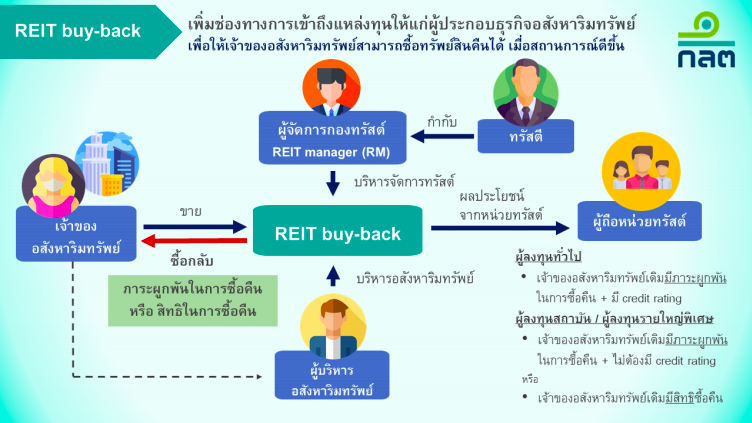
(1) REIT Buy-Back Available to the General Public
This requires an agreement where the property owner has an “obligation to buy back” so that investors clearly understand the expected returns. Additionally, the credit rating of the original property owner must be disclosed to provide investors with information for their investment decisions, as the main risk of “REIT Buy-Back available to the general public” lies in the owner's ability to repurchase.
(2) REIT Buy-Back Available Only to Institutional Investors and Ultra-High Net Worth Individuals
This form of REIT Buy-Back carries higher risk than the first, as it can be structured with an “obligation to buy back” without requiring a credit rating of the original property owner, or it can be set as an agreement granting the original property owner an “option” to buy back. In the case of an option, the original owner may choose to buy back or not, depending on whether the market price exceeds the predetermined option price. If the market price is lower than the option price, the original owner may opt not to repurchase, thus increasing the risk for investors compared to the first option.
Investing in REIT Buy-Back differs from traditional REITs in terms of returns and risks. Investors should carefully consider the potential of the properties they invest in and the appropriateness of the price at which the REIT invests, as well as the risks and impacts if the original property owner fails to comply with the agreements.
Since the SEC issued the REIT Buy-Back guidelines effective February 1, 2021, several businesses have shown interest. Currently, there are REIT managers who have submitted proposals to offer trust units for investment in properties under the REIT Buy-Back concept to the SEC. Investors can study the information and follow updates on the SEC website (www.sec.or.th).
Additionally, the SEC is in the process of revising the guidelines to allow more flexibility in investments, including the option to invest in leasehold rights. Further guidelines will be issued soon.
The SEC aims for the capital market to play a significant role in helping businesses access funding sources to enhance liquidity, preserve assets, and maintain employment during this challenging time, while also providing investors with opportunities to invest in potential properties through REIT Buy-Back.
Source:
* Tourism Authority of Thailand, compiled by Krungthai COMPASS
** Economic Division of Tourism and Sports (as of January 25, 2021)
The opinions expressed in this article are those of the author and do not necessarily reflect the views of the Securities and Exchange Commission.
Original document click https://www.sec.or.th/TH/Template3/Articles/2564/190464.pdf
and https://web.facebook.com/sec.or.th/posts/813087215994484?_rdc=1&_rdr