Real Estate Company Performance Q2/2020
In the first quarter of 2020, the real estate market clearly slowed down due to the impact of the COVID-19 pandemic. Consumers delayed their decisions to purchase properties, leading developers in the second quarter of 2020 to launch various campaigns and promotions to stimulate sales and transfers. They adjusted their sales strategies to sustain performance and cope with the economic challenges posed by COVID-19.
TerraBKK summarizes the performance in the second quarter of 2020 to assess the operational results of real estate companies listed on the stock exchange, based on data from the stock market and announcements from each company as follows:
Total Revenue
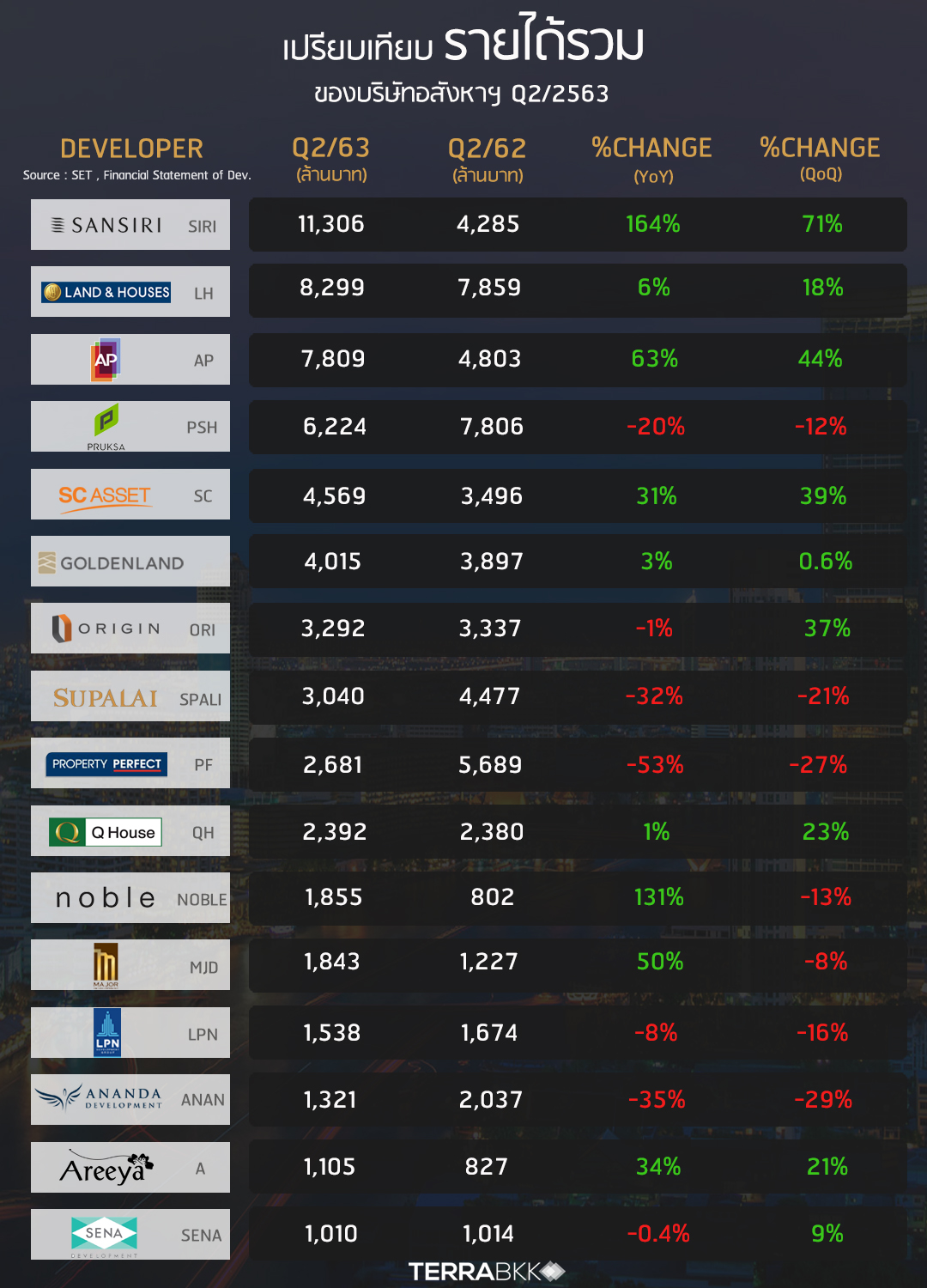
The company with the highest revenue in this quarter is
Sansiri with revenue of 11,306 million baht, showing a significant increase compared to the same quarter last year and the first quarter of this year, due to the “Cash is King” strategy that involved campaigns and promotions to clear old stock, which received a positive response, especially in horizontal projects where sales and transfers increased, particularly in the townhouse segment, which saw a 242% increase (QoQ). Recently, Sansiri has announced several sold-out projects.
Land and Houses reported revenue of 8,299 million baht, growing compared to the same period last year and the first quarter of this year, primarily from sales of horizontal projects, especially single houses, with a continuous backlog of horizontal projects awaiting transfer. They also launched more horizontal projects to focus on the real demand customer segment.
AP Thailand reported revenue of 7,809 million baht, showing remarkable growth as they achieved record sales for horizontal projects, focusing on launching horizontal projects targeting real demand, and several condominium projects such as Life Pinklao, Life Sukhumvit 62, and Aspire Ngamwongwan have sold out.
Pruksa reported total revenue of 6,224 million baht, decreasing compared to Q2 of last year and the previous quarter, due to horizontal projects targeting middle to lower-income customers, whose purchasing power has declined. Additionally, other operators have also shifted to the horizontal market due to changing consumer behavior, resulting in Pruksa losing market share. Revenue from transfers decreased as there were no completed condominium projects ready for transfer during this period, and several projects were canceled, along with announcements to sell land for development.
SC Asset reported revenue of 4,569 million baht, growing both YoY and QoQ, from transfers of horizontal projects and backlog of condominiums recognized as revenue this year. Recently, SC Asset has raised its sales and revenue target to 17 billion baht (up from the previous 16 billion baht).
When looking at revenue growth, it is evident that Noble has seen dramatic revenue growth compared to the same period last year, driven by accelerated sales and transfers of completed projects ready for transfer. They also launched projects priced below 5 million baht (previously focusing on middle to high-end condominiums), and despite being in the COVID period, they managed to generate sales from the international market, accounting for about 27% of total sales.
Net Profit and Net Profit Margin
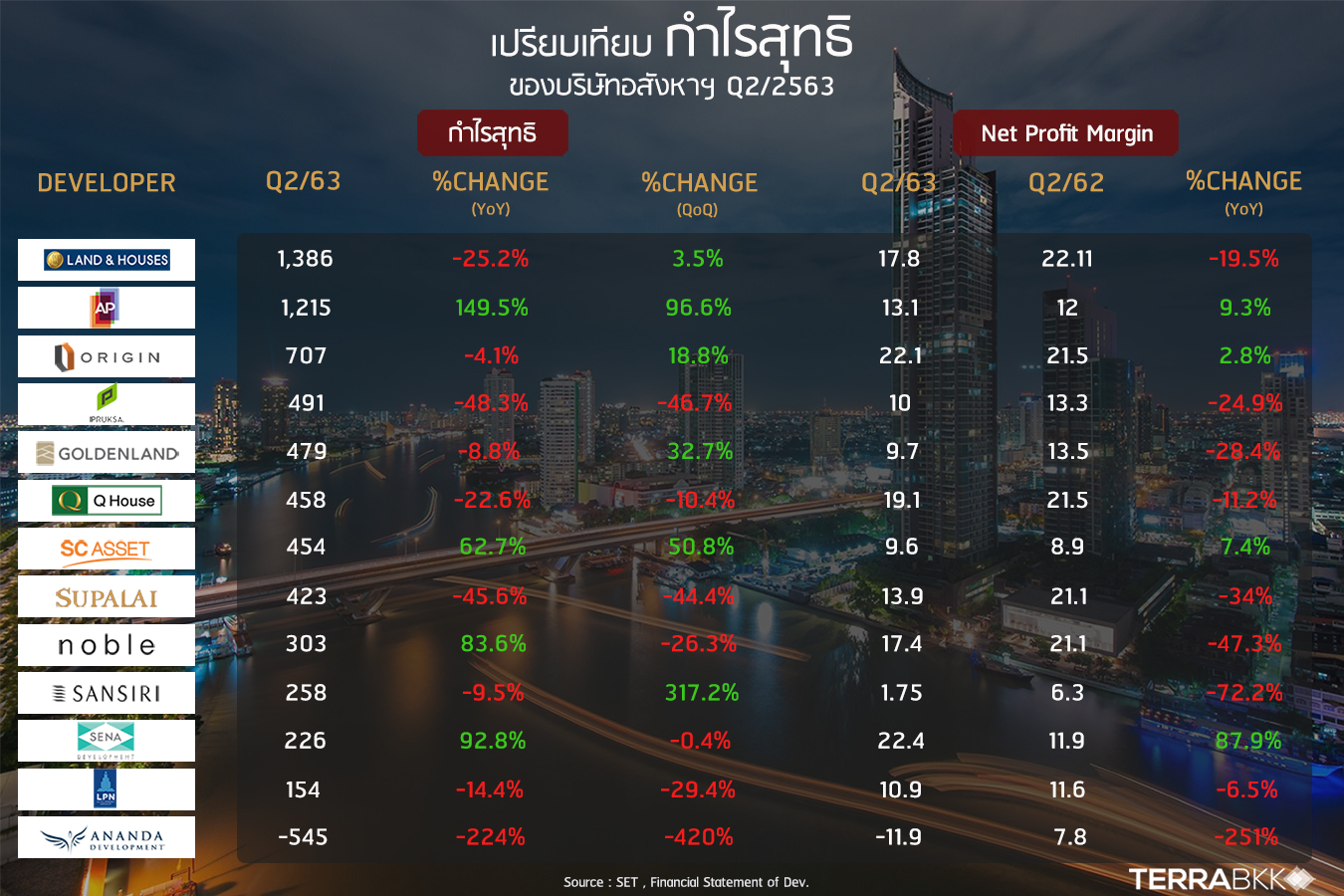
The company with the highest net profit remains Land and Houses, which reported profits higher than market expectations, but compared to the same period last year, profits decreased by 25.2% due to the hotel business and reduced profit sharing from joint ventures.
AP Thailand saw net profit grow significantly during the COVID-19 crisis in the past half year, aligning with the increase in revenue from sales of horizontal projects and transfers from joint venture condominiums that have grown. Profit sharing from joint ventures mainly came from the Life Ladprao and Life One Wireless projects, and they controlled selling expenses by focusing on online marketing.
Origin saw net profit increase from the previous quarter due to accelerated stock clearance, allowing for sales closures in several projects. Recently, they managed to close sales for The Origin On Nut within 2 days and controlled expenses by selling through online platforms that helped reduce costs associated with building sales offices.
Sena saw net profit grow by 92.8% compared to Q2/2020, primarily due to profit sharing from transfers of joint venture projects that have been ongoing since the end of last year from the Nich Mono Sukhumvit-Bearing and Nich Pride Tao Pun Interchange projects.
For Sansiri, although net profit decreased from Q2 of last year, it increased compared to the first quarter of this year. When looking at the net profit margin or profitability, it is found to be at a low rate. Price reductions in exchange for sales have increased costs, resulting in lower gross profits. Additionally, interest rates have risen due to delays in launching new projects, with some land not being developed.
Ananda reported a negative figure of 545 million baht, suffering losses from underestimating costs for the construction contracting business. However, in this quarter, presales exceeded targets, driven by sales from horizontal projects and condominiums (especially in locations along the subway).
Revenue Performance and Target (MB)
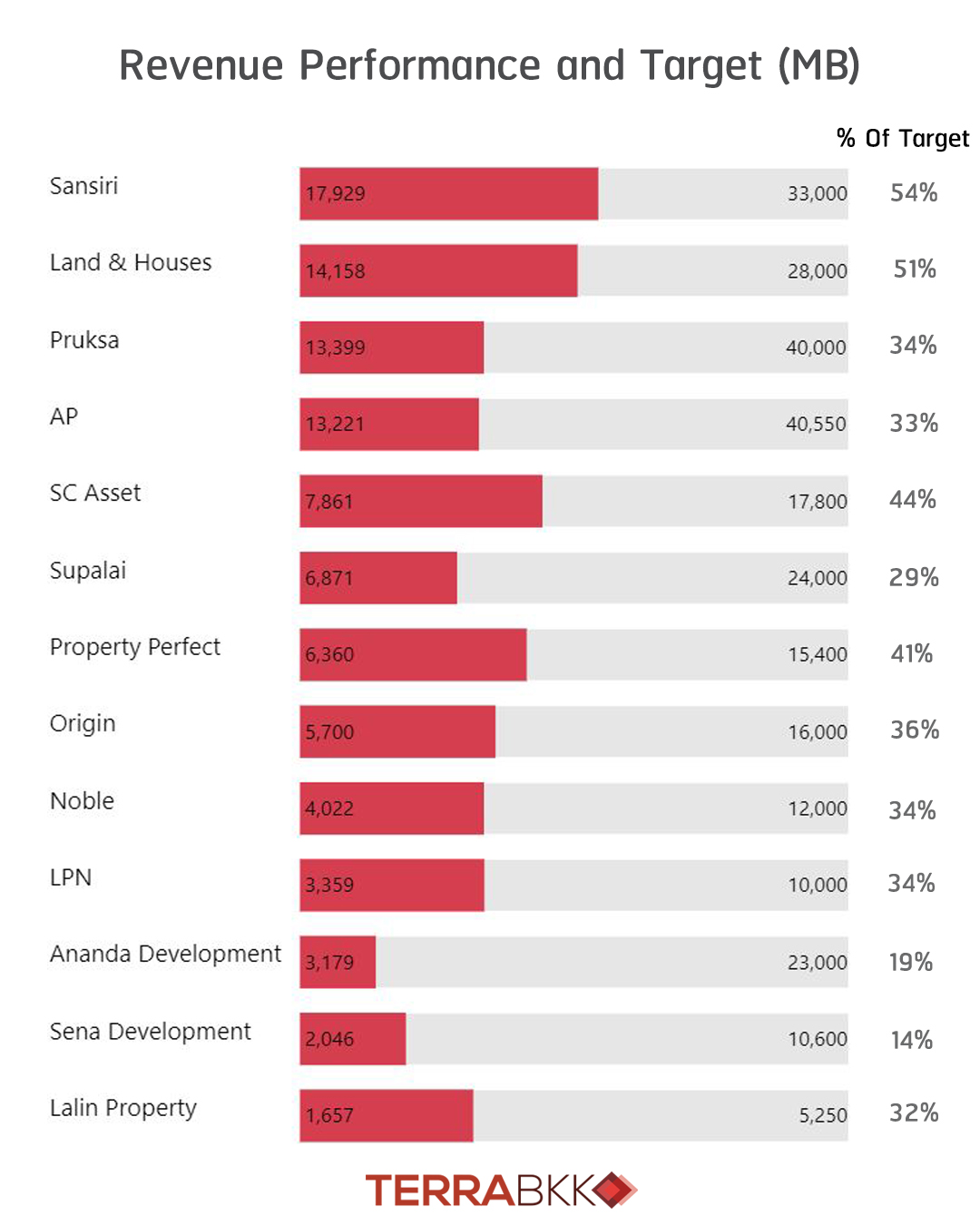
Half a year has passed, and when comparing the ability to generate revenue against set targets to see how much each company has earned and how much more they need to reach their goals, it is found that the company that has achieved the highest revenue against its target is Sansiri, achieving 54% of its goal. Following closely is Land and Houses at 51%, SC Asset at 44%, Property Perfect at 41%, Origin at 36%, LPN at 34%, which is equal to Noble and Pruksa at 33%, AP at 33%, Lalin at 32%, Supalai at 29%, Sena at 19%, and Ananda at 14%. The companies that have achieved a high proportion of revenue will find it less burdensome in the next half year to generate revenue to meet their set targets. However, it remains to be seen whether any companies will adjust their operational strategies or announce changes to their targets.
Although the performance in this quarter has decreased compared to the same period last year, when compared to the first quarter of this year, which was affected by the COVID-19 outbreak, the performance shows a positive trend as developers have adapted to cope with the situation during this COVID crisis. It will be important to monitor the performance in the second half of the year and observe how each developer will strategize and operate to survive amidst the economic challenges posed by COVID-19.