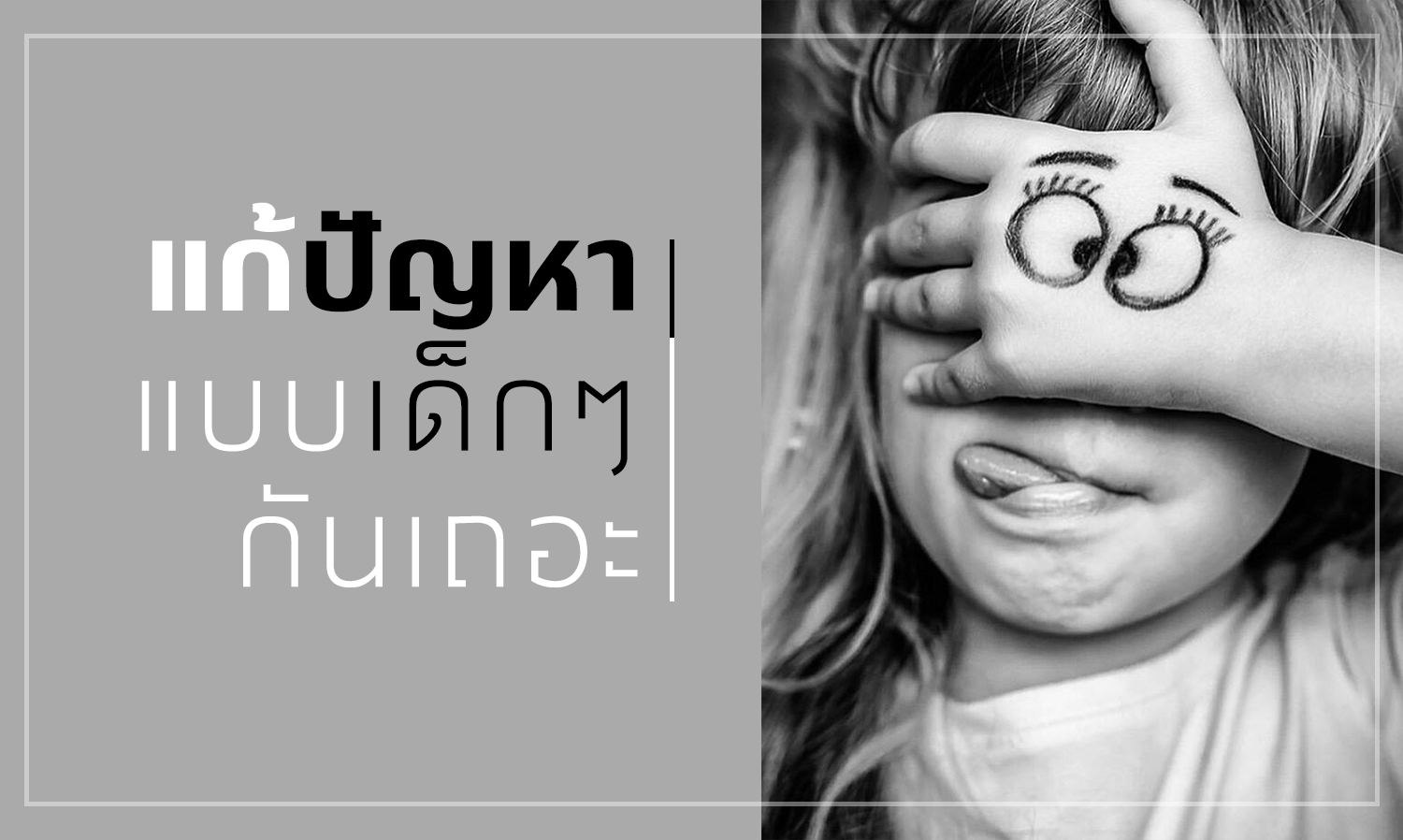
Let's Solve Problems Like Kids
We've often heard people say, "Don't solve problems like a child," which usually refers to simplistic thinking or a lack of reasoning. This article invites you to reconsider that perspective.
The term "problem" can vary greatly, encompassing many dimensions and factors that cannot be fully covered or compared in every context. Here, we will focus on interpersonal problems. From an attitude perspective, everything begins with adjusting our mindset, and other aspects will follow. This article will provide interesting examples of mindset shifts that could be beneficial for your life.
What Are Childish Problems?
Generally speaking, childish problems are indeed childlike. They often revolve around relationships with the environment, such as conflicts with friends or misunderstandings with adults.
But wait! Don't we still face similar issues as adults? Conflicts with those around us, whether direct confrontations or disagreements in thought, are not so different from the misunderstandings between children and adults, especially with those who consider themselves more "grown-up".
However, the difference lies in how children and adults express their feelings when problems arise. This often leads to different outcomes. Reflect on how we handled conflicts as children and how children typically resolve issues.
Childlike Problem-Solving Methods
- Why were you mad at me first? (Speak directly)
When two people have a conflict, we all know that not talking it out makes it hard to resolve the issue. Yet, sometimes, talking can make things worse. How do we communicate?
As adults, we often feel we have to justify our thoughts by providing examples, like saying, "If... hypothetically... try to think from your perspective..." Such reasoning can lead to pushing blame onto the other party and complicating the conversation. Asking, "Do you understand?" can turn into a point of contention, and if the other person disagrees, the problem escalates.
When children argue and eventually talk it out, their initial statements often express their feelings directly, such as, "Why did you say that about me?" or, "Why did you do that?" Sometimes, they might not even know why the other person is upset and simply ask, "Why were you mad at me first?" with a tone that is more curious than confrontational.
This straightforward approach stems from their honesty in communication. Generally, when children talk it out, they tend to reconcile rather than escalate conflicts, unlike adults who often complicate matters with too many reasons. If we observe closely, children are more willing to listen. A key factor is that children do not start by labeling the other person (e.g., saying the other person doesn't understand or hasn't thought things through) but instead express how they feel, which is something we often know about ourselves before understanding others.
- I'm not mad at all (Take a step back)
Children often haven't built up walls of pride or ego, which allows them to have fewer conditions for stepping back or resolving conflicts. In the first example, even if the other person opens up and speaks directly, it doesn't mean adults will respond in kind or easily concede. Adults often think, "It has to be this way... it must be said like that..." With so many conditions stemming from pride, peace often remains elusive. Many times, adults don't even state what they want directly, sometimes getting so caught up in their feelings that they forget their original desires. When asked if they are angry, children might respond, "I'm not mad at all..." Even if they were angry initially, this response signals a desire to resolve things, to step back, and to reconcile. This method has fewer complicated conditions for children... but at the same time, the response "I'm not mad at all" can mean different things coming from children and adults. For children, it means they are not mad or have moved on, while for adults, it might not be so clear. Resentment can linger and resurface later, leading to the conclusion that such responses stem from a tendency to be sarcastic as adults, which complicates problem-solving further.
- I don't know... (Be brave to admit) –
In many situations, the cause of a problem is clear, and we know who is at fault. However, when asked about the cause, the result can become a problem simply due to a refusal to accept responsibility or attempts to make excuses. This is often a normal psychological defense mechanism. But when it occurs in different situations or with different people, the outcome may not make sense to the other party (in simple terms, it sounds unreasonable), leading to further conflict.
For example, when faced with a question they can't answer or an unintentional incident, most children will respond innocently with "I don't know". Adults, on the other hand, may fear looking foolish or being wrong, so they "know" but..." provide reasons for their actions, even if the outcome is damaging. If damage occurs and they blame the other party for not accepting responsibility, they will have reasons to justify their actions. Upon reflection, this should be called "not knowing" because if they truly knew, they wouldn't have caused harm. Being brave enough to admit mistakes is something we rarely hear from adults.
- Is he mad at me? (Ask if you're curious)
Similarly, there are times when we sense that someone might be displeased or unhappy with us, whether we know the reason or not. Responses can vary, such as being defensive or going through a third party to convey messages like "What did I do to upset you? Tell him that..." These actions can feel like declaring war or closing off the possibility of "understanding the problem". Sometimes, people might just act as if nothing happened, but that doesn't mean the problem is resolved; it can leave lingering feelings.
Another aspect of this is involving a third party, which can complicate direct communication. Instead of using a third party to resolve the issue, it can become a way to build barriers or escalate the situation without knowing what really happened. It's clear that this doesn't solve the problem. In the honesty of children, if they have questions, they simply ask. Asking through a third party is often easier than asking directly, but the outcomes can be entirely different.
Moreover, the role of the third party can vary. Some may meddle, while others might misinterpret intentions. If one party asks directly but assumes the other is upset, they might respond accordingly. Even among children, this isn't always positive; sometimes, children will encourage their friends to be angry with the other party, saying things like, "I'm mad at Mali, so we shouldn't talk to her. Anyone who talks to Mali isn't our friend!" This is a typical childish behavior that we can let slide, but it's interesting to note that some adults still behave this way. Consider whether this is acceptable among friends.
- Apologize first (Be ready to forgive)
Many people know that saying "I'm sorry" is one of the first things to do, whether it works or not. It often helps ease tensions, especially when said sincerely. In many conflict situations, adults face similar issues as mentioned earlier. When pride and ego are high, these two syllables become hard to give up.
In many cases, what should be easy to resolve remains unresolved simply because one party wants the other to "acknowledge" or "lower" their pride. But when the other party refuses to concede, they don't see it as lowering their pride but rather as losing face (they view it from different perspectives). Everyone forgets that they too are exhibiting their own pride by insisting that the other must yield. This creates a situation where one party's pride increases while the other feels uncomfortable and misunderstood. Even when we want them to understand and resolve the issue, it often backfires. Sometimes we think or perceive that they aren't trying, but why don't we consider that we should restore feelings and relationships quickly? The reasons they "want to try" will follow more easily.
- Worried about playing...
Children often "worry about playing". For children, play is happiness, and having friends to play with increases that happiness. Conflicts should end because they want to continue having fun together. Having many friends makes playtime more enjoyable. This is likely a childlike motivation because children cherish their moments of happiness and have short-lived sorrows.
As adults, it seems to become increasingly difficult to keep sorrows short and happiness long, not to mention that happiness is hard to come by while sorrows are easy. Sometimes, we may forget what we truly want. Regardless of age, everyone desires "happiness" more than sorrow. If we could think like children again, we might see what is truly important. We could stop wasting time on problems and instead have more time for fun and happiness, which would surely be better, wouldn't it?
I hope this article serves as an engaging read that shifts your perspective on problem-solving. Set aside your adult mindset and try using childlike methods to resolve issues.
This revised article was first published on Facebook Sirichaiwatt on 18/5/2020.
SOURCE: www.sirichaiwatt.com