Overcoming Crisis with Rinen: The Business Philosophy of the East
As one of the leading economies in the world, Japan's private sector is recognized for its strength and efficiency, with many businesses at the forefront of global industries. Surveys reveal that Japan has the highest number of companies that have been established for over 100 years. What shapes the success of Japanese businesses? Dr. Kritinee Pongthanlerd from the Faculty of Commerce and Accountancy at Chulalongkorn University, also known as Ketu Wadi Marumura, discusses 'Rinen', the core philosophy that Japanese businesses adhere to in their operations, creating strengths that help them navigate various crises and endure until today.
What is Rinen?
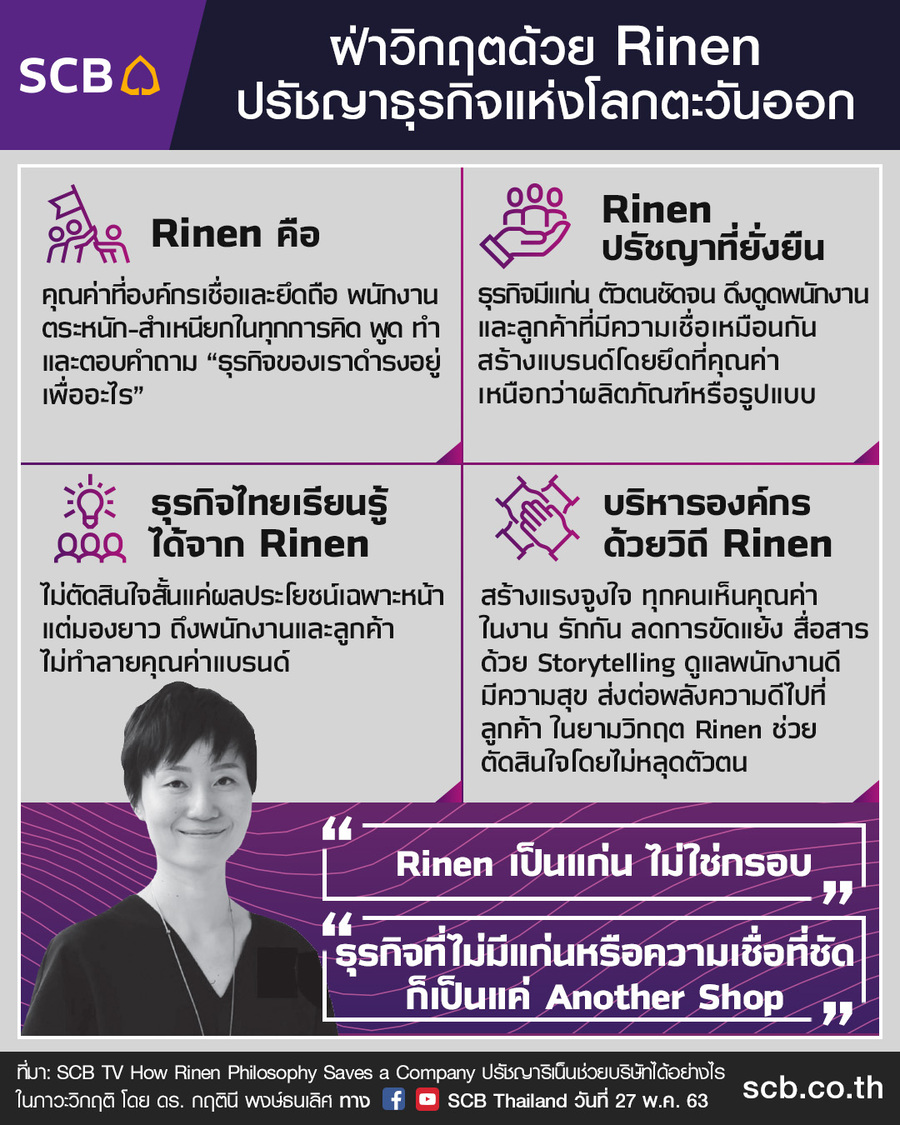
Rinen is the vision, mission, and values that an organization holds, answering the question, "Why does our business exist?" It is a steadfast principle that guides every decision about the direction of the business. Both management and employees are aware of and reflect this value in every thought, word, and action.
Dr. Kritinee, or Professor Kade, provides an example of a card-making company that faced a downturn due to fewer people sending paper cards. The company president reconsidered the core values of the business and asked, "Why do we make cards?" He then announced the company's Rinen, which aimed to preserve the Japanese culture of gratitude (Arigato Culture). Employees felt proud of their work, recognizing it as more meaningful than just selling paper cards.
Rinen is not limited to long-established organizations; startups can also have Rinen. Professor Kade cites the case of Teamlab, known for its works that blend technology with digital art. Teamlab's Rinen is to explore new relationships between humans and nature, and between themselves and the world through art, using digital technology as a tool to connect humans more closely with nature. The Rinen of Teamlab stems from the founder's childhood belief in the bond with nature and the desire for children in cities to experience nature through technology, as well as the concept of being Borderless, where the world is interconnected and can be explored. A strong Rinen philosophy leads to products that inspire people to engage.
How Does Rinen Begin?
Professor Kade explains that Rinen can arise in two ways: 1) it is conceived by the founder, or 2) it reflects back on the company's inception, identifying what pain points the business aims to address. Rinen is akin to the Ikigai philosophy for individuals regarding the value of life, differing only in that a business must have a singular Rinen, while individuals can have multiple roles.
Why is Rinen Necessary?
Rinen is crucial for guiding company decisions in alignment with its core values and maintaining its identity. For instance, Oisix, an online fresh food retailer, has a Rinen focused on creating a better future through food, ensuring that the fresh produce they sell is organic and of high quality. During a crisis, Oisix had to make decisions to survive, but those choices could not compromise product quality, which would contradict the company's Rinen.
Professor Kade cites the investment company Kamakura, which has a Rinen supporting good companies to create a better society. This clear direction leads the company to support only those businesses producing quality products, aiming for sustainability. In times of crisis, a clear Rinen allows the company to choose to support struggling good businesses rather than invest in rapidly growing stocks solely for profit. Having Rinen encourages organizations to reflect on their stance; without it, investors may lack confidence in the company's identity.
Moreover, Professor Kade notes that a loss of identity often occurs in companies that have grown and succeeded for a while and have the potential to expand into other products. For example, Muji, which has a Rinen of producing quality, affordable goods for a better life, at one point ventured into making cars, mobile phones, and trendy clothing, leading to a drop in sales. This prompted Muji to return to its core Rinen and revive its essence. Regarding whether a company with Rinen can only produce one type of product, Professor Kade explains that it is not limited to a single product but having a clear Rinen allows for principled business expansion without losing identity. For instance, Muji offers a variety of products under the Rinen of creating a better life, enhancing people's lives. Rinen serves as a foundation for growth and development, not a restrictive framework. Therefore, organizations with a strong Rinen will not be limited in their product ideas and methods; if the Rinen states, "I will deliver good things to customers," it can be achieved through innovative products and services.
When asked if Rinen can change with circumstances, Professor Kade believes it can adapt depending on the industry but should not deviate significantly from its original essence. For example, Kayak, an agency that originally created websites, transitioned to developing applications and events, adjusting its Rinen every five years along the main theme of fun and creativity to bring smiles to the world.
When Rinen is Clear, Everything Else Becomes Clear
How can everyone in the organization feel the same Rinen? Professor Kade explains that Japanese companies emphasize Rinen even before hiring. One of the interview questions is, "How much do you resonate with our company's Rinen?" For instance, Plan Do See, a wedding planning business, has a Rinen focused on delivering the spirit of Japanese service (Omotenashi) to customers. Their service is akin to being a customer themselves, searching for the best venues across Japan and abroad, ensuring that these locations are historically significant. If Plan Do See invests, it must create value for the city where the venue is located, making everyone involved feel proud. These aspects make employees feel that their work at Plan Do See is meaningful and motivating, leading the company to rank among the top ten organizations that new graduates aspire to join.
The case of Plan Do See illustrates that having a clear Rinen helps select individuals who share the same beliefs and resonate with similar values, fostering unity in the workplace. Additionally, the unique Rinen that attracts like-minded individuals also appeals to customers who appreciate the company's identity. In other words, when a company's Rinen is clear, its customer base becomes clear as well.
Using Rinen to Overcome Crisis
During the COVID-19 crisis that impacted all sectors, Professor Kade mentioned the case of Hoshinoya, a luxury hotel chain in Japan, which was among the hardest hit. However, with Hoshinoya's Rinen focused on delivering Japanese service (Omotenashi) to people worldwide, management and employees revisited the organization's core to determine how to provide excellent service to customers even in abnormal circumstances, such as how to deliver food to customers in a way that makes them feel comfortable and safe. Professor Kade added that having a clear Rinen gives the organization a strong historical background, instilling customer trust, which helps protect the company during crises. In some organizations with a robust Rinen like Hoshinoya, the organization's name can even serve as a substitute for Rinen in communication to foster mutual understanding.
Managing Organizations with Rinen
Another crucial aspect of using Rinen to manage organizations during crises is prioritizing employee welfare. Professor Kade provides a clear example with Enough Food, a company facing severe financial difficulties and nearing bankruptcy. The president had to decide how to allocate the last 2 million yen budget: to promote products or to care for injured employees and upgrade machinery for safer working conditions. Reflecting on the company's Rinen, which states, "We will create a good company," the management chose to invest in employee care and safety upgrades. This decision garnered overwhelming positive feedback, leading employees to work diligently and helping the company recover.
In another case, Yagisawa Shoten, a soy sauce manufacturer over 180 years old, was devastated by a tsunami that destroyed its factory and raw materials, including the starter culture for soy sauce fermentation. Initially, the president considered shutting down the business but realized the importance of the dedicated employees. He decided not to give up, gathered the staff at the evacuation center, announced a fresh start, and paid the last month's salary. This event was captured by journalists and publicized. When a research company saw the news, they remembered that Yagisawa Shoten had previously sent starter culture for their experiments and returned the remaining culture to help the company resume operations. This case exemplifies a chain of goodwill, where organizations that do good receive good in return.
Professor Kade added that Japanese people hold the belief that no one can thrive alone; survival is not solely due to individual talent but because of the support of others. Therefore, good Japanese companies place great importance on maintaining relationships with the community, suppliers, and manufacturers, as well as caring for employees. If employees are unhappy, they cannot deliver good service to customers, regardless of the company's efforts to communicate otherwise. Caring for employees is akin to vaccinating those within the organization to strengthen them for helping those outside.
Communicating Rinen to Reach Employees' Hearts
Japanese companies' emphasis on employee welfare results in very low turnover rates. Professor Kade cites the example of Plan Do See, which ensures that every working day feels like growth for employees. The company rotates roles, allowing chefs to serve food and servers to work in the kitchen, helping everyone learn that they can create happiness for customers and understand each other's roles, reducing conflicts within the organization.
Professor Kade believes that storytelling is a vital tool for embedding Rinen in employees' hearts. For instance, Japan Airlines has a company museum that communicates safety by allowing all new employees to view exhibits of aircraft accidents and real items from passengers, such as the last letters written by fathers to their children. This form of communication is powerful compared to mere verbal explanations. In the case of Domohorn Wrinkle, a cosmetics company that sells exclusively through call centers, employees initially focused on sales and pressured customers, resulting in returns worth 20 million yen and a lawsuit. To communicate the consequences and prevent recurrence, the company displayed returned product packaging at the entrance with a reminder: "This is what happens if we forget the customer."
What Can Thai Businesses Learn from Rinen?
Thai entrepreneurs can also create Rinen for their businesses. In family businesses, it is essential to have clear discussions with parents about the changing social landscape. Without a core belief that resonates with customers, the business risks becoming just another shop. Second or third-generation heirs can start building Rinen today, as seen in the case of Bar B Q Plaza, which transformed from a regular pork grill to one that creates happiness through its offerings. For new executives in large organizations, the challenge of establishing Rinen lies in having a clear personal Rinen that reflects in their actions, demonstrating to others their commitment. An example is Kazuo Inamori, who revitalized Japan Airlines with a clear Rinen focused on serving the airline and the country. He engaged with all employees, from mechanics to flight attendants to executives, seeking to uncover the true spirit of Japan Airlines and encouraging everyone to articulate it. Inamori dedicated himself to the task of recovery, uniting all employees to restore Japan Airlines.
In conclusion, Professor Kade emphasizes that Rinen prevents entrepreneurs from making short-sighted decisions based solely on immediate benefits, encouraging a long-term perspective that genuinely considers employees and customers. This approach helps avoid mistakes that could damage the brand. Organizations with Rinen will achieve 1) a clear brand identity due to a solid decision-making foundation, and 2) customers who genuinely love the company's products/services, as a clear Rinen attracts those who resonate with the business. Importantly, if Thai businesses embrace Rinen, the beneficiaries will be Thai society, which will have organizations creating valuable products and services sustainably.
SOURCE: www.scb.co.th