The Middle Class: The Ultimate Purchasing Power of Today
The Middle Class: The Ultimate Purchasing Power of Today
Over the past few decades, it must be acknowledged that the economies of Asian countries have grown significantly due to various factors, including government policies, capital relocation, and technological advancements. This has led to job creation and income generation, allowing many people who were previously not well-off to move into the middle class. It is undeniable that today, the middle class in these countries has become a crucial driving force for the global economy. Today, Terrabkk invites everyone to understand this group better, exploring how their potential will increase in the present and future, so that readers can leverage this knowledge for their business endeavors.
The Middle Class and Continuous Growth Potential
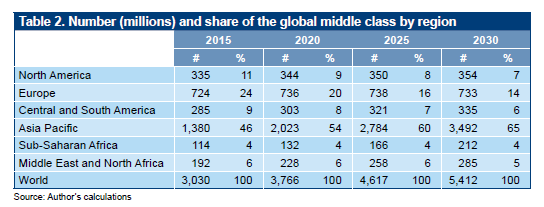
According to the GLOBAL ECONOMY & DEVELOPMENT WORKING PAPER 100 (FEBRUARY 2017), it was reported that in 2015, there were approximately 3.03 billion people in the middle class, representing 41% of the global population of about 7.379 billion (www.populationpyramid.net).
The region with the largest middle-class population in 2015 was the Asia Pacific, which accounted for 1.38 billion of the total 3.03 billion middle-class individuals, or 46% of the middle-class population.
Furthermore, the GLOBAL ECONOMY & DEVELOPMENT WORKING PAPER 100 (FEBRUARY 2017) projected that by 2030, the middle-class population would reach 5.412 billion, representing 63% of the global population of approximately 8.548 billion (www.populationpyramid.net).

The region with the largest middle-class population in 2030 is again the Asia Pacific, with 3.492 billion middle-class individuals out of a total of 5.412 billion, accounting for 65% of the middle-class population.
If we look at the 15-year period from 2015 to 2030, the middle-class population is expected to grow at an average rate of 44%, equating to an annual growth rate of 2.9%. In comparison, the global population is projected to grow at an average rate of 13.7%, or 0.9% annually. This indicates that the growth rate of the middle-class population is significantly higher.
The Spending Potential of the Middle-Class Population
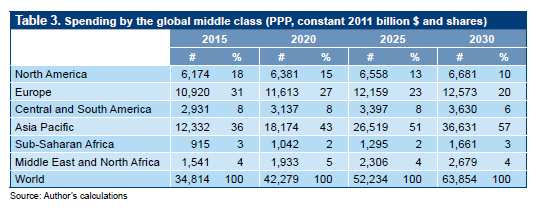
In 2015, the spending of the middle class was approximately $34,814 billion. By 2030, it is projected that the spending of the middle class will reach around $63,854 billion, representing a 45% increase from 2015. The region with the highest spending will be the Asia Pacific, with an average spending of $36,631 billion, accounting for 57% of total spending in 2030.
Behavior of the Middle-Class Population
Purchasing Quality Products and Brand Names The middle class primarily consists of individuals who have recently improved their financial status, moving up from lower-income brackets. As a result, they seek to purchase quality products that reflect their status. This consumer group is sensitive to social status and is interested in buying brand-name items to elevate their social standing, provided that the products are of high quality.
Attention to Product Details and Services, Especially Niche Products This group not only demands high-quality products but also values after-sales service and the overall experience of purchasing and using the products. Additionally, if a product or service makes them feel special, they are willing to spend money on it without hesitation.
E-Commerce as a Shopping Option The middle class is a demographic that has widespread access to various technologies and desires greater convenience in their lives. Consequently, online shopping has become one of their primary options, as it effectively meets their lifestyle needs.
Given these details, Terrabkk believes that the middle-class population represents a highly promising group with the potential to impact various businesses in the future. It is essential to remember that this group is growing annually and their income continues to rise. If your business can appeal to and win the loyalty of this demographic, you certainly have a chance to succeed in the competitive business world.