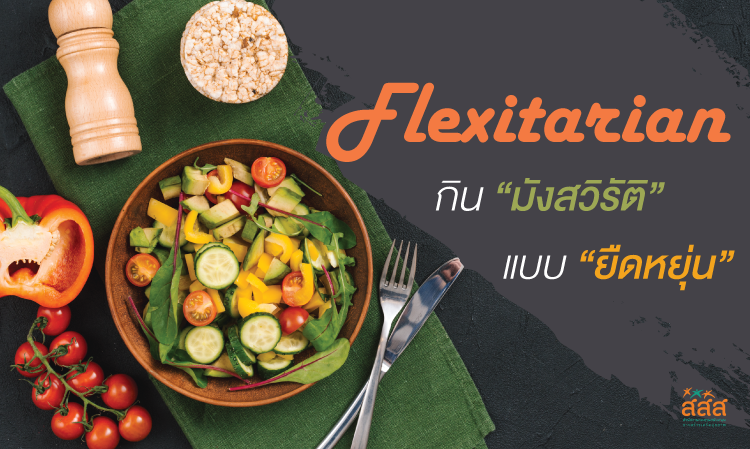
Flexitarian: The Flexible Vegetarian Diet
Nowadays, many people are turning to vegetarianism, commonly referred to as 'eating veg' because it is a lifestyle that does not harm animals and is gentle on the planet. Additionally, vegetarianism contributes to better health.
The vegetarian lifestyle has evolved significantly from its origins, moving beyond just the prohibition of all types of meat. Recently, a more flexible approach to vegetarianism has emerged, allowing individuals to care for the planet and their bodies without being overly strict, known as Flexitarianism, which is gaining popularity worldwide, including in our country.
What is vegetarianism, and how flexible can it be while still being considered vegetarian?
Before discussing Flexitarianism, let's first understand traditional vegetarianism. Vegetarianism is a dietary practice that dates back to ancient India and Greece, based on the principle of abstaining from harming animals (where 'mangsa' means meat and 'virati' means abstaining). Therefore, a vegetarian is someone who does not wish to consume meat.
Vegetarians must refuse foods made from both direct and indirect animal products, such as milk, cheese, eggs, honey, and gelatin. However, it is important not to confuse Vegetarianism with Veganism. Vegans not only follow a dietary practice but also adopt a lifestyle that believes animals have rights. Thus, vegans reject both food and products derived from animals or tested on animals.
Vegetarianism has gradually gained popularity over the years, but strict adherence to a vegetarian diet is challenging for most people. A survey by the Humane Research Council reported that 84% of vegetarians, both Vegetarian and Vegan, returned to eating meat after attempting to quit, and 43% of those who had previously followed a vegetarian diet stated that maintaining a strict vegetarian lifestyle was not feasible.
Today, the trend of vegetarianism is no longer solely based on religious beliefs. Some individuals choose to adopt a vegetarian diet for health reasons or to avoid supporting the livestock industry, which harms the environment. This has led to various flexible vegetarian options that make it easier for people to incorporate vegetarianism into their lives, such as Lacto-vegetarians (who consume dairy but not eggs), Ovo-vegetarians (who eat eggs but not dairy), Pesco-vegetarians (who eat fish and seafood), and Semi-vegetarians (who avoid red meat but still consume fish, poultry, dairy products, and eggs). Flexitarianism is essentially another name for Semi-vegetarianism.
The term Flexitarian is a relatively new addition to the Oxford English Dictionary, added in 2014. Dawn Jackson Blatner, the author of the first book on the Flexitarian Diet, defined this eating style as "you can call it 'almost vegetarian' because it allows you to enjoy the benefits of a vegetarian diet while still incorporating some meat protein on occasion."
Why is everyone interested in Flexitarianism?
Looking back 5-10 years, we might have thought that most people turning to vegetarianism were adults adhering to a moral code against harming animals. However, today, many millennials are interested in vegetarianism, particularly the Flexitarian lifestyle, which allows for some meat consumption while still adhering to the principle of reducing meat intake.
According to The Vegan Society, the popularity of all types of vegetarianism worldwide surged by 9.87 times in 2018 compared to the previous year. Currently, there are about 7.3 million strict vegetarians in the U.S., but around 22.8 million identify as focusing on plant-based foods. Meanwhile, a report from Waitrose indicated that one in three Brits is consuming less meat, and one in five identifies as Flexitarian. The rapid growth of the flexible vegetarian trend can be attributed to various factors.
A 2018 study from the University of Oxford also highlighted that vegetarianism is one of the best ways to address environmental issues, as the livestock industry is a significant contributor to global warming. Currently, the livestock industry accounts for about 14% of greenhouse gas emissions, equivalent to the emissions from the entire transportation sector. Additionally, reducing meat consumption from today can help decrease the expansion of grazing lands and areas for growing animal feed, which contributes to the loss of local forests, grasslands, and savannas.
How can beginners start eating Flexitarian?
For meat-eaters interested in transitioning to Flexitarianism, starting is easy. The principles of flexible vegetarianism are not rigid but are based on simple guidelines: eat less meat. Generally, it is recommended to consume meat no more than three times a week while ensuring a balanced intake of nutrients, as follows:
- Eat energy-rich foods, such as carbohydrates, which include rice, like brown rice, mixed rice, or sprouted brown rice.
- Consume foods rich in minerals and vitamins, such as vegetables, especially leafy greens and yellow vegetables, as well as various fruits.
- Include protein-rich foods, which can be obtained from various legumes, and occasionally add nuts to increase protein and healthy fats.
- Supplement with some animal protein on certain occasions, focusing on fish, lean meats, eggs, dairy, and yogurt.
Thank you for the information from www.thaihealth.or.th