Decoding the Success Formula of 'Don Quijote': Captivating the World with an Army of Diverse Products
Even if you're not a die-hard fan of Japan, anyone who has had the chance to visit the Land of the Rising Sun has likely heard of the renowned “Don Quijote” (Donki)<\/strong><\/span>, a discount store conveniently located in key areas of various cities in Japan. No matter who visits, they must stop by this kingdom of goods that offers a wide range of products, from snacks and casual food to cosmetics, electronics, and even luxury items. It has become a common question to ask, “Does Donki have…?” but perhaps it’s better to ask, “What doesn’t Donki sell?”
Of course, becoming the globally recognized discount store that recently opened a branch in Thonglor, Donki has a backstory filled with inspiration just like other brands. In the business world, there’s no such thing as easy or lucky. What’s most interesting is how Donki has crafted its success formula to win the hearts of people worldwide.
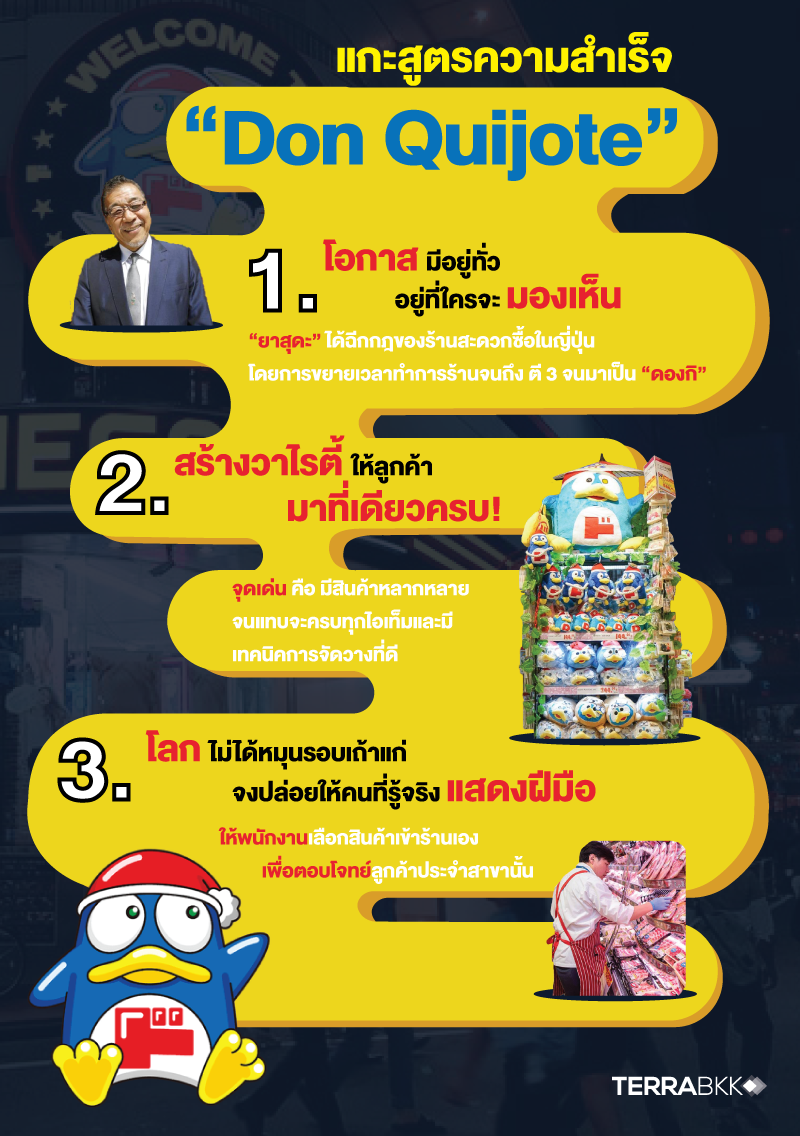
<\/strong>1. Opportunities are everywhere; it’s about who can see them.<\/strong><\/span><\/p>
Looking back to the brand's inception in 1978 by “Takao Yasuda”<\/strong><\/span>, he started his business journey by opening a 60-square-meter store with regular operating hours. However, due to a shortage of staff in the early days, Yasuda had to work the night shift, restocking and arranging products after closing. This led customers to mistakenly think the store was still open, causing them to visit frequently. This small detail sparked a brilliant idea in Yasuda to break the rules of convenience stores in Japan, which typically closed early, often by 11 PM. He chose to extend operating hours until midnight or sometimes even until 3 AM the next day. This boldness to be different quickly made Yasuda's store popular, achieving sales of up to 200 million yen per year before expanding and developing into the first “Donki” store in 1989. It later grew into “Don Quijote Holding”<\/strong><\/span>, a major investment group in Japan that diversifies into various businesses, focusing on retail and real estate development. <\/strong>2. Create variety for customers; everything in one place!<\/strong><\/span><\/p>
A hallmark of Donki that is widely praised across Japan is its vast selection of products. If someone asks what Donki sells, it can be hard to answer because they offer nearly every item that shoppers, whether Japanese or tourists, are looking for. This includes food, snacks, beverages, alcohol, cosmetics, seasonal items, daily necessities, sports equipment, fashion products like clothing and bags, bedding, furniture, electronics, stationery, bicycles, toys, and miscellaneous items. However, merely having a diverse range of products isn’t enough. The technique of arranging various types of items at Donki is also noteworthy. While it’s not complicated, it’s practical. Donki places easily sellable, low-priced items on the lower shelves to attract customers, while larger, more expensive items that receive less foot traffic are tucked away on higher shelves. One of the management techniques at Donki is that instead of cloning Yasuda into versions 2, 3, or 4 for employees, he didn’t waste time trying this method for long. He only intensively trained staff at the first branch. After that, he chose to empower branch employees to make decisions on everything, from product selection to purchasing and pricing. He believes that branch staff are among those who know best what customers want and are interested in buying, ensuring that Donki's products across its hundreds of branches meet customer needs, leaving them satisfied and likely to take something home. These are the three key strategies that Yasuda, the founder of the discount store with a law degree from a prestigious university in Tokyo, has used to turn his savings into a guide for success to be passed down through generations. <\/p>
<\/strong>3. The world doesn’t revolve around the owner; let those who know best showcase their skills.<\/strong><\/span><\/p>
 <\/p>
<\/p>