Interview with CEO of HABITAT, Mr. Chanin Wanichwong: From Small Investor to Real Estate Developer with a New Model of 'Lifestyle Investment' That Provides Immediate Returns to Customers Upon Purchase
Interview with CEO of HABITAT, Mr. Chanin Wanichwong on 'Lifestyle Investment'
This is another model of real estate business specifically designed for investment.
'Lifestyle Investment Model' may not be a familiar term to many, but for real estate investors, it could be an alluring investment type. This 'Lifestyle Investment' is a unique model in the real estate sector aimed specifically at investment. However, developing projects under this model is not easy, as it requires creating condominiums or vacation homes that match the style of hotels, including building design, service quality, and amenities, while also ensuring attractive returns for investors.
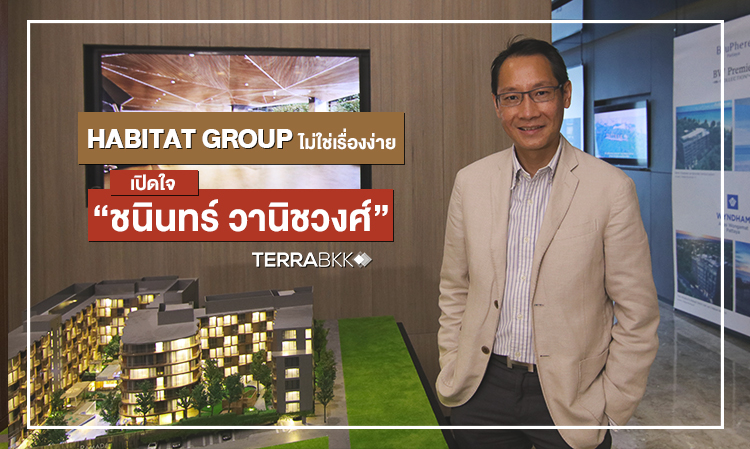
Recently, TerraBKK had the opportunity to speak with Mr. Chanin Wanichwong, also known as 'Chen', the CEO of Habitat Group Ltd., who transitioned from an IT businessman to a small real estate investor, and now fully into real estate development.
The Journey from IT Businessman to Small Real Estate Investor of Chanin Wanichwong
Mr. Chen shared an interesting story about how he started 16 years ago, leading to the establishment of Habitat Group today. Who would have thought that from a small beginning, where he aimed to buy a condominium for personal use, he would see it as an investment opportunity in real estate, particularly in condominiums that were then priced at around 50,000-80,000 THB per square meter, making it an easy decision to invest. He allocated part of his investment for rental purposes, generating returns of 7-8% per year. After renting for 1-2 years, it was time to sell for capital gains, which yielded considerable profits.
As rental investment returns decreased, a significant change occurred.
“As the returns from traditional investments began to decline and competition in the market increased, I started looking for new opportunities to become a developer and develop projects myself,”
Using my experience as a small investor who had rented out and bought-sold over 80 units, I analyzed and found that to be a developer who could meet customer expectations, the product must have good design, complete functionality, and a clear style. I believe that if done well, it would definitely attract luxury customers.
I spent over 2 years studying the real estate market and found that properties in tourist cities were still growing well, especially 'Pattaya', an important tourist city in the eastern region, known for its proximity to Bangkok, year-round tourism, and a high hotel occupancy rate of up to 80%.
In 2012, I felt it was a good time to sell all my properties in Bangkok and use the initial capital to invest in projects in Pattaya, leading to the establishment of 'Habitat Group' from that day on.
What does 'Habitat Group' do?
Many may not know what Habitat Group is doing today. I want to clarify that Habitat Group is a developer that differs from typical real estate development companies in the market. Our focus is on investment properties, which we call the 'Lifestyle Investment' model, targeting the Pattaya market. Customers receive fully furnished condominiums ready for rental, along with services from 4-5 star hotel chains. Habitat Group guarantees rental income for the first 3 years, after which it shifts to a profit-sharing model.
In Bangkok, the model is designed for rental condominiums, with partners from Japan who understand the needs of Japanese tenants and manage the rentals entirely. Rentals in Bangkok will be long-term contracts.
It is evident that the model of Habitat Group does not focus on owner occupancy but rather on investment, underpinned by quality service. I believe that investing in good solutions will enhance product value, providing good capital gains for buyers in the long term. This is the concept of Habitat Group that sets it apart from other developers in the market.
How did the 'Lifestyle Investment' business model come about?
The inception of this business model stemmed from my real investment experiences, both as a buyer for personal use and for investment. Having been a small investor who bought, sold, and rented out over 80 condominiums, I recognized many issues faced by investors.
Therefore, I considered that the initial business phase of Habitat Group was a newcomer in this industry. Thus, creating traditional products in a highly competitive market would be challenging. I needed to think about
developing a business model that was distinct, leading to the creation of a model that provides rental solutions to customers directly. The first project of Habitat Group was a pool villa named The Ville Jomtien Pool Villa.
This project consists of 80 fully furnished pool villas, each with a 15-meter swimming pool and complete household amenities, allowing customers to purchase and rent out immediately.
Initially, we tested the idea by launching it in phases. Phase 1 was opened for customers buying for personal use, receiving positive feedback from foreign customers and investors. We launched a campaign guaranteeing rental returns for the first 3 years, with the concept that after customers transfer ownership, Habitat Group would manage the rental through an established agency network both domestically and internationally, while allowing homeowners to stay for 14 days per year.
This rental model alleviates investor concerns about rental issues, as Habitat Group handles everything from rental management to property maintenance, guaranteeing returns, while customers can also stay for 14 days per year. This has become a new form of real estate investment that attracts investors seeking low-risk assets that can generate rental income and capital gains of about 5-6% per year.
The first project, The Ville Jomtien Pool Villa, was a successful test of the idea, leading to the second project designed entirely as a hotel. Habitat Group began consulting with leading global hotel chains to design the project as a complete hotel system. Each project name includes the brand of the hotel chain, such as X2, WYNDHAM, BW Premier COLLECTION, etc. Currently, Habitat Group has 7 projects in Pattaya and plans to open another 3 projects in the latter half of 2019.
How do you view the risks associated with this business model?
It must be noted that most condominiums in Pattaya are built with thousands of units per project. Creating such a large supply often carries a high risk of unsold units, leading to the need for guaranteed rental returns. However, the issue is that these supplies were not designed to function as hotels, which may not meet rental demands 100%. I believe that the 'Lifestyle Investment Model' carries less risk because the core Business Model of Habitat Group is primarily about creating hotels. In cases where units do not sell out, we can retain them as hotel rooms for rental, as hotels can generate rental returns of around 6-7% per year.
My direct investment experience has led to a careful selection of locations for each project by Habitat Group, ensuring they are suitable for rental, while also focusing on product design, functionality, and selecting reputable hotel chain partners for long-term rental management.
“I have never worried that this model would not succeed because if we sell out, it's great. But if we don't sell out, we can adjust the remaining units to operate as a hotel. However, in the past, by keeping each project size to no more than 200 units, Habitat Group has successfully sold 100% of all units.”
Buying just one condominium allows you to co-own a 4-5 star hotel.
Previously, Habitat Group primarily developed projects in Na Jomtien and Jomtien, targeting around 70-80% Thai customers. However, we have now started to venture into urban projects, particularly in North Pattaya, to attract foreign customers interested in purchasing properties for personal use or investment. Currently, the tourist demographic is increasingly purchasing real estate, with approximately 60% being Thai customers and around 40% foreign customers, particularly from China.
Most customers understand the business model of Habitat Group as being specifically for investment properties, making it easier to explain project details for sales. Customers know that Habitat Group builds hotels and invites everyone to buy in as co-owners of the hotel. Additionally, each year, they can stay for 14 days with monthly returns, with the first 3 years offering a guaranteed return of 6% per year, after which profit sharing is based on agreement.
Returns that customers of Habitat Group will receive:
For buying and selling with Habitat Group, it is similar to purchasing typical real estate, with standard down payment options. After project completion, we guarantee returns for the first 3 years. However, for customers with reserves who do not wish to make down payments and prefer to pay in full, they can receive returns immediately from the construction phase. This is divided into two options: if customers pay 50% of the purchase price, they will receive a return of 4% per month. If customers pay 100% of the purchase price, they will receive a return of 5% per month.
For marketing strategies, we utilize both traditional offline channels and increasingly enter online channels, as well as participate in international trade shows. Thai real estate remains attractive to foreign investors due to relatively low prices, averaging 200,000-300,000 THB per square meter in Bangkok, while tourist cities like Pattaya average around 100,000 THB per square meter, with beachfront properties priced at no more than 150,000-160,000 THB per square meter, offering significant value appreciation, profits, and attractive rental returns.
With increasing competition, how do you adjust your business strategy?
We must acknowledge that there are now more new developers entering the same business model. However, in terms of competition, Habitat Group is not overly concerned. The core of the real estate business is not just about the business model; it is essential to focus on creating products with intrinsic value in prime locations. The products we develop must genuinely meet customer needs. Typical condominiums cannot compete with those designed as hotels. Conversely, if competitors use the same business model, we must examine the credibility of the hotel chain partners involved in management.
Even though some developers may offer higher guaranteed returns than Habitat Group, most customers choose to purchase because they are confident that Habitat Group's model is viable, with guaranteed returns that meet investment needs through designs that create experiences and credibility for customers, leading to project acceptance among investors and word-of-mouth recommendations.
“Ultimately, competition in business is not just about this model alone; it is necessary to understand the entire process deeply, learning what buyers want in projects for rental investment to succeed in business.” Chanin Wanichwong, CEO of Habitat Group Ltd.
Thank you for the information from www.habitatgroup.co.th