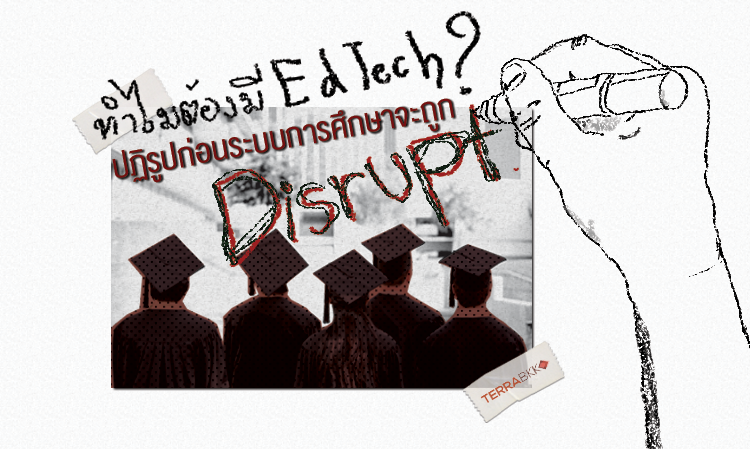
Why Do We Need EdTech? Reform Before the Education System is Disrupted
Did you know? The global education system, which involves attending classes five days a week to listen to teachers lecture for at least six hours a day, under a grading system of 0-4 or A-F, and governed by fear rather than curiosity, has remained unchanged since 1900 to the present day. Despite long-standing questions about these educational systems, there has not been a significant visible change until the current era of the economy known as 4.0, where startups around the world have begun to initiate changes in the education system, calling it EdTech.
4.0 The Era of AI Growth Where Traditional Education Systems Are Ineffective
Under the questioning and attempts to create change in the education system, many alternative classes have emerged today through the
digital platform. The effort to seek knowledge on a particular subject no longer requires going to the library, as it is now available in the digital world, including publications on Google, YouTube, TED Talks, Duolingo, and many more. In addition to knowledge for research, there has been a further exploration of how current technology can converge with the development of the education system, and the answer is AI (Artificial Intelligence), which will assist in personalized learning.The first AI concept discussed is Conversational User Interfaces, or voice response systems, similar to Siri on iOS. This concept aims to develop into chatbots that will interact on a personal level, focusing on teaching and learning. It is intriguing to consider that if lessons suitable for the times are incorporated and the response system can solve problems realistically, traditional lessons in schools or universities may no longer be necessary, especially in lecture-based subjects like history, literature, training, and seminars that do not confer degrees but provide certificates of completion.
Future Changes in the Education System
The awareness of improving the education system is spreading globally. The website medium.com discusses the future of the education system, which is likely to change due to the development of AI or EdTech. The teaching system that will help generate Big Data for development is expected to come from three types of learning:
Personalized Knowledge: This refers to learning tailored to individual capabilities, specific interests, and local cultures. The outcomes of this data can help create lessons and learning experiences suitable for each individual. In the current education system, students receive lessons based on a standardized curriculum, assessed and evaluated according to criteria. Research has shown that this type of lesson does not aid long-term memory retention, which explains why we often forget what we just memorized after an exam.
Knowledge Derived from Learning: This type of learning is akin to understanding mathematics, where one must grasp addition and subtraction before learning multiplication and division. This will shift the assessment from needing 85% knowledge to achieve an A grade to understanding at a C-B level, or merely 60%-70% being sufficient for basic comprehension, leading to further understanding. This type of learning requires a clear analysis of what level of understanding is necessary for progressing to the next level.
Experiential Knowledge: Learning through hands-on experience is the most effective form of learning, leading to better retention than traditional lessons. Currently, experiential learning is often found only in art classes, science labs, or assigned homework, which most children dislike. The challenge is to gather data from experiential knowledge to develop EdTech by asking what types of learning experiences can be effectively delivered through digital platforms.
Why Should the Thai Education System Be Reformed?
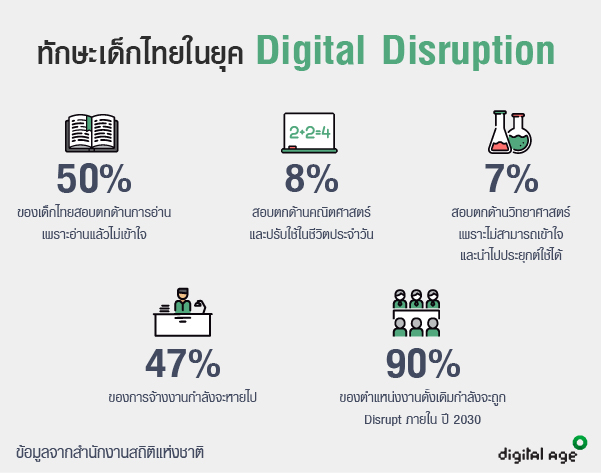
Krating Poonpol, the founder of Disrupt, has expressed concern about the skills of Thai children in the era of Digital Disruption. According to data from the National Statistical Office, it was found that 50% of Thai children fail reading comprehension, 53.8% fail mathematics and cannot apply it in daily life, and 46.7% fail science due to a lack of understanding and application. Meanwhile, 47% of jobs are expected to disappear, and 90% of traditional positions will be replaced by new roles by 2030.
Additionally, it was noted that the Thai education system still produces personnel in a Dump Pipe manner, meaning that the industry produces graduates based on current job demands without strategic and systems thinking. There is also a lack of motivation and enthusiasm to seriously develop the education system. In the EdTech startup sector in Thailand, funding has only reached a few tens of millions of baht, while abroad, total funding has reached 3,000-4,000 million dollars.
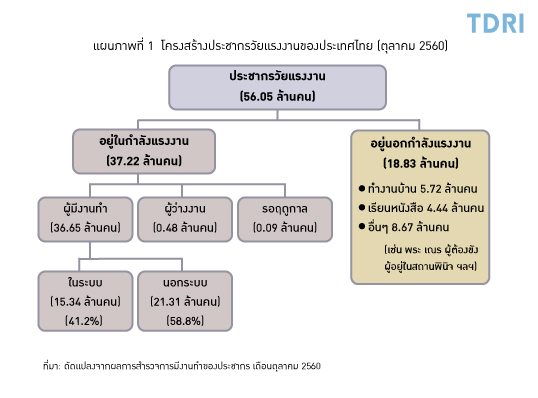
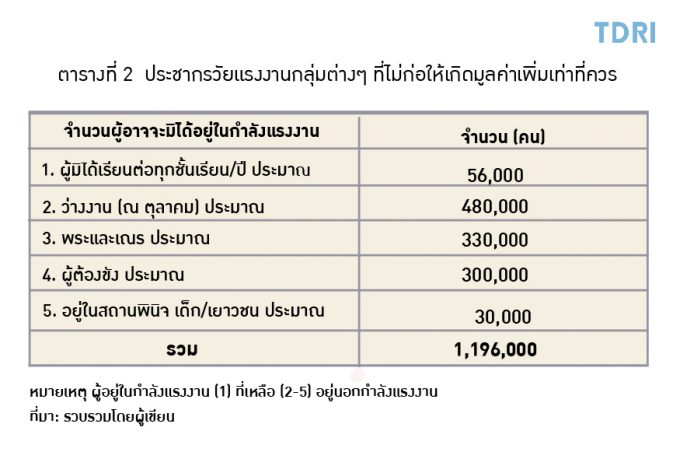
A survey of employment conditions among the Thai population by the National Statistical Office, compiled by TDRI, found a total population of 65.75 million, with 56.05 million in the working-age group. Among those outside the working age, 4.44 million are still studying, consuming more than 20.3% of national expenditure, yet the quality of learners has not been satisfactory. There are still 740,000 students dropping out from grades 1-6 and vocational education, accounting for 16% of all learners outside the working age. Additionally, there are 1.19 million working-age individuals who do not contribute value to the country, including those who do not continue their education at any level, the unemployed (as of October), monks and novices, prisoners, and those in youth detention centers.
The Beginning of Change in the Thai Education System
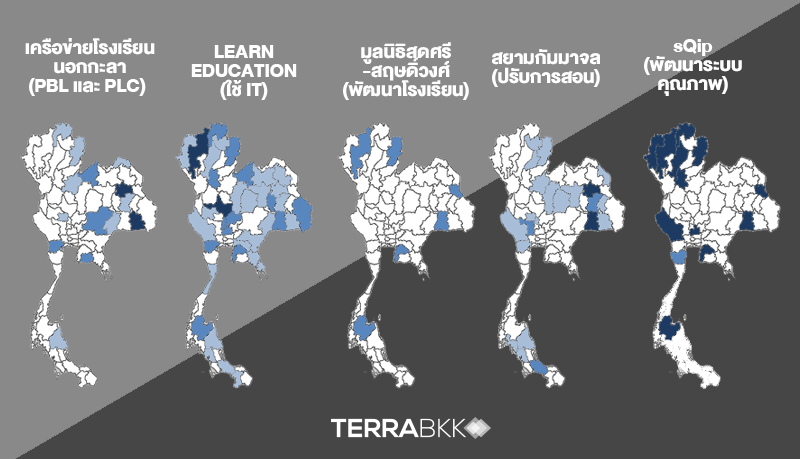
On a positive note regarding educational development in Thailand, several independent organizations and foundations for educational development have been established, spreading to provinces across Thailand, including the Out-of-the-Box School Network (PBL and PLC), the use of IT in learning, the Sodsri-Saridwong Foundation (developing schools), Siam Commercial Bank (adjusting teaching methods), and sQip (developing quality systems), which demonstrate significant movement towards the development of the Thai education system.
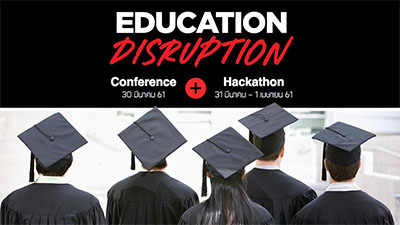
Moreover, a recent event, the Education Disruption Conference and Hackathon 2018, was organized by Disrupt, KBank, and TCP in collaboration with TDRI, dtac, PTT, and Areeya Property, featuring global hosts sharing innovations and new educational technologies.
Additionally, it provided opportunities for startups, non-profit educational businesses, and individuals with teams interested in developing educational technology to apply to present their educational innovation ideas at the EdTech Hackathon, marking a promising start for EdTech in Thailand - เทอร์ร่า บีเคเค
References
Article by: TerraBKK Investment Tips
TerraBKK Find Good Homes, Value for Money, Affordable Prices