
9 Techniques to Foster Reading for the Future of Thai Children
Reading is not just about being able to read; it should bring joy and pleasure to the reader, facilitate learning processes, and lead to the development of other skills such as listening, speaking, writing, analyzing, and synthesizing.
According to a continuous survey of early childhood development across the country from 1999 to 2009 by the Department of Health, it was found that Thai children have an average language development delay of 20%. As of 2014, this average increased to 38.2%. One effective method to improve language skills is “reading books to children.” Professor Pranong Niyomka Horikawa, founder of the Bookstart Thailand project and a writer and translator of children's stories, stated that “Books not only make children smart but also nurture good hearts.”
“When we talk about books or learning, we think of the saying ‘picking a flower shakes the stars.’ No one can say how wondrous the impact of reading is, but there is no doubt now, as it has been proven to be beneficial,” said Dr. Chompoonut Topothai, a specialist at the Health Promotion Bureau, Department of Health, regarding the importance of books and reading, which may be one of the best ways to help develop children in all aspects. She introduced the 4 H framework to promote reading among young children: 1. Health - to ensure children are healthy and develop appropriately; 2. Head - for cognitive development, including IQ and EQ; 3. Heart - for discipline, morality, and ethics; 4. Hand - for skill development, as reading will help children improve their development.
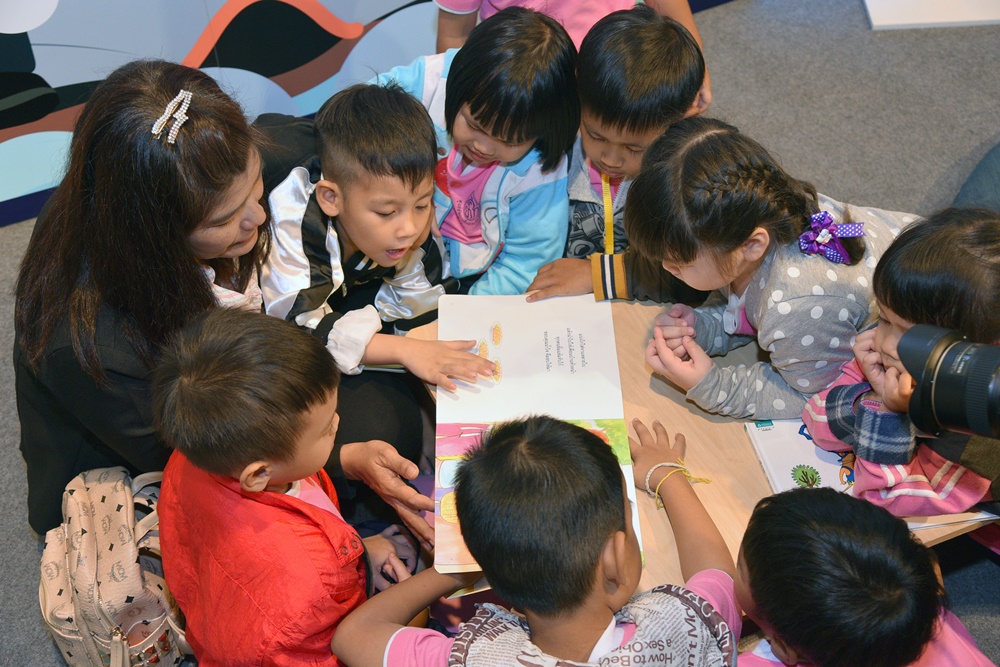
Every child has a different learning style. Parents who want their children to enjoy reading must continuously seek new methods, as there is no one-size-fits-all formula for instilling a love of reading in children. Here are some techniques to start fostering a love of reading in Thai children:
1. Read light, fun stories so children don’t feel bored.
2. Choose appropriate times for reading when children feel relaxed, such as before bedtime.
3. While children are playing nearby, parents should read books in their view, and when something is interesting, read it aloud to engage them, or use riddle books to capture their attention.
4. Try reading new and unfamiliar stories that they haven’t encountered at school.
5. Observe what interests your child and read books related to those topics.
6. Read books that your child enjoys and ask questions to encourage them to think and express their opinions, subtly incorporating correct explanations.
7. Tell the story incorrectly at certain points in their favorite book to stimulate their brain, both in thinking and memory, and practice using language to argue with parents.
8. Create your own stories, letting your child be the main character, as young children often enjoy stories where they are the protagonists, or create stories about familiar things.
9. Read with your child every day and try to discuss the pictures, colors, shapes, numbers, and words in the book. If the book has no pictures, parents can use simple art activities like playdough or large crayons to draw while reading and talking with their child.
In an era where the growth of digital media encroaches on reading time, I encourage parents to focus more on reading than on handing technology to their little ones, to help children grow into well-rounded adults with knowledge, critical thinking, and systematic analysis skills.Finally, I invite those who love reading and those who wish to instill a love of reading in their children to join the National Reading Festival, titled “The Marvel of Reading for Early Childhood,” organized by the Health Promotion Foundation (ThaiHealth) in collaboration with various agencies on February 10-11, 2018, from 9:00 AM to 4:00 PM at the Airport Rail Link Makkasan Station, Bangkok. The event will feature reading techniques, selecting children's storybooks, and various activities.
Thank you for the information from www.thaihealth.or.th