Summary: Decoding GEN Y - The Turning Point of Real Estate 4.0
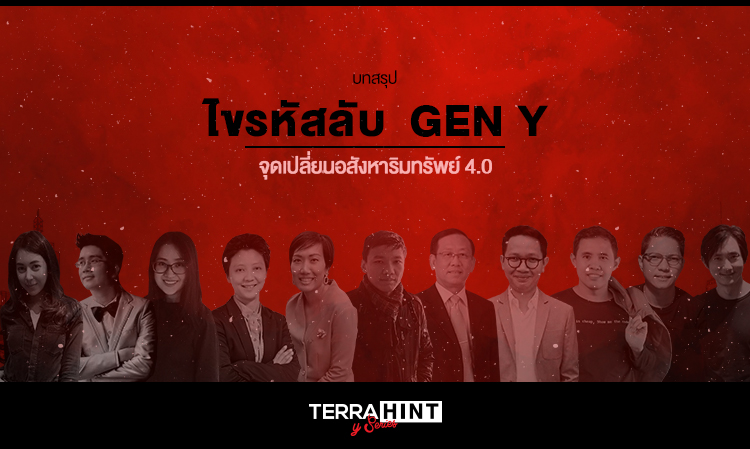
TerraBKK Research has compiled key points from the Creative Talk “TERRA HINT Y Series: Decoding GEN Y - The Turning Point of Real Estate 4.0” held on February 8, 2018, which includes three main topics: an in-depth look at the behaviors of Gen Y who are changing the real estate business, survival strategies for developers as customer needs change, and techniques for creating advertisements that resonate with Gen Y customers. The details are as follows:
In-depth look at the behaviors of Gen Y who are changing the real estate business
A survey of Gen Y behaviors aged 25-37 was conducted among over 500 individuals entering the labor market and beginning to have purchasing power for housing in Bangkok and its vicinity. The findings revealed that over 54% of Gen Y do not plan to buy a home anytime soon because most of this group has an income between 18,000-35,000 THB per month and lacks sufficient savings due to high monthly debts from credit cards and car loans.
Meanwhile, 46% are considering purchasing a home within the next three years, with 57% preferring single-family homes, followed by townhomes at 48.7%, condominiums at 30.7%, and duplexes at 15.8%.
The survey categorized Gen Y behaviors into four groups:
- Smart Choice: Financially planning for a new family and fond of technology.
- Peace in Mind: Concerned about the future, valuing personal identity.
- WE Oriented: Considering social image and family.
- Quality Seekers: Wealth is a life goal, paying attention to every detail.
It was found that the Smart Choice group is most likely to purchase housing in the next three years as they desire their own home to start a family and plan for children in the future. The top three types of housing they are interested in are single-family homes at 40%, townhomes at 26%, and condominiums at 17%. Their budget for purchasing housing is primarily in the ranges of 1-2 million THB at 40%, 2-3 million THB at 30%, and 3-5 million THB at 20%.
Strategic approaches to meet Gen Y's needs suggest that the Smart Choice group should focus on Value-Added and Trendy Style strategies to enhance future value and brand confidence. The Peace in Mind group should emphasize happiness in living, reflecting life values, while the WE Oriented group should prioritize family happiness. The Quality Seekers group should focus on innovation and a sense of achievement in life.
Major real estate developers are gradually adapting to Gen Y, whether through business strategy changes based on Gen Y behaviors, such as technology addiction. The Sansiri brand is adapting with SIRI Lifetech and a digital society, while Ananda emphasizes smart offices and support for startups, as Gen Y enjoys creativity and is bored with routine. In terms of product changes, Land and Houses are modifying single-family homes with multipurpose spaces on the first floor, while Golden Land is adjusting townhomes to function like single-family homes but located near condominium areas close to the BTS. Regarding marketing tools, the shift towards a cashless society includes QR payments and online booking known as I-Booking, along with events that resonate with Gen Y's love for new experiences, such as the Winter Market Fest and Freeform Festival. In terms of project image, major developers are also adapting, such as the advertising campaign featuring the Bang Pho girl by Pruksa and creating unique project atmospheres like the Villaggio project by Land and Houses.
On the retail side, 67% of Gen Y prefer shopping online. Therefore, the retail sector is adapting by creating new forms of entertainment, such as community centers and lifestyle centers. For instance, the current B2S store is no longer just a bookstore but combines lifestyle and co-working spaces.
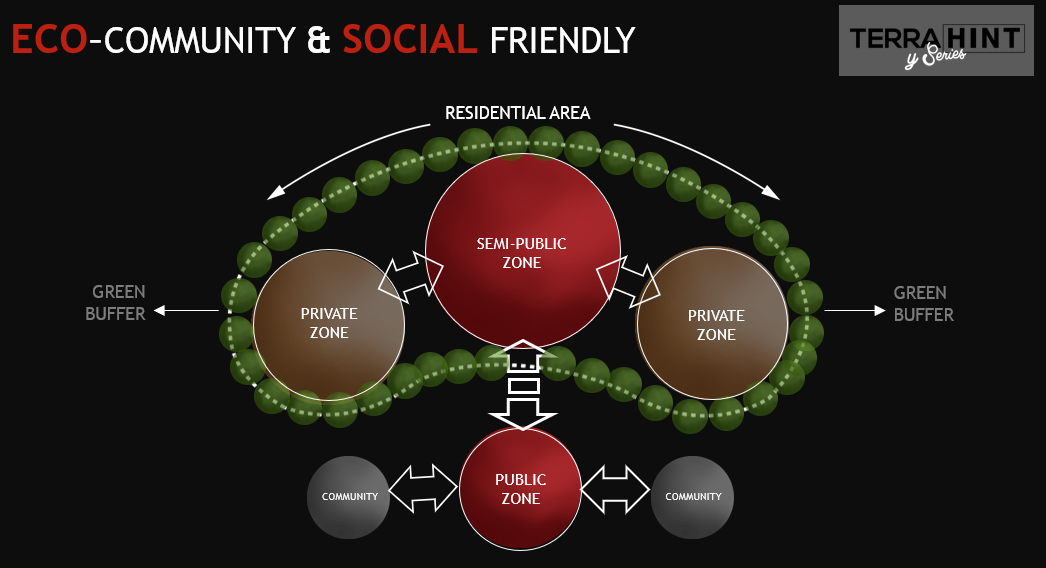
Communication channels must keep pace with Gen Y, which includes having a dedicated website as a storefront for communication with customers and creating engaging content that is mobile-friendly. Additionally, utilizing Facebook effectively to reach target groups and enhance community engagement, similar to LINE for direct communication with customers, is essential. While both Thai and international Gen Y prefer single-family homes, the difference lies in that international Gen Y often prefers renting, unlike Thai Gen Y who still desire to own a home. A concern is the increasing population density in Bangkok and the flood-prone areas. Thus, Gen Y's solution is to leverage technology to assist in work. Is it necessary to be in the office to work? In the future, we will see AI playing a more significant role in work. Ultimately, it is perceived that the lack of green spaces in Bangkok presents a significant opportunity for real estate developers to build their brand while contributing to society, such as allocating common areas in projects for social purposes, like dividing public zones, semi-public zones, and residential zones for residents.
The survival of developers: as customers change, we must change
From the behavior of users searching for homes on the TerraBKK.com website, it is evident that this year, the townhome market priced between 1.2-2.3 million THB will be more popular among Gen Y than condominiums at the same price point, as most Gen Y want personal space and do not necessarily need to live in the city but can conveniently commute.
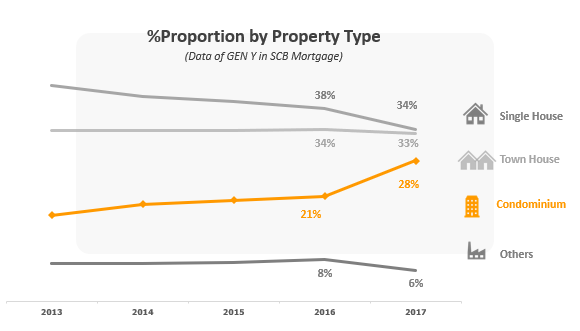
According to Siam Commercial Bank, currently, over 35% of loan customers are Gen Y, up 29% from last year, with most earning between 30,000-45,000 THB. Gen Y tends to prefer online media and has a social lifestyle, so reaching this group requires strategies that are easy to share, tag, and understand. Real estate developers need to adapt more to their customers, which is seen as an opportunity for smaller developers to adapt to customers more easily and quickly than larger developers due to organizational size and work processes, as well as the increasing role of technology in assisting work.
When comparing small and large developers, it is found that over 77% of smaller developers are not ready to use Big Data, as they still operate in a traditional manner, relying more on personal experience than market research. Their internal systems primarily use paper, focusing on sales rather than brand building. Although their operational costs are lower than larger developers, they still face higher financial costs and sell products at lower prices than major brands.
Meanwhile, small real estate developers recognize the importance of Gen Y. Attracting Gen Y customers requires serious study of their behaviors. “Gen Y is slow but fast” – they take time to research information to choose what meets their needs but expect quick service from developers. This is a crucial challenge in developing products that align with the needs of Gen Y today. Communication with target groups through online marketing is essential, while developers should increasingly incorporate technology into their work processes.
Regarding technology to assist real estate developers, there are many options available in the market today. The question is which tools truly meet the needs. Managing backend data related to sales and addressing property repair issues are also important aspects that should not be overlooked, along with accessing market research data on real estate supply. In today's real estate business, the focus should be on Net Profit, not just sales as in the past.
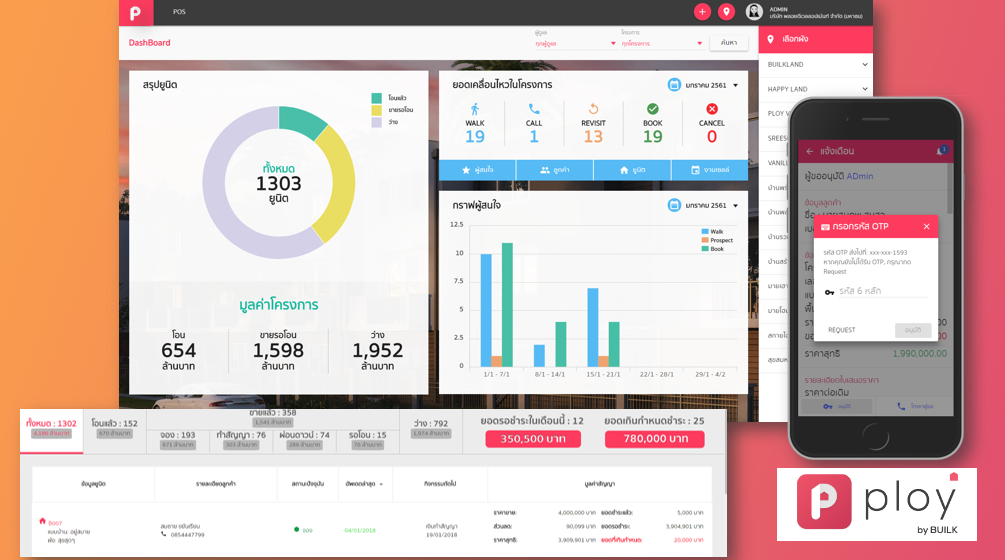
PLOY: Real Estate Sales Management Program simplifies the workflow for Gen Y, covering services such as customer list management, project sales tracking, reducing issues of duplicate unit bookings by providing online unit sale status updates, allowing monitoring of employee performance, and alerting delays in task resolution. Reporting can be done in various formats, such as graphs and tables, to provide users with a clearer overview of the business, including sales reports, payment reports, and after-sales service reports.
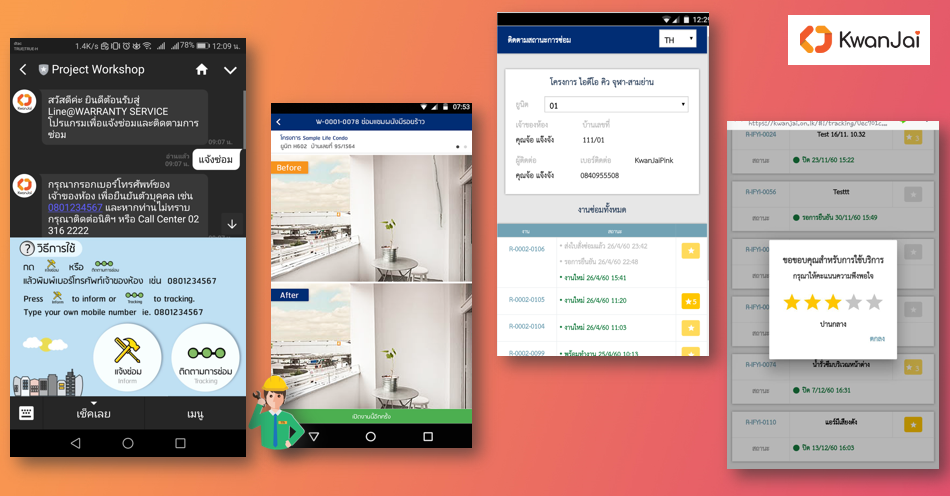
Kwanjai: After-Sales Repair Coordination System for real estate projects enhances operational efficiency in the Gen Y era. When residents need repairs, they can notify via LINE 24/7. Subcontractors receive real-time alerts when assigned repair tasks, reducing the workload for property management and allowing tracking of repair status for residents. Main contractors can also plan management effectively. Project owners can receive summary reports and track repair tasks as data to improve resident satisfaction.
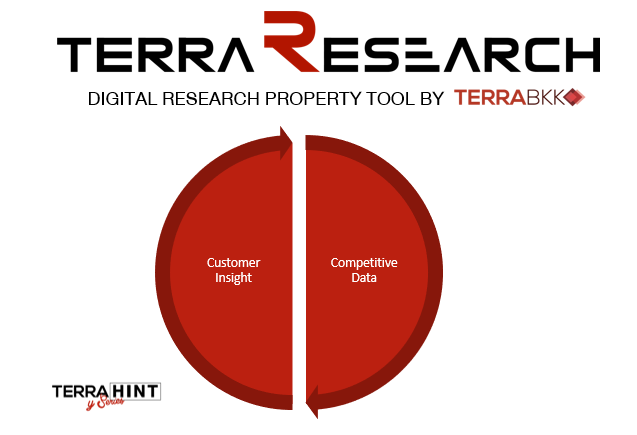
Terra Research is a program for researching and analyzing competition in the real estate market that covers both Customer Insight and Competitive Data for Gen Y, including the number of competitors within a 5 km radius of your real estate project, information on products available in the market for positioning your project, market pricing, comparisons between prices and products in the market, market gaps, and competitors' promotional strategies.
Changes in real estate for Gen Y abroad show that Gen Y in America prefers renting and is not attached to staying in one place for long, typically moving every 3-4 years. In contrast, Gen Y in China often lives with their parents, similar to Gen Y in Korea. When it comes to spending, they tend to invest in experiences rather than material goods. Gen Y in Japan is increasingly living in social apartments, which feature shared common areas for activities. Ultimately, it does not matter who creates for Gen Y, but it is crucial to understand for whom the creation is intended. This is a significant homework assignment for real estate developers.
Techniques for creating advertisements that resonate with Gen Y
Start by understanding GEN Y with the question, “Why was I born?” The answer for this group is to choose to do what they want because they have more opportunities than previous generations. With easier and faster communication channels, it is noticeable that GEN Y is open to information from two main groups: the first being “Micro Influencers” – individuals who influence Gen Y's thoughts. Even if these individuals make up only 5% of the population, they can create significant change. These individuals often share a strong passion for something and are driven to pursue it relentlessly, even in the face of failure. The second group is “Machines,” similar to AI systems that collect data about us without our awareness, such as Google Maps, Facebook, and YouTube, which track our preferences to present targeted options/products/services. Therefore, the solution for creating advertisements that resonate with Gen Y is to identify influential figures who can help Gen Y recognize the brand, as well as effectively utilize AI systems for targeted marketing and customer retention.
Why is Brand Experience important in the Gen Y era? Thailand ranks first in the world for the most time spent online daily, averaging 9 hours and 38 minutes (January 2018), with 90% of internet users in Thailand accessing it via smartphones. It is unavoidable to state that “Everything is communication.” Every experience is perceived through various communication channels, not just advertising media, but also through ratings and reviews, which are significant for Gen Y. The key point today is to create the “first experience” of the brand online. Real estate developers should not only focus on acquiring new customers but also on creating shared experiences with the brand (Brand Experience). This involves engaging products, customers, employees, communities, etc., with the brand to foster perception and ultimately develop habit-forming behaviors. This is crucial for developers to pay attention to.
Meanwhile, advertisers believe that “ideas never get old.” Many times, past advertisements still resonate with the current situation of Gen Y. The principles that remain effective are “Fun + Short + Easy to Understand,” which can entertain people, not just through humor but also by guiding viewers in a particular direction. The challenge in advertising is often the perception that “advertising” is merely a “nuisance.” ---TerraBKK
Article by: TerraBKK Investment Tips
TerraBKK: Find good, valuable, and affordable homes