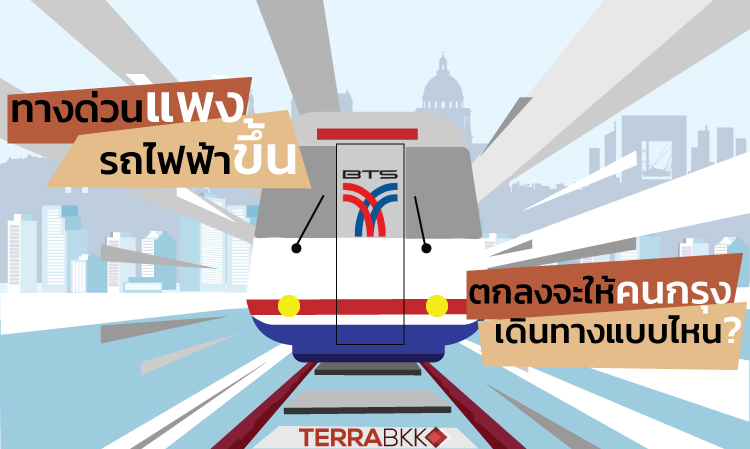
Expressway and Skytrain Fares Are Rising – How Will Bangkok Residents Travel?
Here we go again! Bangkok residents, get ready and prepare your wallets because next year, whether you drive your own car or take the skytrain, you will face increased service fees. This applies to the Blue Line subway, the Purple Line subway, the Green Line BTS, and various expressways. Let's break down how the fare adjustments will work.
Blue Line Subway from Tao Poon to Hua Lamphong
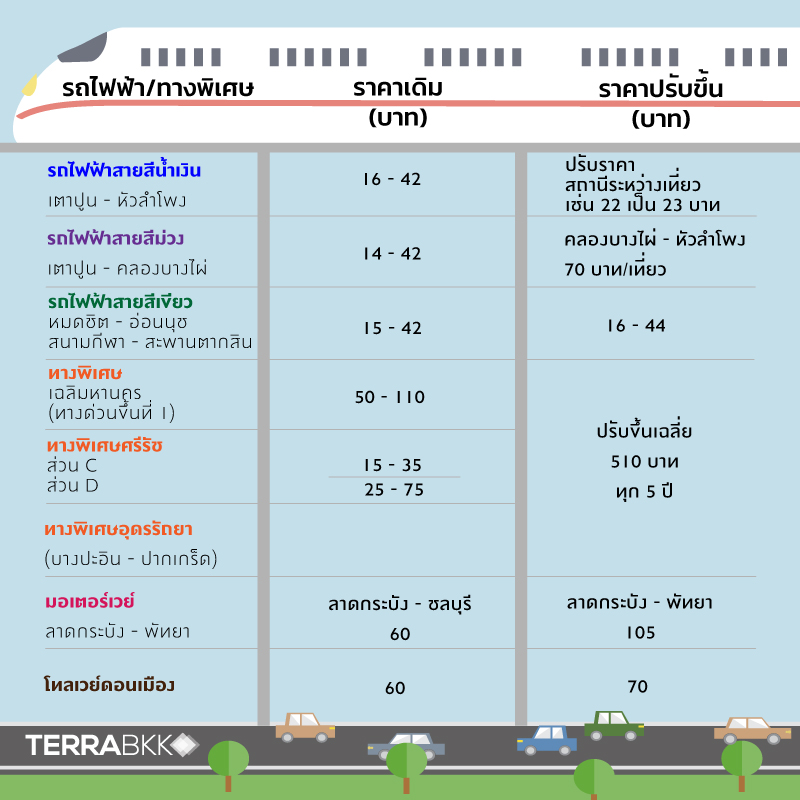
Bangkok Expressway and Metro Public Company Limited (BEM), the operator of the Blue Line from Tao Poon to Hua Lamphong, announced on November 22, 2017, that the company's board has approved a fare increase proposal for the Blue Line subway, which is due for adjustment according to the contract on July 3, 2018. The fare will increase by 1 baht at 3 stations along the route, for example, from 22 baht to 23 baht. The passengers affected will only be those using the service for short distances. The next step is to submit this to the Mass Rapid Transit Authority of Thailand (MRTA) for approval before presenting it to the Cabinet for further consideration. The new fare is expected to be announced starting in January 2018 or by May 2018 at the latest.
Purple Line Subway from Tao Poon to Khlong Bang Phai
Recently, the Purple Line subway, which has just connected with the Blue Line at Tao Poon station, has seen a 10% increase in passengers, averaging around 350,000 to 400,000 trips per day. It is expected that if the Blue Line extension opens in 2019, there will be an additional 4-5% increase in passengers, or about 100,000 trips per day, with normal fares ranging from 14 to 42 baht.
For the Purple Line, there is no fare increase; instead, there is a promotion for long-distance passengers, reducing the fare between the Purple Line and Blue Line from 84 baht to 70 baht for the trip from Khlong Bang Phai station to Hua Lamphong station.
Green Line BTS from Mo Chit to On Nut and National Stadium to Taksin Bridge
Bangkok Mass Transit System Public Company Limited (BTSC) recently adjusted fares on October 1, 2017, after not increasing them for over 4 years, from 15-42 baht to 16-44 baht. However, users of the Rabbit card with stored value can continue to use the old fare until March 31, 2018.
For the Green Line extension that Bangkok manages itself, the On Nut to Bearing and Wongwian Yai to Bang Wa sections had their fares adjusted on April 1, 2017, to a flat rate of 15 baht.
Tollways and Motorways
The Expressway Authority of Thailand (EXAT) is due to adjust toll rates for the first and second phases every 5 years, with past increases averaging 5-10 baht. They will consider this in April 2018, and the outcome may or may not result in an increase.
The only tollway that will see an increase is the motorway, specifically the Chonburi-Pattaya route, affecting long-distance travelers from the Lat Krabang toll gate to Pattaya, with the fare increasing to 105 baht from the current 60 baht for the Lat Krabang to Chonburi route.
Are expressway fare increases meant to discourage car usage? What other policies are there to reduce car use?
“Developed countries are not places where the poor own private cars, but places where the rich choose to use public transport.” This cool quote by Gustavo Petro, former mayor of Bogotá, is always relevant. In developed countries, public transport has advanced significantly, with most citizens opting for public transport over private cars. Why is public transport in other countries so efficient?
In many countries, owning a private car is considered a luxury due to numerous regulations limiting car usage. The government benefits in two ways: it can reduce traffic problems and invest in public transport without incurring losses.
In Japan, only about 30% of the population owns private cars due to laws requiring car owners to have parking spaces at home. It is well-known that living spaces in Japan are much smaller than in our country. Additionally, commercial parking is extremely expensive, charging around 130 baht per hour during the day and 160 baht per hour at night, making Japanese citizens hesitant to own private cars, even though their country is one of the largest car manufacturers in the world.
Such laws have been discussed among scholars and legal experts many times but have always been shelved. In Thailand, where almost every household owns at least one car, no one would be pleased with such regulations. So how can we satisfy the Thai population? Or will we have to wait for a day when Bangkok's streets are clean and free of chaotic traffic?
Article by: TerraBKK
TerraBKK Investment Tips: Find good, valuable, and affordable homes