When Romklao Was Chosen as the Eastern Economic Center
The Economic Center or the Smart City Development Model has emerged in various countries, but it is still a relatively new concept for Thailand. It is no surprise that there is excitement upon learning that it has already taken shape in Khon Kaen Province, where local private sector groups have collaborated to successfully push forward the urban development model, inspiring other provinces to follow suit.
The Pilot Project “Romklao”
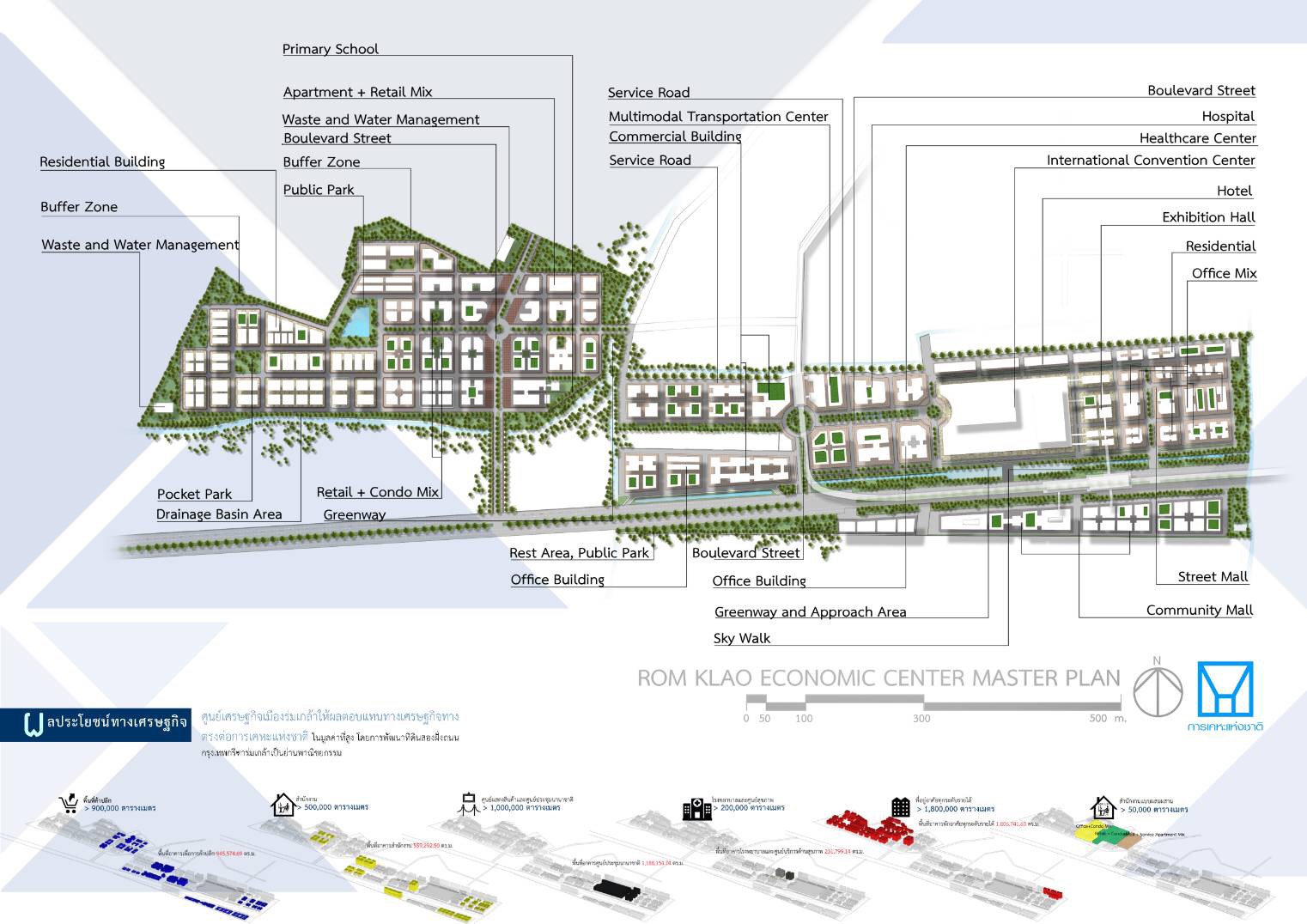
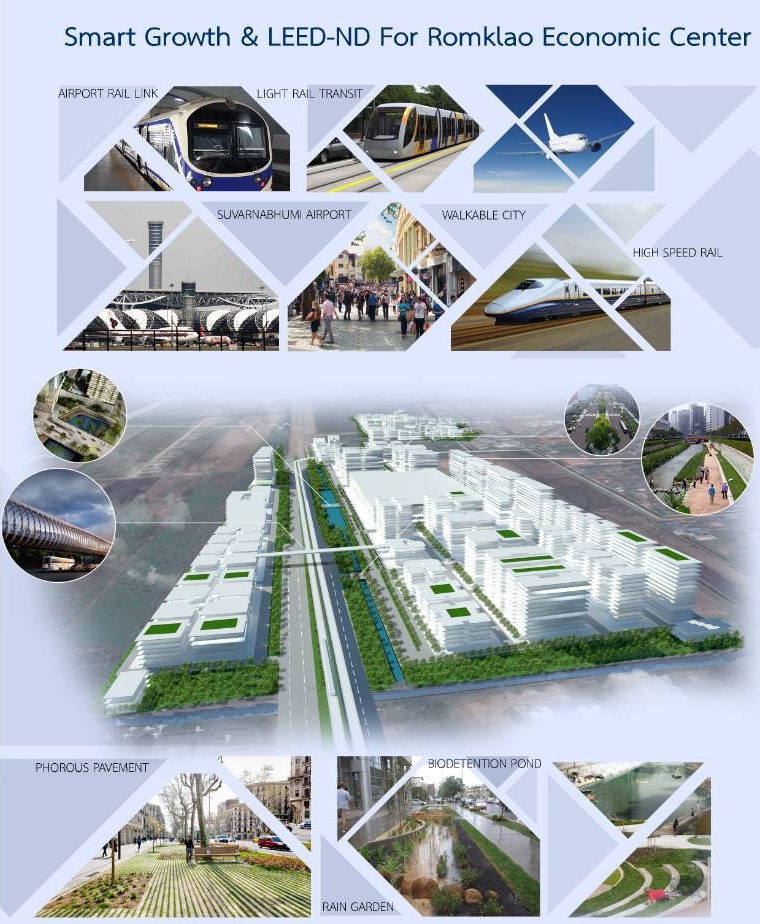
The government also recognizes the opportunities and importance of urban development models. One project currently under study for a master plan is the pilot project “ Romklao ”, which the National Housing Authority has selected as the area with the highest potential. This area encompasses the Romklao housing estate along the Bangkok-Krittha road, between Klong Song Ton Nun and Klong Sam, covering a total area of 564 rai (including both National Housing Authority land and private land). “Romklao” will delineate urban roles and hierarchies according to The Transection Codes, designating areas based on smart growth criteria, leading in energy and environmental design (Leed-ND), and developing areas around mass transit stations (Transit-Oriented Development) to create an economic center and residential area for people of all income levels. Initially, the master plan categorizes land use in “Romklao” into three types:
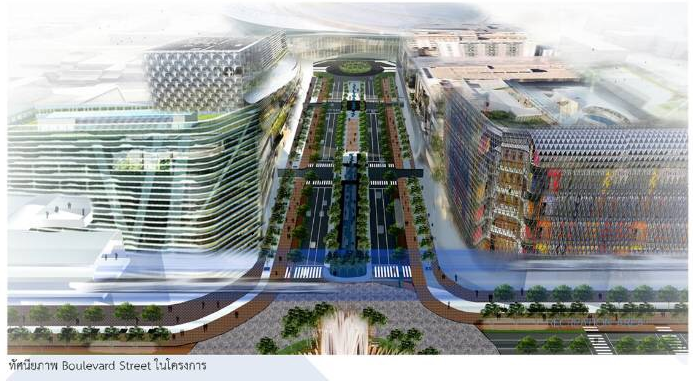
• T6 Urban Core Zone: Includes conference centers, hotels, and commercial buildings to support users and enhance the area’s environment.
• T5 Urban Center Zone: Comprises commercial buildings, hospitals, and various transport hubs to serve as a primary area supporting activities and the economy.
• T4 General Urban Zone: Residential areas with open spaces and green areas for recreation.
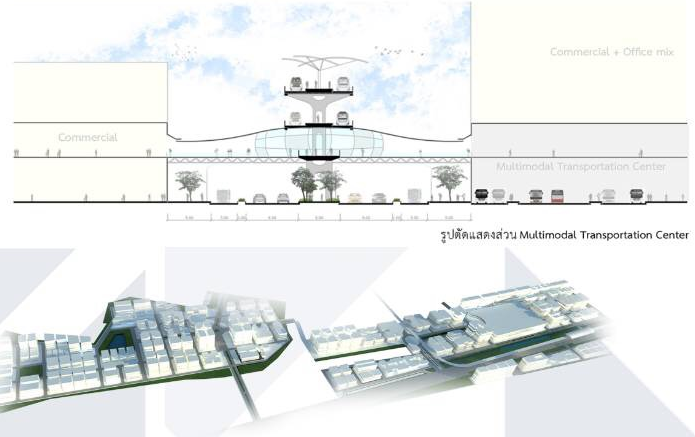
In terms of transportation, “Romklao” will designate areas to serve as a Multimodal Transportation Center, both within and outside the “Romklao” area, connecting the Yellow Line electric train (Romklao Station) to the multimodal transportation center project, leading to Suvarnabhumi Airport.
Financial Innovations to Stimulate Urban Development
Urban development requires significant funding, often perceived as a heavy burden on government support. If funding is raised through bonds, it will undoubtedly impact the country's public debt levels. However, viewing it from a modern perspective, one might argue that funding is not the primary issue in urban development. The Smart City Model could evolve into a business plan that attracts foreign investors effectively in the future. Our world has abundant capital ready to invest for better returns, such as Infrastructure Funds and Real Estate Investment Trusts – REITs. These financial innovations will also become crucial funding sources for the development of “Romklao.”
Case Study: Romklao Economic Center
Statistics show that land prices have been rising every year, impacting the cost of developing housing. Many low-income individuals reside in urban areas, and over 60% of them can afford housing priced at no more than 450,000 baht, while the minimum price for private housing is around 1,000,000 baht, and for public housing, it is 600,000 baht. Therefore, converting assets into REITs will become a financial tool resulting from public-private partnerships (PPP) to develop housing for low-income individuals. For instance, mixed-use areas in projects that allow private sector performance to develop the area can push into the REIT fund for 30 years, generating good yield returns for investors. The profit from the fund value that the National Housing Authority receives can be reinvested to create housing for low-income individuals. Currently, the main issue in the Romklao area is the limitations on land development according to zoning regulations, which prevents full development potential. Adjusting zoning regulations would benefit the Romklao pilot project, leading to increased land prices and full development potential. Thus, can foreign investors acquire land in the country through these financial instruments? This depends on the investment structure of the fund, which can only specify income returns and does not relate to land ownership rights. Once the 30-year term ends, the fund ceases to exist without any ongoing effects. Ultimately, true urban development is about creating a happy city that fosters a sense of ownership among local residents, as demonstrated by the Khon Kaen model, where over 100,000 residents of all income levels have become investors and owners of assets like the electric train, etc.
Background of the “Romklao” Project
The National Housing Authority has received a government policy to study housing development approaches in economic areas designated for special development, such as special economic zones and areas within the service radius of transportation infrastructure. Particularly, areas around railway stations are crucial for this development. Therefore, in the 2017 budget, the Asia Museum Company was commissioned to research housing development along dual-track railways and high-speed rail, studying 123 railway station areas nationwide, analyzing economic size and levels, growth opportunities, population expansion, infrastructure readiness, and potential development areas for large economic zones in the future.
Results of the Study
The researchers selected areas around high-speed and dual-track railway stations, including Phitsanulok, Saraburi, Rayong, Map Ta Phut, Hua Hin, Cha-am, and the area around Lat Krabang Station (Romklao). Subsequently, they organized meetings to gather feedback from stakeholders to analyze readiness for area development, ranking potential based on Smart Growth & LEED ND criteria, ultimately selecting one area for master plan design.
Screening Results
The area around Lat Krabang railway station, specifically along Bangkok-Krittha-Romklao Road, currently owned by the National Housing Authority, has high potential for development as a pilot area. Therefore, the National Housing Authority has permitted the researchers to proceed with the master plan design.
The pilot area spans 630 rai along both sides of Bangkok-Krittha-Romklao Road
The land parcel is adjacent to the Romklao housing community and can connect via road networks and public transport to the economic center of Min Buri, Ram Inthra - Surin Thawong, Bang Kapi, Lat Krabang, and the electric train stations. The land parcel is located between Min Buri electric train station, the Orange Line, and Lat Krabang electric train station, the Airport Rail Link, and Suvarnabhumi International Airport, approximately 8 kilometers from Min Buri station, 5 kilometers from Lat Krabang station, and about 8 kilometers from Suvarnabhumi International Airport.
The pilot area is positioned as an economic development area based on the Airport-Oriented Development concept
It has the potential to support economic activities and housing for Suvarnabhumi International Airport, located outside the controlled airspace. Additionally, the pilot area is a large state-owned land parcel located near Lat Krabang electric train station, which will be upgraded to a high-speed railway station in 2021. This area serves as a crucial connection point between Don Mueang International Airport and U-Tapao International Airport, as well as a rail connection to the country's major commercial ports and the Eastern Economic Corridor development project.
Due to the physical factors of the area, it is highly suitable according to LEED ND criteria
In terms of location and smart connectivity, it is a strategically important point for economic connectivity based on smart growth criteria.
Strategic Economic Design and Infrastructure System
The Romklao Economic Center has applied Smart Growth Principles for economic strategy design, defining the role of the area, international economic connectivity, and infrastructure connectivity for large-scale infrastructure design criteria, including Transit-Oriented Development concepts, Airport-Oriented Development Economic concepts, LEED-ND energy and environmental design leadership, and Form-Based Codes for urban planning. This aims to achieve the objectives of creating an international business area, a walkable city, an energy-efficient city, a livable city, and a city that supports international travel systems.
Management Design Concepts
The Romklao Economic Center has selected a financial management approach that allows private sector participation in investment, according to the Public-Private Partnership Act of 2013, as one option for investing in the economic center project. This utilizes Real Estate Investment Trusts (REITs), which are structured as a “property fund” owned by a trustee (Trustee) without legal entity status. The financial management aims to create long-term asset value for the National Housing Authority, reduce the direct investment burden on the National Housing Authority, and stimulate affordable housing for all income levels. The land area must have high value or be within the international economic center to meet market demand, serving as a model for mixed-use project development by the National Housing Authority moving forward. ---TerraBKK
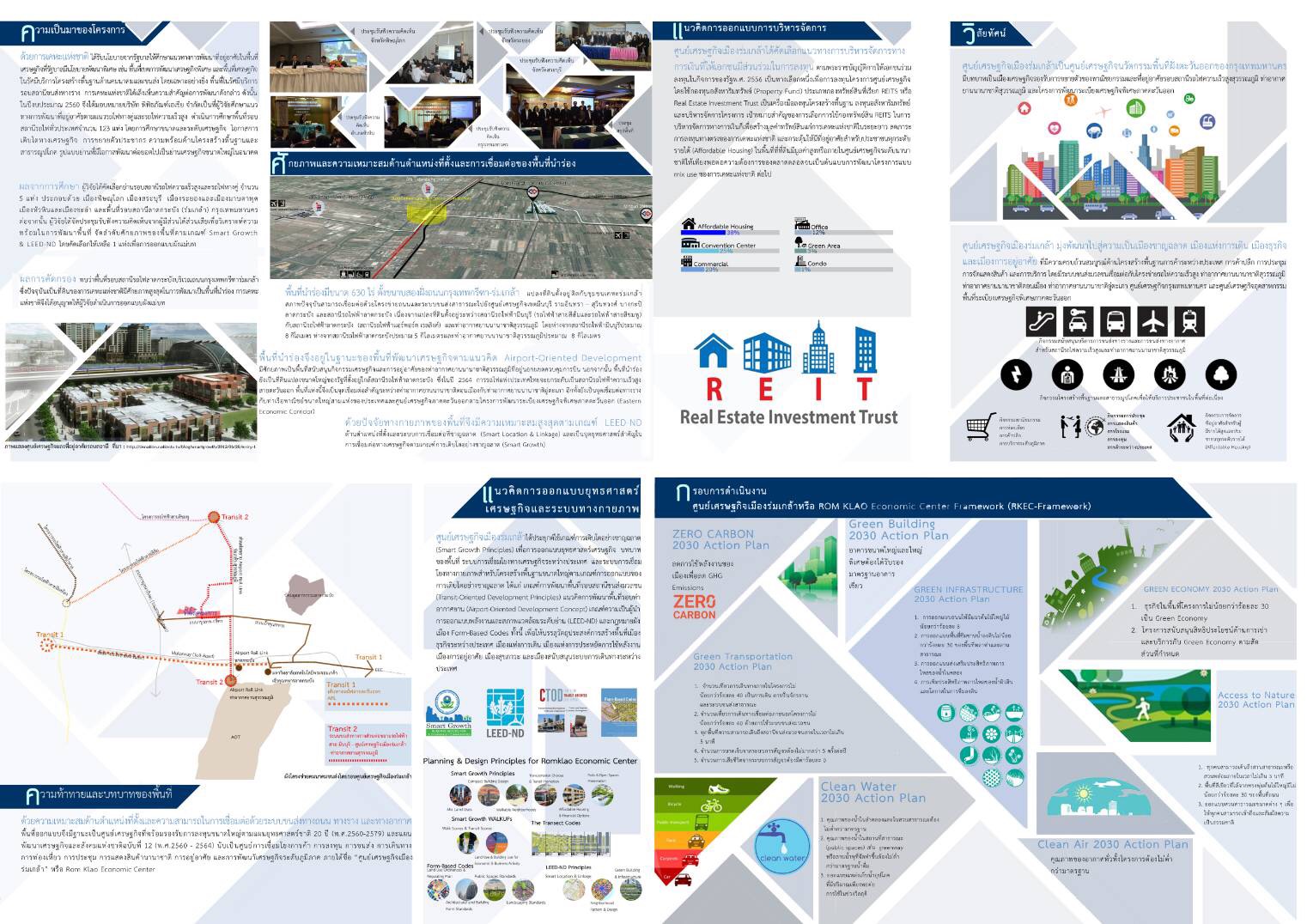
Source: Information from the meeting on the development policy of the economic center and housing for all income levels by the National Housing Authority.