Stock Market During a Crisis
Currently, the Thai stock market (SET) is experiencing a strong upward trend. However, many people are still fearful about whether this rise is genuine, especially with negative news circulating, such as the conflict between the U.S. government and North Korea, and the devastation caused by Hurricane Irma in Florida. TerraBKK has compiled data on the SET index during various crises, both domestic and international, showcasing five events from each category.
International Crises
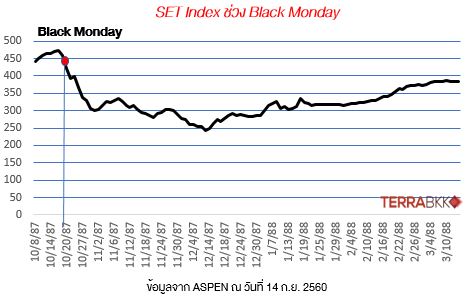
Black Monday
This event marked a panic sell-off that caused the Dow Jones to drop in a single day by the largest percentage in history at -22.6%. The main reason was due to Algorithm Trading (computerized trading systems widely used by funds at that time). When a certain error occurred that the program could not respond to, it led to irrational selling, spreading panic among investors. This was exacerbated by the economic bubble in the U.S., resulting in a severe outcome. The Thai stock market also fell by 8% in one day and took over two months to begin recovering.
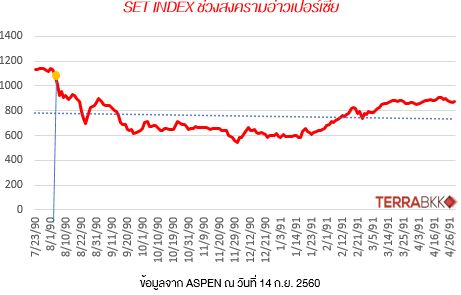
The Gulf War
This war involved a coalition of 34 countries led by the United States against Iraq following Iraq's invasion of Kuwait, from August 2, 1990, to February 28, 1991. The SET index dropped for a full three months from 1143 points to a low of 598 points, a decrease of approximately 52%.
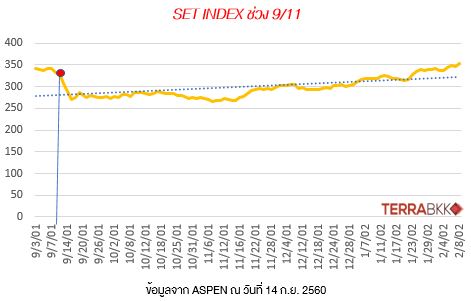
The September 11 Attacks
The September 11 attacks were the most severe terrorist acts in history, involving four suicide attacks against the United States in New York City and Washington, D.C. on September 11, 2001. During this event, the SET index fell from 330 points to a low of 266 points over approximately two months, a decrease of about 19%, before entering a significant upward trend.
The Hamburger Crisis
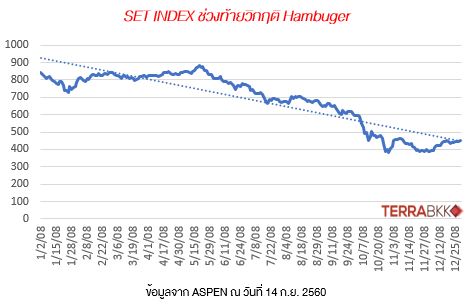
This crisis began with the bursting of the housing bubble in the United States and the default on subprime loans and adjustable-rate mortgages that started around 2005-2006. Borrowers took out loans beyond their means, believing they could restructure their debt. However, restructuring became increasingly difficult as interest rates rose and housing prices fell, leading to a surge in defaults and foreclosures. The financial crisis severely impacted the SET index, which fell from 842 points at the beginning of the year to 449 points by the end of the year, a decrease of approximately 46%.
BREXIT
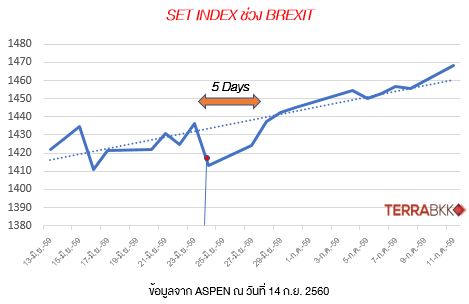
Brexit, a combination of Britain and Exit, refers to the United Kingdom's (often referred to as 'England' in Thailand) official vote to leave the European Union. The direct impact on Thailand is minimal, as only 1.8% of Thai exports go to the UK. However, the indirect effects of Brexit on Thailand may arise from the instability of the EU and the global political economy. The SET index only dropped about 2% the day after the BREXIT announcement and took just five days to return to normal.
Crises in Thailand
May 1992 Uprising
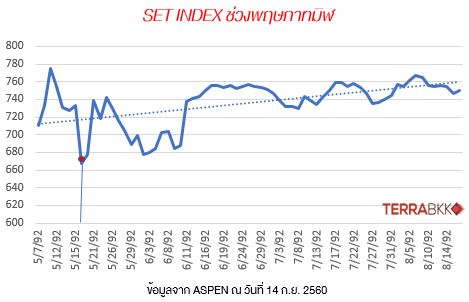
The May 1992 uprising occurred from May 17-19, 1992, following the military coup that ousted Prime Minister Chatchai Choonhavan on February 23, 1991. During those days of unrest, many citizens were injured or killed, causing the Thai stock market to plummet sharply by 65 points to just 667 points from 732 points, before bouncing back by 61 points on May 21, 1992. After the unrest, the stock market remained sluggish but began to recover in September, entering a full upward trend.
The Tom Yum Kung Crisis
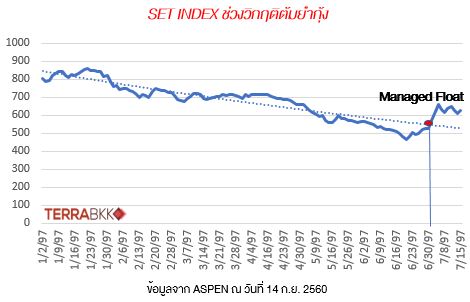
This crisis began with bad debts in the financial institutions, leading to a loss of confidence among depositors and creditors. The Thai baht was heavily attacked as the exchange rate was fixed. On July 2, 1997, it was decided to allow the baht to float under a Managed Float system, and 56 financial institutions were permanently closed. The Thai stock market experienced a prolonged downturn for nearly three years before starting to recover.
Bank of Thailand's 108 Points
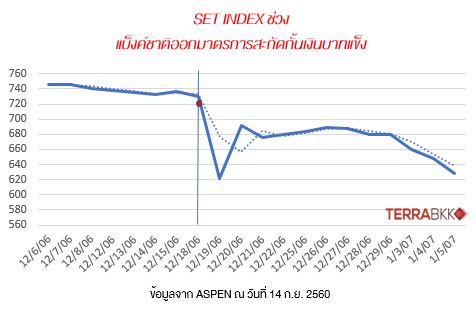
This event occurred when the Bank of Thailand implemented measures to curb the strengthening of the baht by requiring a 30% reserve for short-term capital inflows. This announcement was made on the evening of December 18, 2006, after the market closed, resulting in the Thai stock market dropping to 622 points from 730 points, a decrease of about 15% in one day.
Airport Blockade
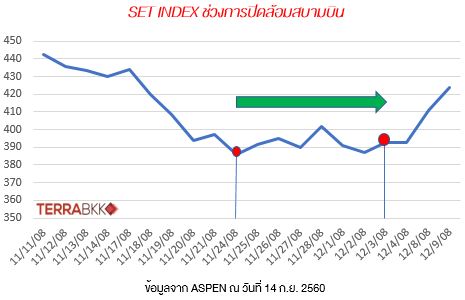
The takeover of airports in Thailand occurred from November 24 to December 3, 2008, when the People's Alliance for Democracy successfully occupied Don Mueang and Suvarnabhumi airports. The event ended when the protests were called off on December 3. Interestingly, the airport takeover led to the SET index starting to recover after being under pressure for a long time, and once the protests ended, the stock market fully entered an upward trend.
Ratchaprasong Terrorist Attack
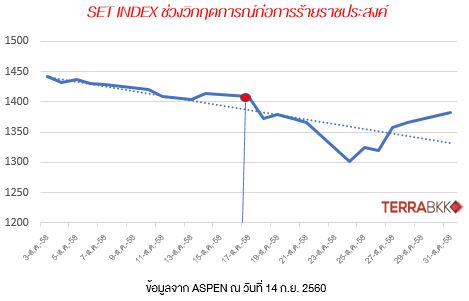
A bombing occurred in Bangkok on August 17, 2015, at 6:55 PM local time at the Erawan Shrine, Grand Hyatt Erawan Hotel, in the Ratchaprasong intersection, resulting in injuries and fatalities. The following day, another attack occurred when assailants threw a bomb from the Taksin Bridge near the Sathorn pier. On August 18, the stock market dropped 36 points from 1408 points to close at 1372 points, eventually falling to a low of 1301 points, a decrease of about 7%. It took about two weeks for the market to recover to normal levels.
We can categorize the ten events based on their impact on the Thai stock market into three types.
Type One: Events with a direct impact on the financial economy
These events cause the stock market to decline for an extended period and begin to recover only when the issues are resolved or addressed appropriately, such as The Hamburger Crisis, Tom Yum Kung Crisis, and the Bank of Thailand's 108 Points.
Type Two: Events that impact the economy but are not direct financial problems
These events lead to a stock market decline that lasts about 2-3 months. The severity of the event affects the degree of the decline. After recovery, the market usually returns to normal or enters an upward trend, such as Black Monday, The Gulf War, and the September 11 Attacks.
Type Three: Events that create panic but do not have a clear short-term economic impact
Such events create panic, causing investors to sell off quickly upon hearing the news. However, the stock market often recovers to normal within a few days, such as BREXIT, The May 1992 Uprising, The Airport Blockade, and the Ratchaprasong Terrorist Attack.
TerraBKK Research believes that each crisis event impacts the stock market in various ways. Events related to the financial economy tend to lead to market stagnation, but not every event causes a significant downturn; some events can indirectly lead to long-term upward trends.