In-Depth Analysis of the "One Belt One Road" Strategy: Is Thailand Benefiting or Losing?
In-Depth Analysis of the "One Belt One Road" Strategy: Is Thailand Benefiting or Losing?
The "One Belt One Road" (OBOR) initiative is one of China's key strategies included in the current five-year national development plan. It connects over 60 countries through land and sea routes, encompassing more than 4 billion people. Thailand is one of the countries that this project passes through. Many scholars are concerned that this initiative will allow China to reap financial benefits solely for itself, while Thai entrepreneurs believe that if the project succeeds, Thailand will directly benefit and help revive its economy...!!!
CG: In-Depth Analysis of the "One Belt One Road" Strategy: Is Thailand Benefiting or Losing?
The One Belt One Road (OBOR) initiative, also known as the 21st Century Silk Road, is a massive global project by China aimed at connecting China to the world, from Asia to Europe, via land and sea. This project was announced by President Xi Jinping nearly four years ago, drawing global attention as China attempts to expand its influence worldwide. The project requires substantial funding, raising questions about its feasibility and risks.
This project could potentially trigger another global financial crisis after the China Construction Bank, the second-largest state bank in China, began raising at least 100 billion yuan (approximately 15 billion USD) from domestic and international investors to support the One Belt One Road initiative.
Globally, interest in the One Belt One Road (OBOR) project has been lukewarm until recently, as it is still in its early stages. However, following the OBOR summit held last May, global attention has shifted towards this initiative, as many are eager to see how China will emerge as a leader in promoting global trade, especially as the United States under Donald Trump adopted an "America First" policy.
Moreover, the OBOR project has been underway for over three years since its initial announcement. A summit of national leaders is essential to evaluate the project's success and its impact on the involved countries. OBOR is a massive global infrastructure project requiring an investment of approximately 1.4 trillion USD, connecting 60 countries across Asia, the Middle East, Europe, and East Africa, affecting 65% of the world's population and impacting one-third of the global economy and one-fourth of global trade.
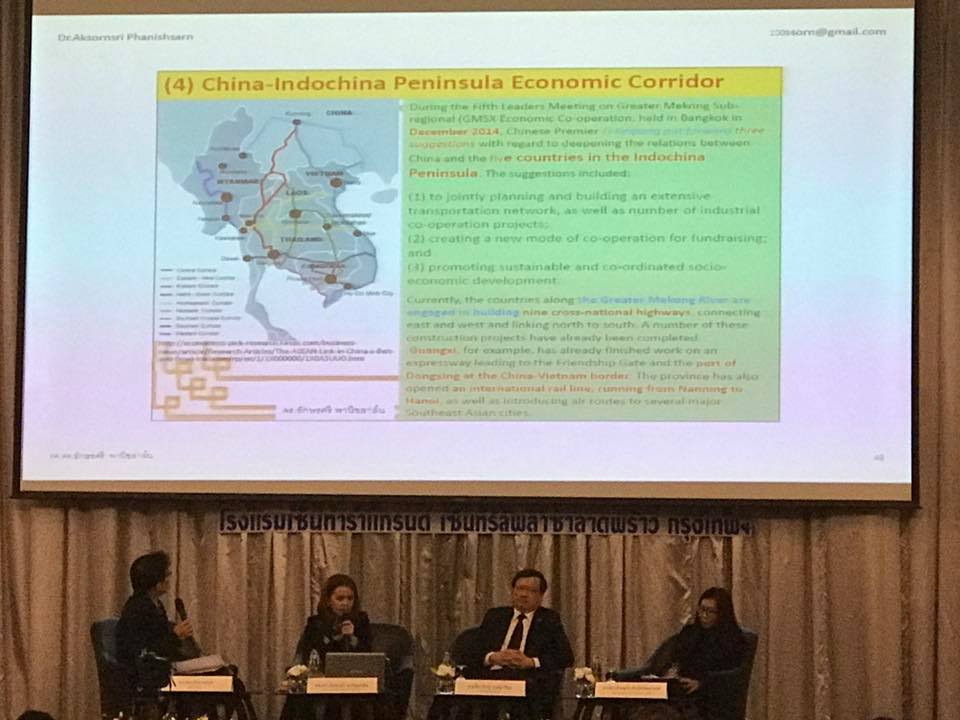
The One Belt One Road initiative consists of six land corridors and one maritime route. The land corridors include: (1) the Eurasian route from western China to western Russia, (2) the China-Mongolia-Russia eastern route, (3) the western China-Central Asia-Turkey route, (4) the China-Indochina Peninsula-Singapore route, (5) the China-Pakistan route, and (6) the China-Myanmar-Bangladesh-India route.
The maritime route starts from China's coastal cities, passing through Singapore, Malaysia, India, and the Mediterranean Sea.
According to Assoc. Prof. Dr. Aksornsi Panitsasan from the Faculty of Economics, Thammasat University, China currently has a railway project connecting Kunming to Singapore, which passes through Thailand. There are plans to invest in Chiang Rai as a connecting point, with one railway line reaching the Isthmus and eventually extending to Singapore. Additionally, a high-speed train will connect with China's economic corridor, specifically the Da Nang area in Vietnam, linking through roads to Tavoy. Thailand has plans to support the economic zone at the Indochina intersection in Phitsanulok to enhance transportation and logistics capabilities. Successful past OBOR projects include the China-Pakistan Economic Corridor valued at 62 billion USD, which includes road construction, railways, and power plants, as well as the 1.1 billion USD Sri Lanka port project, high-speed rail in Indonesia, and industrial estates in Cambodia.
The goal of the 21st Century Silk Road is for China to seek new economic stimuli, as its economic growth has fallen below 8%, and further declines are inevitable. Thus, the OBOR project will serve as a new engine to drive the economy while addressing domestic overcapacity issues, particularly in steel, construction, and building materials, to absorb excess production. At the same time, the Silk Road will support China's energy needs, such as gas pipeline projects in Central Asia and deep-water port projects in South Asia, as China seeks to stabilize its economy in politically volatile Central Asia.
Thai Perspectives on the "One Belt One Road" Trade Route
Mr. Vikrom Kromadit, Chairman of the Thai-Chinese Business Council, believes that the implementation of the OBOR project, along with the establishment of the Asian Infrastructure Investment Bank (AIIB) and the Silk Road Fund, demonstrates that China is ready to emerge as a global and regional superpower peacefully. The OBOR project, which passes from Laos into Nong Khai province and continues to the Gulf of Thailand, with the destination at Laem Chabang, will provide Thailand with direct benefits in terms of food consumption, energy, accommodation, and machinery spare parts for maintenance. In terms of transportation, it is believed that expansion will reduce unit costs and lead to the growth of the transportation system in Thailand to meet increasing demand from China.
Thus, Thai entrepreneurs must adapt and study Chinese consumer preferences for Thai products to present those products effectively while developing raw materials into new goods that meet the continuous demands of Chinese customers. The government must expedite the development of the Eastern Economic Corridor (EEC) to completion, enhancing infrastructure such as road expansions, deep-water ports, airports, and power plants to support Chinese investment routes. If these projects succeed, they could drive Thailand's economic growth by about 5% per year in the future. However, Mr. Vikrom cautions that Thailand must be wary of environmental issues and waste associated with industries, as well as the import of certain products from China, such as steel and machinery, which may impact Thai companies.
Dr. Phitsanu Rianmahasan, advisor to the Minister of Commerce and consultant at the Institute of Management and Innovation, states that OBOR will benefit Thailand economically and strengthen trade relations with China. However, Thailand should proactively open its market to welcome more Chinese investors to replace Japanese investors, who are currently declining in both economy and technology. For instance, the government could analyze new economic corridors beyond the EEC, connecting routes to the Gulf of Thailand and the Andaman Sea to attract Chinese investors, extending to India, Africa, and Europe.
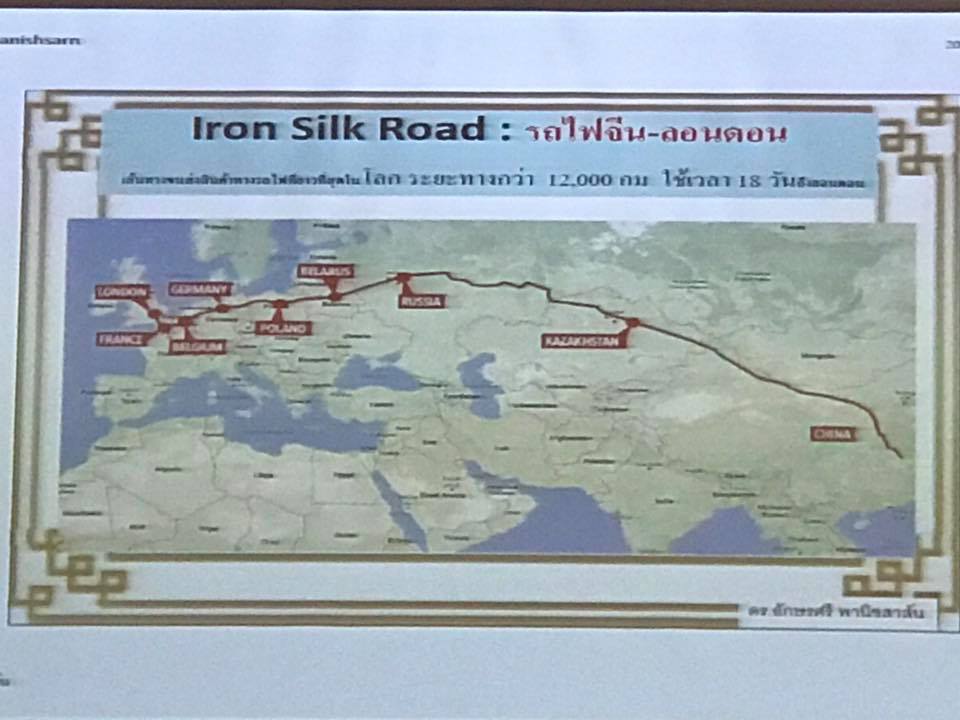
Ms. Kanyapak Tantipiphatpong, President of the Thailand Shipowners Association, notes that OBOR will not negatively impact maritime shipping and will enhance Thailand's logistics system. OBOR will serve as a route from Central Asia to the East, which is believed to not only have no adverse effects but also help open markets for Thai entrepreneurs to export more to African countries. Currently, exports from Thailand to European countries can still be shipped by sea as usual, taking about 21 to 30 days, while exports from China by rail from Chengdu to Europe take about 18 days.
Mr. Kraisinth Wongsurakrai, Secretary-General of the Thai-Chinese Business Council, believes that the OBOR project will not allow China to solely exploit benefits from other countries unless those countries permit it, as seen in some African countries like Kenya and Ethiopia, which urgently need rapid infrastructure development. Thailand must assess the benefits it can gain from joint ventures with China, including negotiation channels to ensure clear agreements between both parties. Thailand will benefit from direct connectivity within the CLMVT group, enhancing trade and investment in the region for better growth. Additionally, utilizing maritime routes will help mitigate disputes between China and other countries.
Professor Wiroj Tangwanit, an expert in Chinese language and culture, states that China's large population serves as another weapon for the country, in addition to being a superpower. This leads some countries, like Laos, to restrict Chinese investments to prevent excessive population and investment expansion. In terms of business in Thailand, it is perceived that Thai people do not need to make significant adjustments, as they are not afraid of Chinese competition, since most Chinese will settle in Thailand and have a fondness for the country.
Ultimately, it seems that the Silk Road project in the 21st century could bring significant benefits to Thailand in various aspects. What remains to be seen is the establishment of equitable agreements that create value in investments between Thailand and China, as China strives to elevate and transform its economy by leveraging its role in global economic development and funding to encourage countries to use Chinese-produced goods, such as high-speed trains, power generation equipment, and communication devices along the OBOR routes. Moving forward, it will be crucial to monitor how the more than 60 countries along the OBOR routes will absorb China's excess industrial capacity and how the "One Belt One Road" will facilitate borderless global trade.
--- Special Report by TERRABKK