Why is 'Ekkamai' Classified as Central Sukhumvit?
When we talk about Sukhumvit Road, it stretches all the way to Trat province, covering a distance of over 488 kilometers! However, nowadays we only refer to 'Sukhumvit' within the city, such as around Asoke, Phrom Phong, Thonglor, and Ekkamai. Even when considering just the urban area, it is still a considerable distance. Thus, we categorize Sukhumvit into three sections: the beginning, the middle, and the end. If we measure true development, the beginning and middle sections of Sukhumvit are the main areas, serving as genuine hubs for business and community. But have you noticed that every time the central Sukhumvit zone is divided, everyone readily includes 'Ekkamai' in central Sukhumvit? Sometimes we cut it off at Phra Khanong, and other times at On Nut, even though they are only a few sois apart. Of course, Ekkamai's uniqueness lies in its proximity to Thonglor, just 500 meters apart, with connecting sois like Thonglor Soi 10 and Soi Jaem Chan, which is why Ekkamai has always been associated with Thonglor.
From 'Phrom Phong' to 'Ekkamai'
When discussing the locations in the beginning and middle sections of Sukhumvit, many people envision a prime area filled with shops, restaurants, cafes, services, and luxury residences. It is well-known that the beginning and middle sections of Sukhumvit have traditionally been the residences of Thailand's wealthy and prominent families, and Ekkamai has been recognized as part of central Sukhumvit. TerraBKK Research believes this is due to three main factors occurring simultaneously.
1. Transportation and Access to Amenities
The Sukhumvit area has a connected network, with the main road being Sukhumvit Road, linking various districts together, while secondary roads, known as Sukhumvit sois, connect to other roads like Phetchaburi and Rama 4. However, one drawback of Sukhumvit is that most minor sois do not connect with each other, leading to clear divisions between zones such as Asoke, Nana, and Phrom Phong. But for Sukhumvit Soi 55 (Thonglor) and Soi 63 (Ekkamai), there are connecting sois, namely Thonglor Soi 10 and Soi Jaem Chan. This gives both areas an advantage, allowing them to access amenities more easily than other Sukhumvit sois.

2. The Expansion of Condominiums from the Beginning of Sukhumvit to Ekkamai
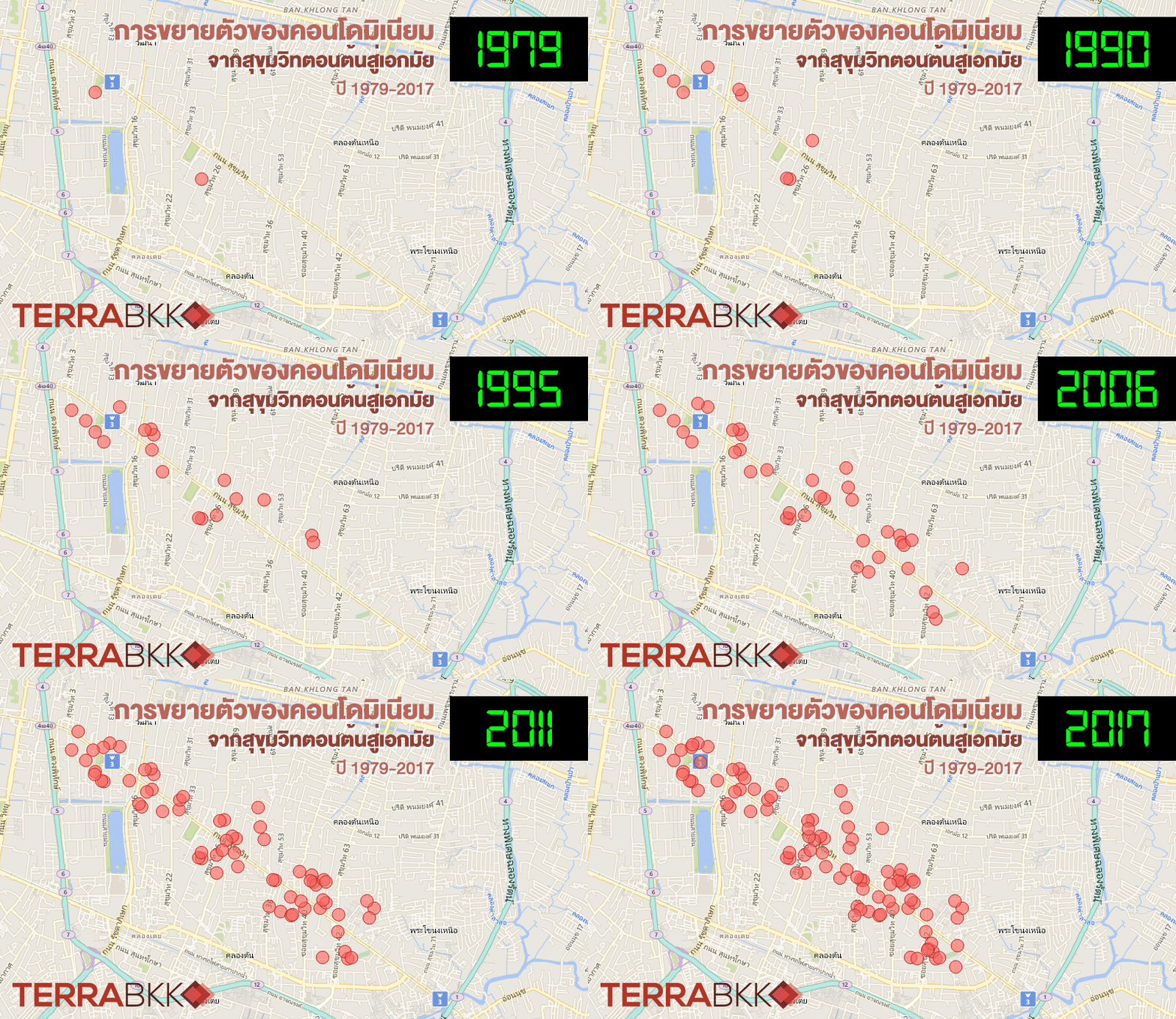
Looking back 20 years ago, when the BTS first opened, it was not yet the boom period for condominiums. At that time, condominiums were primarily concentrated in the city center. The image below shows that previously, condominiums were only found in the beginning of Sukhumvit, not extending much beyond Phrom Phong. However, as of 2017, with the BTS expanding beyond the city center along the train lines, existing properties have seen price increases, and new developments face challenges due to limited available land. The only option is to expand along the BTS lines from Phrom Phong towards Thonglor and Ekkamai. Therefore, it is not surprising that the zoning of Sukhumvit may change over time based on suitability.
From the image below, it can be seen that condominiums began to spread to 'Ekkamai' about 10 years ago and have continued to see supply added, while the beginning of Sukhumvit has started to slow down due to limited land availability. Currently, 'Ekkamai' has very little vacant space left, especially on the southern side (the side adjacent to the BTS), which appears to be particularly dense.
3. Land Appraisal Prices Growing by 50%, Comparable to Thonglor
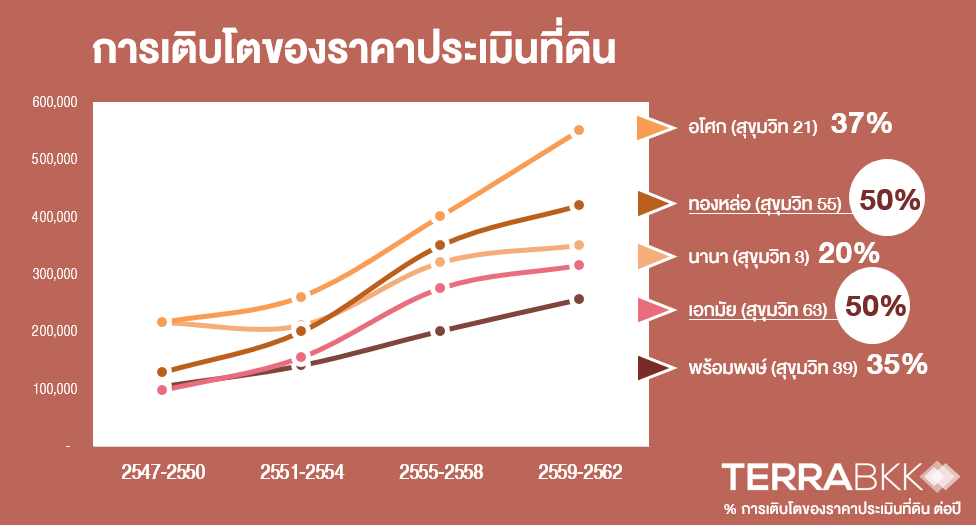
Another factor that strongly supports the growth of 'Ekkamai' is the land appraisal prices from the Treasury Department. When comparing important sois on Sukhumvit Road, 'Ekkamai' is not lagging behind other sois. In fact, the growth of land appraisal prices in 'Ekkamai' is said to be the fastest among other sois.
The graph shows that initially, the land appraisal price of Ekkamai from 2004-2007 was close to that of Phrom Phong, but in recent years, the price of Ekkamai has rapidly increased, nearing that of the beginning of Sukhumvit, such as Nana. Meanwhile, the growth rate of land appraisal prices has reached 50%, comparable to Thonglor. This indicates a significant upward trend.
Additionally, there are many other important variables, including projects from both public and private sectors, as well as the characteristics of the residents in this Sukhumvit area, to emphasize the centrality of Sukhumvit and prepare for its evolution into the beginning of Sukhumvit.
Development and Revitalization Projects in Thonglor-Ekkamai by UDDC
One of the pilot areas for development and revitalization that the Urban Design and Development Center (UddC) is collaborating on with Bangkok Metropolitan Administration sees the Thonglor-Ekkamai area as having potential in various aspects, including being a connecting point with central and outer Bangkok, as well as being an area with diverse economic activities. The development and revitalization approach for the Thonglor-Ekkamai area involves improving the road network to enhance connectivity, designating areas to promote development, increasing green spaces, and improving the appearance and accessibility of the canals. In the future, we will see Thonglor-Ekkamai emerge as a creative business district that sets trends for the city, a densely populated residential area, and an international job hub, along with walkability and a supporting feeder system.

Who Lives in Ekkamai?
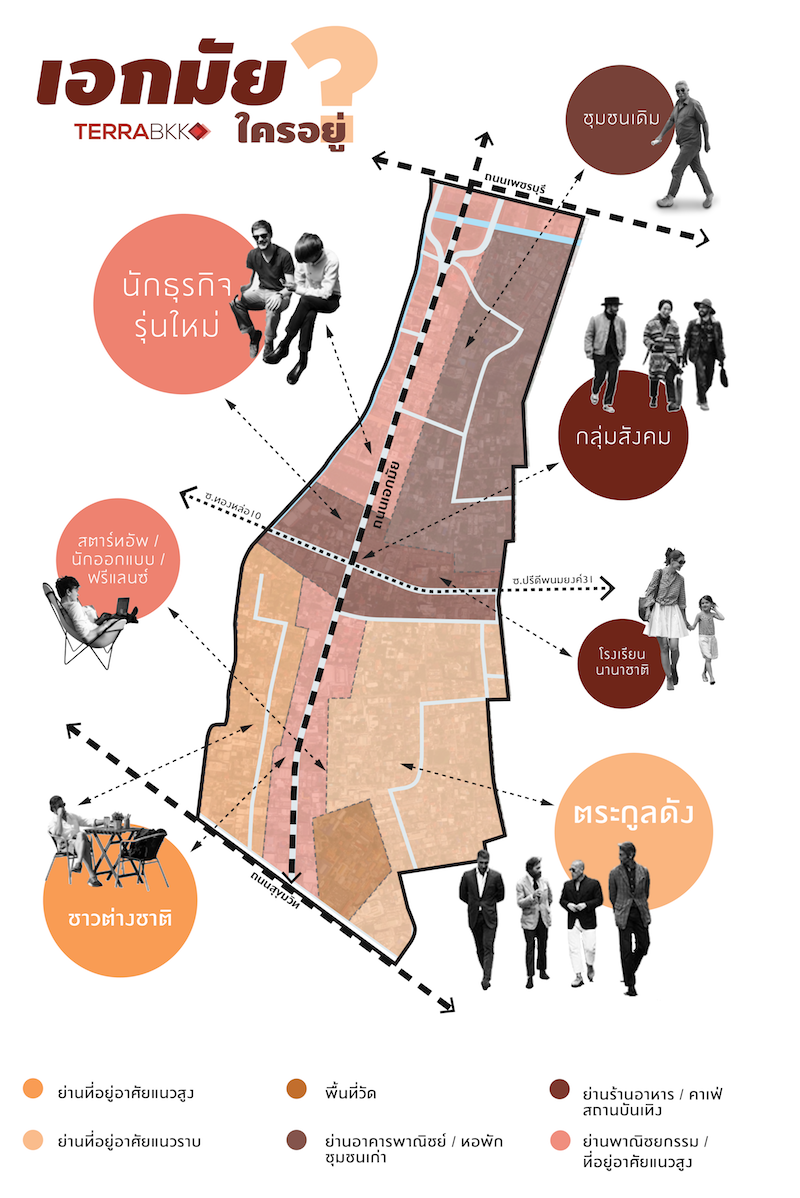
When comparing the differences within Ekkamai Road to categorize land use types, we find slight variations, which can be classified into six types of land use: high-rise residential areas, temple areas, restaurant/cafe/entertainment areas, commercial buildings, dormitories/old communities, low-rise residential areas, and commercial/residential mixed-use areas.
Central Ekkamai The vibrancy of Ekkamai Road clusters around Central Ekkamai (the intersection of Soi Ekkamai 12 - Soi Thonglor 10), where restaurants, clubs, and cafes popular among Bangkok residents are grouped together. Due to its connectivity with Thonglor and Soi Pridi Banomyong 31, Central Ekkamai serves as a hub for activities and a hangout spot.
Southern Ekkamai has a high density of activities due to its proximity to the Ekkamai BTS station, making it easy for people to circulate. However, areas not adjacent to Ekkamai Road can be divided into high-rise residential areas in Soi Setthabut and low-rise residential areas in even-numbered Ekkamai Soi, which are primarily residences of traditional wealthy families.
Northern Ekkamai leans towards Phetchaburi Road and can be divided into two sides. The odd-numbered Ekkamai side is relatively lively, as it features visible restaurants and services, connecting with Thonglor. In contrast, the even-numbered northern Ekkamai side sees less development within the sois, as they are narrow and do not connect, mostly consisting of old communities, commercial buildings, and rental apartments.
'Ekkamai' is a Worthwhile Investment
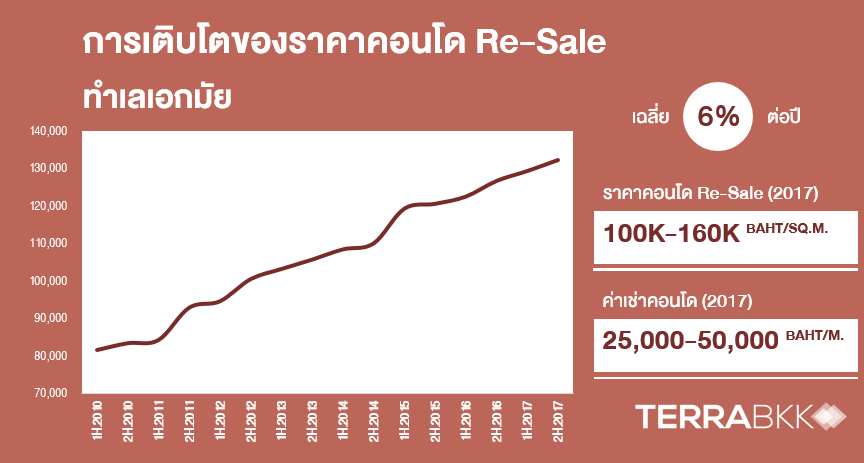
Ultimately, all that has been said would be of little value if we simply state that 'Ekkamai' is part of the central Sukhumvit zone. What we are trying to convey is that the zoning of Sukhumvit reflects development, urban changes, and the gradual expansion of Sukhumvit Road towards Ekkamai, impacting the changes in prices and rental rates. When TerraBKK Research looked back at the changes in resale condominium prices, they found an average growth of 6% per year, with some projects exceeding 10% per year.
For those considering purchasing for rental purposes, the minimum rent in Ekkamai starts at around 15,000 baht per month. However, the average rent across the entire zone is approximately 25,000-55,000 baht, yielding returns of 4-6% per year. The prices of condominiums in this area are still considered attractive for investment, as Ekkamai serves as a connecting point between central and outer Sukhumvit, keeping condominium prices relatively reasonable. Second-hand condos can still be found at around 100,000 baht per square meter, making 'Ekkamai' an interesting location for investors, particularly focusing on foreign tenants, especially Japanese, who are regarded as grade A tenants.
At one point, the TERRABKK team interviewed Japanese residents in Thailand about their choice to live in the Ekkamai-Phra Khanong area. It was found that Japanese people prefer this zone due to the lower cost of living compared to Phrom Phong and Thonglor.
From all these images, TERRABKK believes that one day 'Ekkamai' may evolve into the beginning of Sukhumvit, with other factors such as shopping and business hubs driving the area closer to being considered 'inner Sukhumvit' - TERRABKK
Article by: TerraBKK Knowledge Base
TerraBkk: Find quality homes at affordable prices