CONSTRUCTION TECH: Transforming the History of Thai Construction with Unexpected Steps of a New Business Model
In-depth with Phait Phadungthin of Builk.com, the pioneer of Thai construction history
The B2B App Idol with unexpected advancements in a new business model
It seems like a long journey from the starting point when we talk about “Boat” Phait Phadungthin, the founder and CEO of Builk Asia, who has created a new chapter in the online construction business as the first in Asia with the Builk.com platform, a free cost estimation software for construction businesses, and the founder of the Thailand Tech Startup Association, where he currently serves as an advisor.

The Era of Transition to Industrial Tech
Today, “Boat” Phait has branched out into various businesses, expanding his pioneering model into B2B e-commerce under the YELLO brand, an online construction materials store, and the Conmat Supplier business named JUBILI, a sales and customer relationship management system for construction material stores, which gained fame from viral ads on the popular page “Jae Joo.” He has also taken on the role of Startup In Residence at the modern real estate company Ananda Development Public Company Limited, and has jumped into enhancing the real estate sector by developing apps to assist in sales and facilitate residents’ living (Sale & CRM App) with charmingly named apps like ‘Ploy’ and ‘Kwanjai.’
“The construction industry often talks about this being the era of Industrial Tech. Previously, we discussed IoT (Internet of Things), but today we talk about IIoT (Industrial Internet of Things). Nowadays, water pumps in buildings no longer require personnel for inspections; instead, we focus on how to enable real-time data transmission. Excavators can almost drive themselves because in America, people are reluctant to work in construction and prefer jobs that offer a better quality of life. Therefore, construction sites must rely on machinery to replace labor,” Boat explains the real situation where technology plays a crucial role in the construction industry.
The success of branching out ‘flowers’ from the ‘fruit’ of products and business models under this man's ideas did not come from luck or winning the lottery, but rather from a series of bold experiences, starting from his leap into contracting at the age of 23 before transitioning to developing ERP software for construction businesses, facing numerous ups and downs before finding his footing.
Despite having many storefronts, if we speak the startup language, all of this constitutes an ecosystem based on the traditional business that Boat is most familiar with and excels in, which is the construction business.
For those unfamiliar with the construction industry, let me briefly introduce the starting point of Builk: what it is and how it has transformed the construction sector.
“We once gathered data showing that in a construction project, contractors must contact at least 40 external individuals and agencies, including owners, managers, engineers, structural design teams, electrical designers, plumbing designers, subcontractors, and suppliers. This is the risk of this business because we are borrowing the noses of 40 people to breathe. This often leads to construction projects being delayed and exceeding budgets by about 20%. This is a problem that people in the construction industry have become accustomed to,”
“Risk is something everyone in the construction industry faces. Project owners have risks that affect contractors and suppliers at every step. If payments are delayed or defaulted, it leads to increased prices and credit terms, adding about 1.5% per month as a buffer. When everything in the supply chain is padded to mitigate risk, real estate construction becomes inefficient. What we do is find ways to create or implement technology to solve this, and collaboration is another method we use to help reduce inefficiencies,” the founder of Builk illustrates the industry's challenges from firsthand experience.
Builk is an extension of the ERP software that Boat started in 2005. Initially, the ERP system was primarily used by large construction businesses. However, in reality, construction businesses of any size should have good backend management. Boat thus shifted to develop an ERP system that caters to a larger market (Mass Market), targeting SMEs in the construction sector, leading to the pioneering of Builk, a cost control system that is free to use along with its features.
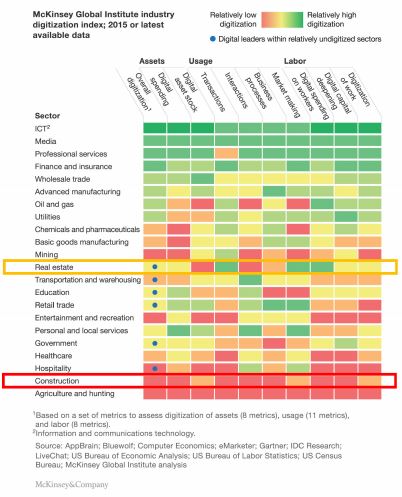
“THE CONSTRUCTION INDUSTRY IS AMONG THE LEAST DIGITIZED.”
-McKINSEY & COMPANY
From that point, Boat opened a new world, meeting investors and experts who coached him in business, creating a pathway to be invited to join the 500 Startup Accelerator program in Silicon Valley with leading Tech Startups for four months, marking a significant leap that fostered growth for Builk.
“In the startup world, there is a discipline called Growth Hacking, which focuses on how to achieve rapid growth. I tried to follow that model, but it didn’t yield results. Spending over a hundred thousand baht a month on advertising to attract customers yielded little response because we are a business app, and there were no examples of B2B apps in Thailand. Then I met the founder of Trulia, a leading real estate platform in America. He taught me that there is no Growth Hacking in B2B; what you need is Hand Shaking and Networking. When Trulia was not yet growing, this founder traveled to meet real estate associations in every city, flying in the morning and returning in the evening, just to build a strong network,”
“I believe in that approach. When I returned in 2014, what I did changed significantly from four years prior. I engaged heavily in offline activities, acting like an event company, traveling nationwide to talk with construction and real estate business owners, and opened training courses on how to use Builk. I needed to prove myself to event companies and leverage the power of corporate partners to grow. I started negotiating with banks, suggesting that the data I had accumulated could help their clients operate more systematically, making it easier for banks to lend to construction businesses. When banks fully supported this idea, they offered to reduce interest rates by 1% for Builk members, and that year, I grew 4-5 times,”
This demonstrated the company’s portfolio and service areas on the website for clients to view, along with a construction materials system linked to construction material stores, allowing for price requests and specifications to be shared via the website. Additionally, there was a project cost management system for budgeting, purchasing, profit and loss management, and cash flow management, enabling updates and information sharing with all relevant parties, including selecting quality contractors and continuously delivering work to members. With the comprehensive system for construction business operators, Builk has thus fostered a community of construction professionals.
Decoding the B2B App
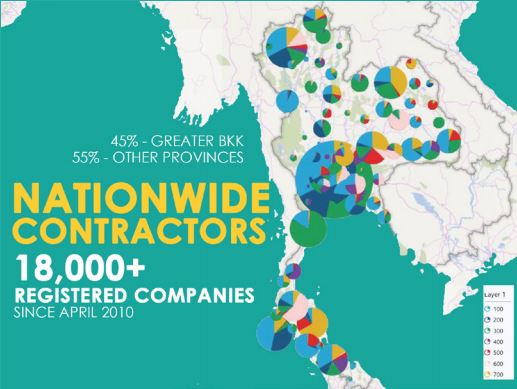
It took time for Builk to reach over 18,000 construction company members nationwide, with more than 40,000 users, reducing costs for construction businesses and managing projects worth tens of billions of baht annually, gaining attention as a case study from TDRI (Thailand Development Research Institute). All of this was not easy; it involved years of trial and error.
The first two years of Builk’s establishment had no revenue. Even though it was free to use, there were few users. They solved this by continuously organizing training sessions until they began to attract advertisements from organizations and businesses. However, this was still not a sustainable revenue stream. Eventually, a significant turning point came when “Boat” returned to rectify his previous failure in expanding the business to Vietnam. In 2012, he revisited the market to expand Builk’s user base and encountered a business plan competition related to startups and investor meetings. Although “Boat” graduated in civil engineering from Chulalongkorn University and was familiar with business competitions, he knew little about startups. Nevertheless, he jumped in to compete and was selected to represent Vietnam in the final presentation at Echelon, the largest Tech Startup competition in Asia, held in Singapore. Builk won first place in 2012 because, at that time, no one had created a free program in the construction industry before.
Innovating Ideas and Upgrading Business Models
Similar to other startups, they often do not know where their business model will end, as it may not have a definitive endpoint. Since all processes of Builk members must be conducted through the website, all data is categorized as Digital Data. Builk can analyze every aspect of the construction industry, from predicting the demand for steel in the next six months, which will benefit Modern Trade by allowing them to stockpile or increase production, to analyzing which Modern Trade brands are currently selling well and which regions of the country are experiencing growth in construction business.
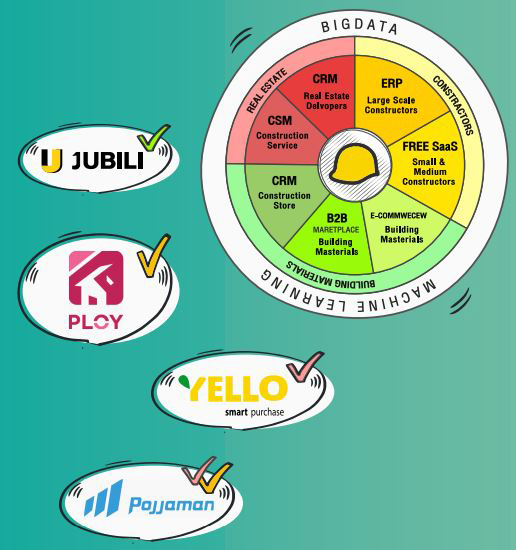
This led to a new platform for “Boat” that goes beyond just selling “Analyzed Data” but also ventures into e-commerce under the YELLO brand, an online construction materials store, and the Conmat Supplier business named JUBILI, which gained traction from the viral story “Jae Joo Construction Materials” (a symbolic name for small construction material stores). “Once I started analyzing data, our revenue increased significantly. Currently, 95% of our income comes from e-commerce because the system can analyze supply and demand. For instance, I know there is a demand for steel for our Builk members’ projects, so I request steel from factories to sell at special prices, adding only a small profit margin but offering special privileges or discounts to Builk members. By aggregating orders from over ten thousand members for the factories, along with orders from stores, we achieve Economy of Scale, allowing us to obtain products at lower prices, and the factories handle the logistics, saving customers on shipping costs.”
Although everything seems to be in place, Boat admits there are still limitations, as they cannot fulfill every order. One of the obstacles is that YELLO and JUBILI cannot handle deliveries themselves. A good solution is to find partners to help distribute products and serve as storage points, leading to the idea of creating the viral story “Jae Joo Construction Materials” to find small construction material stores to help distribute our products. In simple terms, Jae Joo is like the Airbnb version for construction material stores.
A Commitment to Elevate the Construction Industry
“When we launched the campaign “Jae Joo Construction Materials,” it became very popular, with construction material stores reaching out to us, asking how to sell online. They had tried but failed. We saw that we could help them compete with Modern Trade. I view this as a survival strategy for both us and them. I’m not the owner of a construction material store, but I see them as Airbnb because these stores have warehouses and trucks that are not fully utilized. We just need to make these resources beneficial, helping us with deliveries, which increased our sales from 100 million to 500 million.”
The phenomenon not only boosts sales for all parties but Boat’s intention goes further, aiming to facilitate this industry through strategies that enhance efficiency and reduce risks using Data Analysis. With the data Builk has, we can analyze how reliable a contractor is, allowing store owners to avoid risks.
“Credit Scoring is a system we developed, similar to a living bureau. We have collected this data for 7 years, ranking contractors among over 18,000. Therefore, if someone is looking for a contractor to build a loft-style house in Chiang Mai, I can tell you who the top 3 A-grade contractors are. Homeowners won’t have to take risks. When contractors go to buy materials, they can purchase from construction material stores or Jae Joo members in Chiang Mai. I believe this will drive the industry forward,” Boat’s forward-thinking mindset has led his business to expand into markets in Indonesia, Laos, and Myanmar, especially in Myanmar, where Builk has established an office named Builk Myanmar Construction Academy, which has received a very positive response as Myanmar is awakening to seek new knowledge to enhance its construction industry.

New Challenges on the Real Estate Road
The extensive experience of this man is reflected in the business model he pioneered, leading to a transformation in the Thai construction industry. It is no surprise that he has been approached by leading real estate companies like Ananda Development to take on the role of Startup In Residence, marking a leap from construction to real estate. This not only presents new challenges but also opens new perspectives and ignites a greater passion for learning in Boat.
Builk’s dynamic working style suggests that Boat is unlikely to stop here, as he does not see himself merely as an app in the construction or real estate tech sector. There are many technological trends that will come to transform the current standing in ways that are unpredictable. Therefore, the future of Builk still has many paths to explore, which we must keep an eye on.
Thanks for the information from: HINT MAGAZINE