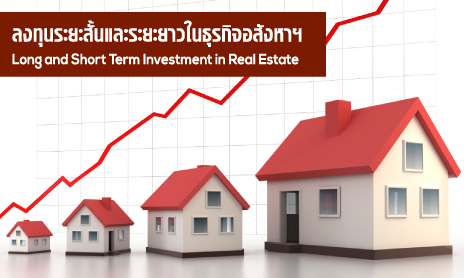
Short-term and Long-term Investment in Real Estate
Real estate is a high-investment, high-return, and high-risk business. Investing in real estate can be done in various ways, and we categorize investors in real estate based on the duration and purpose of their investment into two main types:

1. Short-term Investment
This type of investor is also known as a speculative investor. They reserve a condominium or a new house project and sell it at a higher price when the project is nearing completion, but at a lower price than buying directly from the project (typically, the closer the project is to completion, the selling price increases by 5-10%). This type of investment requires less capital than long-term investments. For example, if a condominium costs 1.5 million baht, the expenses would include reservation fees + contract fees + down payment totaling 75,000 baht. If the investor aims to profit 50,000 baht from selling the reservation, the buyer would need to pay 125,000 baht for the reservation. Thus, the seller can achieve a return on investment (ROI) of up to 66%.
Seeing such numbers may attract many, but consider for a moment that “selling a condominium reservation carries risks equal to the potential profits.” If a buyer cannot be found, the investor may have to sell at cost or even lower. Additionally, if the economy is poor during the selling period, finding a buyer becomes difficult. To avoid losses when selling a reservation, various factors must be considered:- Prime location in the area, and the project must pass the Environmental Impact Assessment (EIA).
- Sold out within a year The total reservations or sales of units or houses in the project must be sold out within one year.
- Low reservation fees and down payments The reservation or down payment should not exceed 5-10% to ensure profitability and to avoid high-risk investments.
- Sell before the building is completed Since imagination is often more beautiful than reality, the completed building may not resemble the show unit. Additionally, there will be competition from other speculators offering a variety of units, giving buyers more choices and making sales more challenging.
- Sell during an uptrend The decision to buy or the completion of the building is likely to occur during an economic uptrend, as people will have purchasing power and prices will be favorable.

2. Long-term Investment
This type of investor operates under the belief that the population is increasing while the land resources remain the same. Investing in real estate for residential purposes will appreciate in value, outpacing inflation, making it a safe asset investment. This type of investment has two main sources of income:
Profit from asset sales (Capital Gain) This profit is realized only when there is a buyer for the asset, and the following principles must be considered:
- Trends in land development or land use in the desired location, which is an area where people are interested in moving in, conducting business, or passing through.
- Condition of the building or structure to assess its value at the time of sale.
- Choose the right time to sell A sale is considered profitable when it can be sold for more than the total cost of purchase plus interest paid, with a target profit of at least 6% per year (IRR=6%) (this is sufficient to outperform deposit interest rates and surpass returns from bonds).
Rental income (Dividend Yield)
This type of income is considered steady profit, suitable for those who purchase the asset with cash or borrow the least amount possible. On average, rental returns are close to the bank loan interest rates, approximately 5-7% in general locations and 10-15% in popular areas. Locations worth investing in typically have three characteristics:
- Proximity to advantageous locations such as offices, businesses, and educational institutions.
- Convenient transportation located in areas with good public transport systems, including buses, piers, and rail transport such as trains, subways, and sky trains.
- Low crime rates ideally with minimal history of break-ins, manageable through effective security systems.