Public Parks and an Aging Society: Designing Urban Spaces for the Elderly in Bangkok
Thailand is entering the era of a "Complete Aged Society," where over 20% of the population is aged 60 and above. According to data from the Department of Older Persons as of February 2026, the proportion of elderly in Thailand stands at 21.99% and continues to rise, reflecting a significant demographic shift. Provinces such as Lampang, Phrae, and Lamphun have the highest proportions of elderly at 28.01%, 27.46%, and 27.37%, respectively. In contrast, Bangkok has an elderly population proportion of 24.43%. Given this trend, it is projected that by 2030, Thailand will transition into a "Super Aged Society" with over 28% of the population being elderly.
This demographic change impacts economic, social, and urban planning dimensions, particularly increasing the burden on the working-age population, which may affect family dynamics and leave some elderly individuals without care or emotional support. Additionally, the elderly may experience feelings of loneliness, worthlessness, or being a burden, leading to mental health risks such as depression and other health issues, especially in cases of financial insecurity, which further increases vulnerability and raises the demand for health and welfare services, ultimately leading to long-term budgetary burdens on the government.
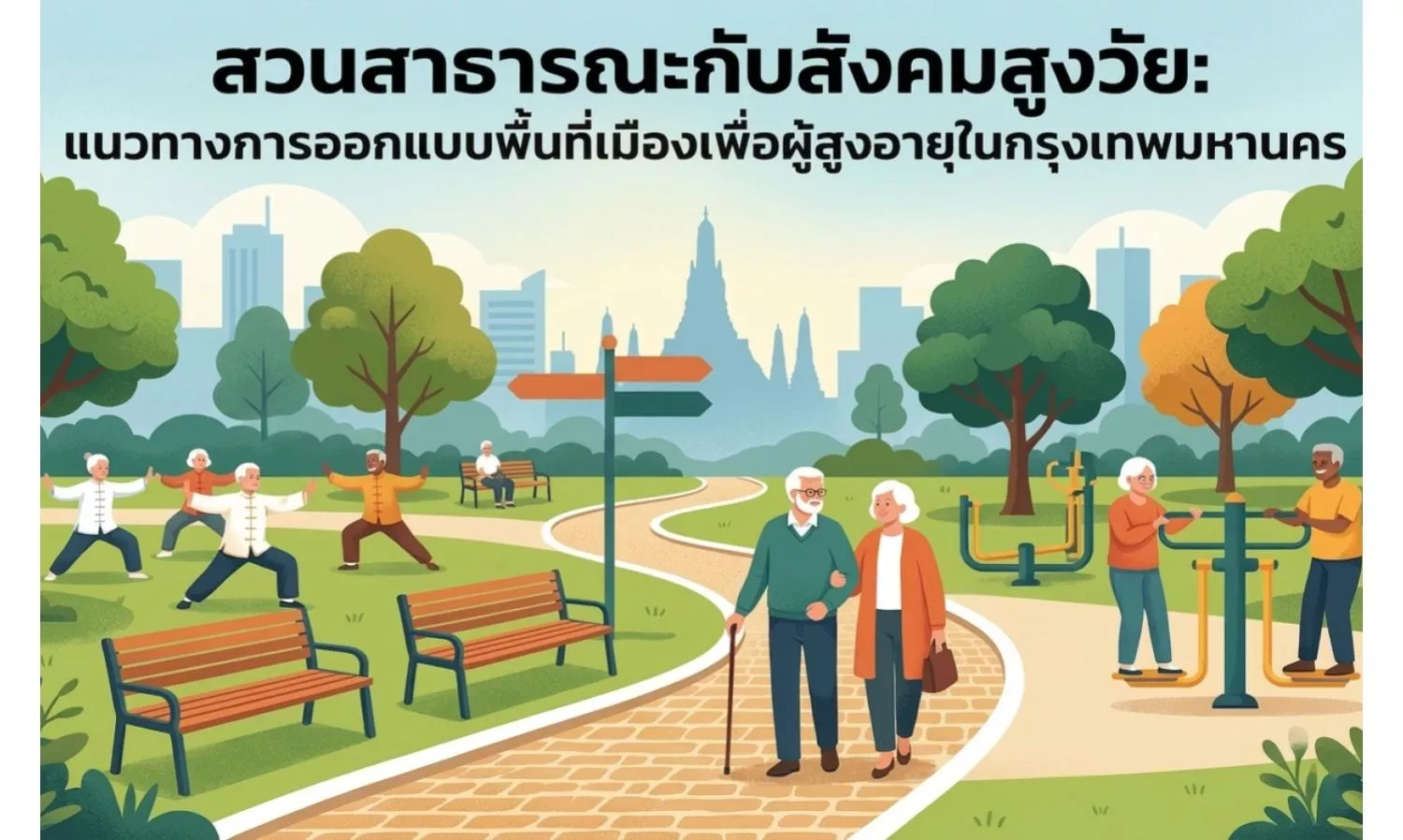
In this context, "public parks" are crucial urban elements that directly enhance the quality of life for the elderly by promoting physical health, providing mental relaxation, and fostering social interactions. Studying the behavior of elderly individuals in using public parks, particularly in major urban areas like Bangkok, is vital for generating empirical knowledge to support the design and development of age-friendly cities sustainably.
Currently, Bangkok has approximately 40 public parks covering an area of 5,755,520 square meters, serving a population of 5,422,567, which translates to only 1.06 square meters of park space per person. This is significantly below the World Health Organization's (WHO) minimum standard of 9 square meters per person, indicating a clear inadequacy of public park space to meet the needs of the population, especially the elderly. Despite numerous studies showing that suitable parks can significantly enhance both physical and mental well-being for the elderly by encouraging physical activity, reducing sedentary behavior, improving mental health, and promoting social interactions, elderly individuals in Bangkok still represent a relatively small proportion of park users.
Research into the characteristics of parks that encourage greater use by the elderly is essential for guiding policymakers, designers, and developers in enhancing public parks in Bangkok to effectively meet the needs of the elderly. This involves analyzing environmental factors related to park usage across seven dimensions: accessibility, activity diversity, seating arrangements, temperature and weather conditions, aesthetics, safety, and social interaction. Interviews with 299 elderly individuals revealed that the majority (66%) prefer public parks over semi-public spaces, such as areas around shopping centers or mixed-use buildings. Most users are male, spend an average of less than one hour per visit, prefer to travel by private car, and often visit alone for exercise and various activities within the park.
When considering factors influencing elderly park usage, "accessibility" emerged as the most critical factor. Many elderly individuals reported that walking or using public transport to access parks lacks convenience and safety, leading them to rely primarily on private cars. Infrastructure issues, such as discontinuous sidewalks, unsafe crossing points, and a lack of clear navigation systems, pose significant barriers to public space access for the elderly.
Moreover, factors such as activity diversity, seating arrangements, aesthetics, safety, and opportunities for social interaction significantly influence the decision to use public parks. Parks that provide a calm, shaded atmosphere with ample seating and effective security measures, such as surveillance cameras and attentive staff, encourage elderly individuals to spend longer periods in parks (more than one hour) and are more likely to return. Conversely, parks that emphasize commercial elements, such as numerous food or beverage outlets, do not attract elderly users, indicating that public space design should prioritize meeting basic needs for exercise, relaxation, safety, and social interaction over commercial development.
Based on the study's findings, recommendations for urban planners and public park designers to better accommodate the elderly in Bangkok and other provinces include:
Firstly, prioritize developing convenient and safe access to public parks in all aspects, including walking, cycling, and public transport, alongside providing sufficient parking for elderly individuals who still need to use private cars. Additionally, improve access routes to parks to ensure they are user-friendly and safe by designing effective wayfinding systems, such as directional signs, distance markers, and landmarks to enhance confidence in accessing and using the spaces.
Secondly, park designs should focus on creating a calm, shaded, and relaxing atmosphere to serve as a restorative space for the elderly. This can be achieved by increasing green areas, establishing quiet zones, and providing appropriate and comfortable amenities.
Thirdly, developing parks solely to attract tourists or for photography may not significantly promote usage among the elderly. Therefore, it is essential to emphasize physical activities, social activities, and appropriate recreational activities to motivate ongoing usage.
Finally, designing spacious, comfortable, and high-quality open areas is crucial for attracting elderly users, as it facilitates meaningful social interactions. Coupled with organizing diverse activities that align with the needs of the elderly, this will enhance the appeal of public parks and promote long-term usage.
The results of this study can also be applied to the design and development of semi-public spaces in various real estate projects, particularly those catering to elderly users, both in residential and commercial sectors, which increasingly prioritize the allocation of communal spaces to align with the context of an aging society in the future and adequately respond to the needs for living, well-being, and social interaction.
Research Article
Pongprasert, P. (2025). Creating Inclusive Public Parks: Identifying Park Features That Encourage Elderly Visitation in Bangkok, Thailand. Journal of Environmental & Earth Sciences, 7(6), 138–147. https://doi.org/10.30564/jees.v7i6.8283