Systems Thinking: A Mindset to Conquer a Rapidly Changing World
In the VUCA era (Volatility, Uncertainty, Complexity, Ambiguity), our world is changing rapidly and becoming increasingly complex due to various factors, including rapidly advancing technology, shifting consumer demands and behaviors influenced by technology usage, as well as uncertain economic conditions.
Adapting in this era is crucial, whether it involves learning new technologies, adjusting business strategies, or developing new skills to effectively tackle the challenges and opportunities that arise.
The question is, how do we adapt when the rapid complexity of our surroundings feels overwhelming, making us sometimes feel that human capabilities cannot keep pace with the world?
Systems Thinking is the answer to this dilemma.
Systems Thinking, or systemic thinking, is a way of thinking that views situations and elements from a holistic perspective, considering various factors and the relationships between them, how they work together, and how they impact one another.
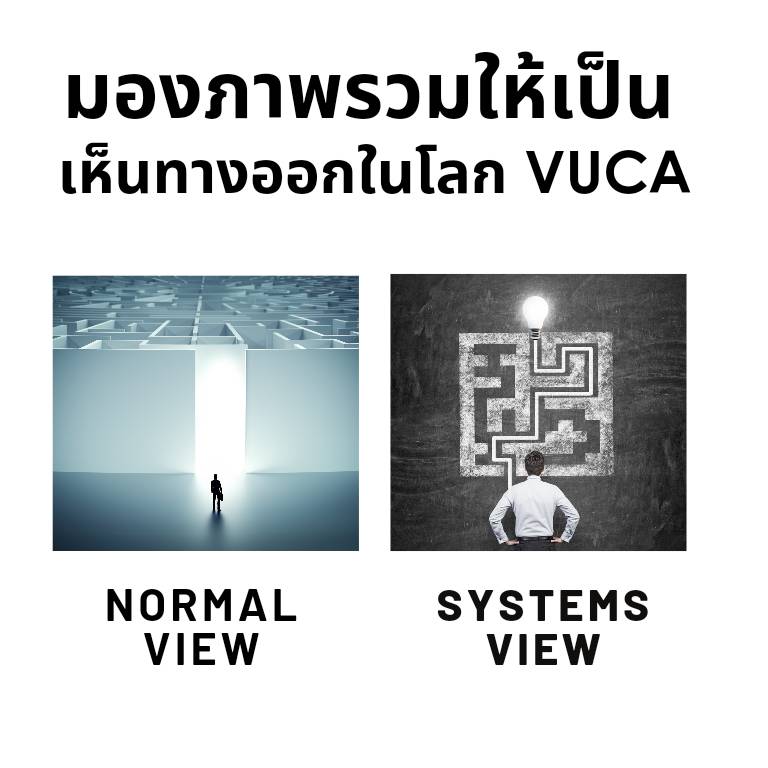
In today's world, where everything changes rapidly—be it technology, the environment, or even human behavior—there is a high degree of uncertainty and complexity in causes and effects, leading to ambiguity in situations. This significantly affects interpretation and decision-making. However, we can still see the big picture, identify potentially related factors, and understand the patterns of relationships and consequential impacts among various elements. This enables us to identify problems and root causes that are often hard to see, allowing us to solve issues and make decisions with minimal side effects, which is beneficial in the long run.
In the workplace, systematic thinking is a skill that organizations must prioritize. If employees at any level adopt a systematic way of thinking, it will create a strong foundation for developing other skills across various work areas, especially in problem-solving and innovation.
Components of Systems Thinking
Systems Thinking helps us analyze events or situations in a more systemic or holistic manner by considering:
- What is the purpose (Purpose) of the system?
- What are the elements (Element) within the system, what are their roles, and how do they function?
- How are these elements interconnected (Interconnection) and how do they impact one another?
For example, if we view an organization as a system, we can understand its goals (the purpose of this business system), how each business unit operates (elements), and how these units relate to one another (interconnection).
By thinking systemically, we realize that all parts must work together; otherwise, it can negatively impact the overall organization.
Benefits of Systems Thinking
Systems Thinking is not limited to executives; employees at all levels can develop this way of thinking. The benefits of Systems Thinking include:
Benefits for Executives
- Holistic Perspective: Executives can see problems and solutions in a broader context, enabling quicker and more effective decision-making.
- Resource Management: It helps executives manage time and resources more efficiently.
- Improved Decision-Making: Understanding relationships and patterns within the organization allows executives to make better decisions.
Benefits for General Employees
- Enhanced Problem-Solving Skills: Employees can tackle complex problems more effectively and anticipate potential future issues.
- Collaboration: It enables employees to work together more effectively by understanding the relationships and impacts of their work within the system.
- Innovation Development: Systems Thinking fosters creativity and the development of new innovations.
Organizations that cultivate systemic thinking at all levels gain a significant advantage in fostering growth into the future. When executives can see the chaotic changes and the long-term business direction that truly aligns with the organization's goals, they can make well-informed decisions that harmonize all parts of the organization, whether departments or employees.
At the same time, employees can use this systemic thinking to address work-related issues. When combined with other thinking styles, such as Creative Thinking, it can lead to significant innovations in products, services, or even improved work methodologies, as well as a better understanding of how to collaborate with other departments toward a unified organizational goal.
Conclusion
Thus, Systems Thinking is an essential skill in this VUCA World, where our world spins with speed, uncertainty, complexity, and ambiguity. Those who can think systemically will see the broader picture of various situations, enabling them to analyze causes, find solutions, and make decisions for better long-term outcomes.