EIC's Outlook on the Office Rental and Retail Rental Business in 2023: Signs of Recovery Amid Excess Supply Risks and Other Challenges
The retail rental business in 2023 is expected to show improved growth across all areas, driven by a recovering demand for retail space as outdoor activities become more normalized following the easing of the COVID-19 pandemic. This is coupled with significant new supply expansion, particularly in suburban areas that have been less affected than others. Meanwhile, Midtown and Downtown areas are also showing signs of recovery. However, the gradual recovery of purchasing power and the substantial increase in new supply remain pressing factors.
- Retail rental market in the Downtown area in 2023: It is expected to rebound due to the central location's ability to attract traffic from both locals and international tourists. Rental rates in this area are also anticipated to recover after a continuous decline due to COVID-19 and previous rent reduction measures.
- Retail rental market in the Midtown area in 2023: Expected to grow at a rate similar to that of Downtown, driven by the significant increase in new supply. However, traffic may not match that of Downtown, which could slow down the rental rate slightly, keeping it just below Downtown's rental rates.
- Retail rental market in the Suburb area in 2023: Continues to expand and is the only area that has shown growth even during the peak of the COVID-19 pandemic. However, the anticipated increase in new supply may lead to a slight decrease in rental rates in the short term. Nevertheless, the location's alignment with urban expansion suggests that the market will continue to grow and is expected to return to previous levels in the future.
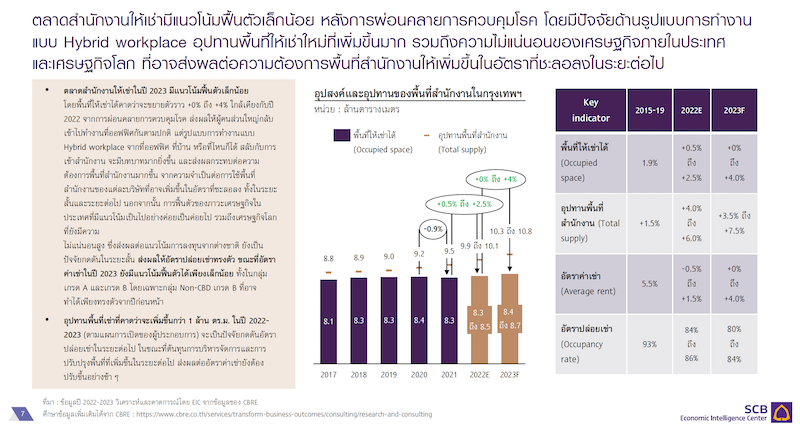
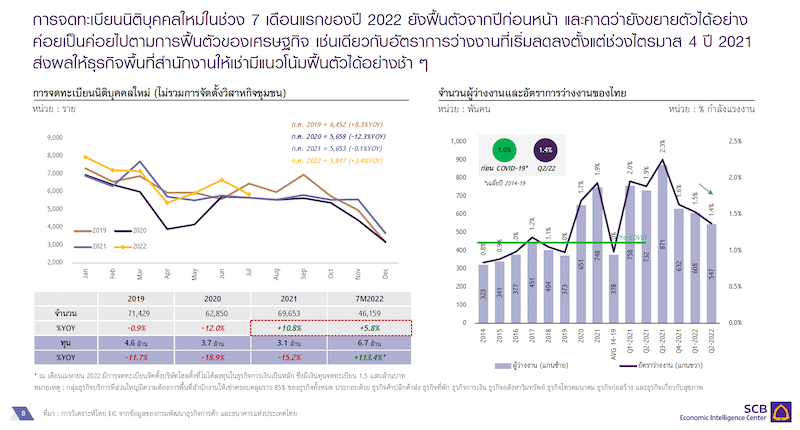
Nonetheless, the recovery of the office rental and retail rental businesses in 2023, as well as in the near future, is likely to be gradual, with several challenges to monitor, including increasing excess supply, the hybrid workplace trend affecting office rentals, and intensifying competition from retail spaces in provincial areas.
- Increasing excess supply is expected to rise significantly in the near future due to operators' expansion plans, with growth rates anticipated to exceed the recovery of purchasing power, which will be a key factor limiting the recovery rates of both the office rental and retail rental markets.
- The hybrid workplace trend—working from the office, home, or anywhere—will play a more significant role, likely becoming a rapidly adopted standard in the near future, thus impacting the demand for office rental spaces more profoundly.
- Intensifying competition in retail rental spaces in provincial areas is expected as major players expand into key provinces with greater potential, which may increasingly affect the competitiveness of smaller local operators.
EIC believes that operators in the office and retail rental sectors need to start adjusting their strategies to address these challenges. Traditional office rental formats may no longer suffice, even if they are newly opened or located in CBD areas. Offering additional alternatives, such as flexible and adaptable space designs, incorporating technology, differentiating formats, and considering more mixed-use projects, will enhance competitiveness and reduce risks. For retail rental spaces, attracting purchasing power and traffic through diverse and distinctive space formats, collecting and analyzing customer data and journeys, and emphasizing digital experiences alongside physical experiences will become the new standard that retail operators must adopt moving forward.
Read the full report at... https://www.scbeic.com/th/detail/product/real-estate-161122