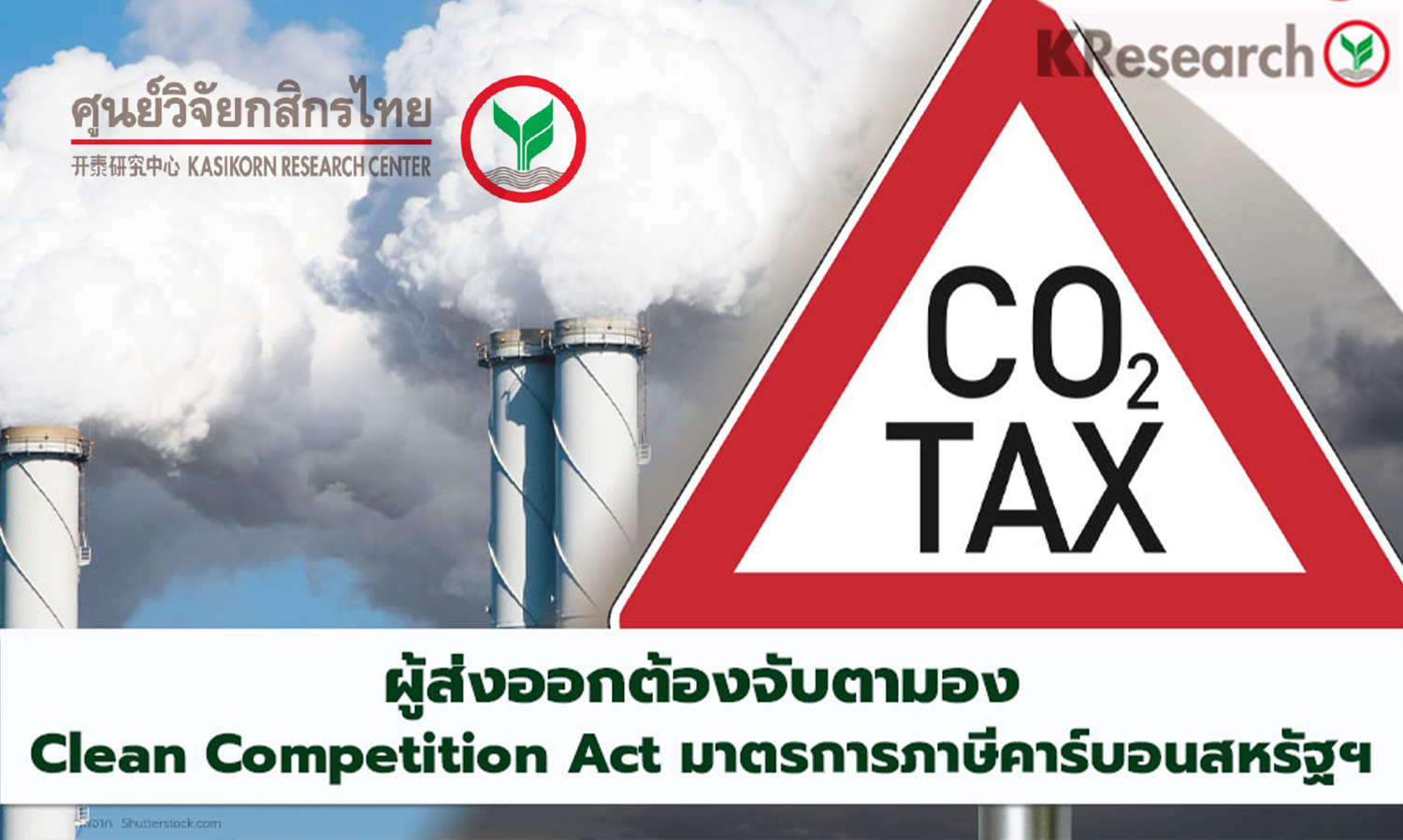
Clean Competition Act and U.S. Carbon Tax Measures That Exporters Should Monitor (Kasikorn Research Center)
The U.S. Senate has proposed the Clean Competition Act, which includes measures for establishing a carbon pricing mechanism for domestically produced goods and a Carbon Border Adjustment Mechanism (US-CBAM) for imported goods. The targeted industries include petroleum production and refining, petrochemicals, fertilizers, hydrogen, adipic acid, cement, steel and iron, aluminum, glass, pulp and paper, and ethanol. In the short term, Thai exporters in these targeted industries should collect greenhouse gas emission data, which will need to be reported regularly for the EU-CBAM set to take effect in 2023 and the US-CBAM currently under consideration. Meanwhile, in the medium and long term, operators should accelerate investments to modify production processes to be more environmentally friendly and reduce greenhouse gas emissions. Otherwise, they will face increased export costs, which will affect their future competitiveness.
The U.S. Senate proposed the Clean Competition Act for consideration in Congress in June 2022 to establish carbon pricing for goods that generate significant greenhouse gas emissions produced domestically and from imports. This is referred to as a carbon pricing mechanism for domestically produced goods and a Carbon Border Adjustment Mechanism (US-CBAM) for imported goods, aligning with President Joe Biden's environmental policy aimed at achieving net-zero greenhouse gas emissions by 2050.
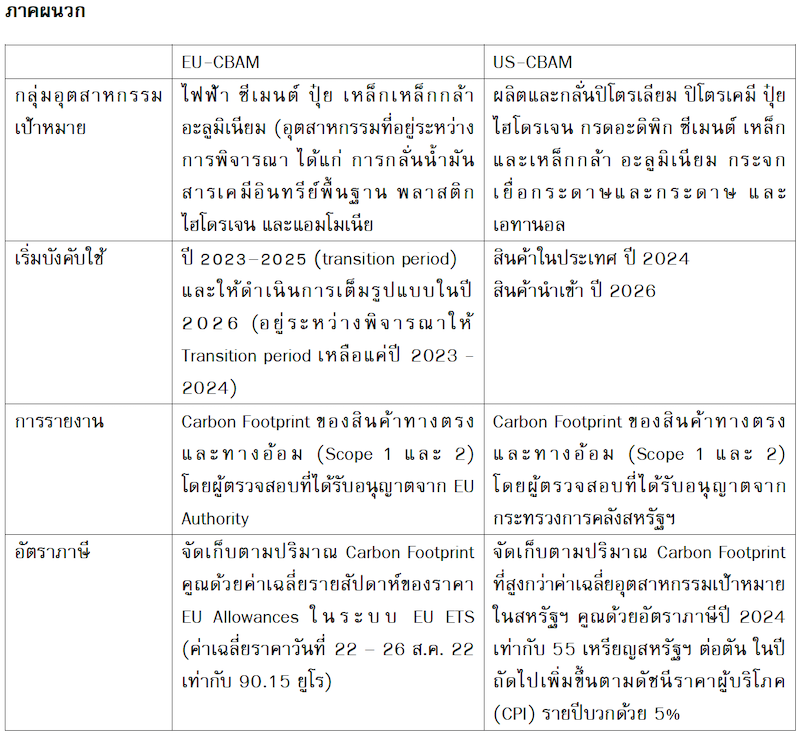
- Carbon Pricing Mechanism for Domestically Produced Goods: Starting in 2024, producers in targeted industries in the U.S., including petroleum production and refining, petrochemicals, fertilizers, hydrogen, adipic acid, cement, steel and iron, aluminum, glass, pulp and paper, and ethanol, will be required to report greenhouse gas emissions from production processes and electricity usage (Scope 1 and 2), along with electricity consumption and production volume data to the Treasury Department. This data will be used to calculate the average greenhouse gas emissions from domestic industries. Producers with emissions exceeding the average will be taxed based on the excess emissions. The average emissions threshold will decrease from the first year of calculation, reducing by 2.5% from 2025 to 2028, and by 5% from 2028 onward. The initial tax rate will be $55 per ton of carbon, increasing annually based on the Consumer Price Index (CPI) plus an additional 5%. Additionally, exporters can receive tax refunds based on the volume of goods exported.
- Carbon Border Adjustment Mechanism (US-CBAM) for Imported Goods: This will be implemented starting in 2026, categorizing imported goods into two types: 1. Goods from targeted industries that will be subject to the same carbon tax as domestically produced goods, and 2. Finished goods that use raw materials from targeted industries and exceed a specified weight threshold for carbon tax liability. In 2026 to 2027, the weight threshold will be set at 500 pounds (approximately 226 kilograms), and from 2028 onward, it will be adjusted to 100 pounds (approximately 45 kilograms). Importers will need to report greenhouse gas emissions from production processes and electricity usage (Scope 1 and 2), along with electricity consumption and product volume data certified by an auditor approved by the U.S. Treasury. However, countries classified as Least Developed Countries (LDCs) by the United Nations will be exempt from this tax.
Impact on Thai Exporters:
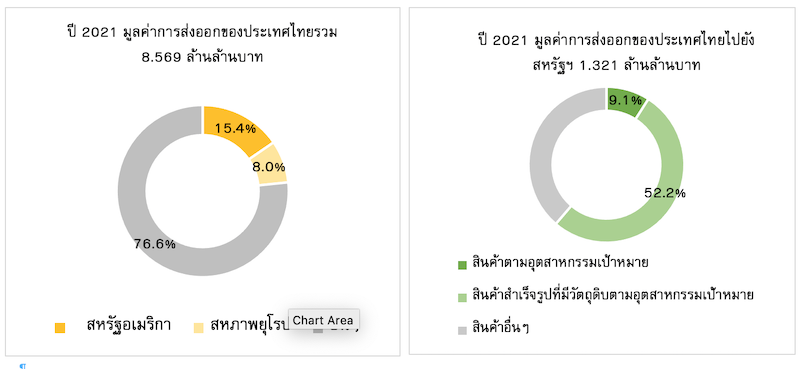
Thailand does not qualify as an LDC, meaning it cannot request an exemption from the US-CBAM. Consequently, Thai exporters sending goods to the U.S. in targeted industries will face higher costs once the law is enforced. In 2021, Thailand's total exports to the U.S. amounted to 1.3 trillion baht, making the U.S. the top export market. The value of exports in targeted industries to the U.S. was 119.631 billion baht, accounting for 9.05% of total exports, primarily from the steel and iron industry at 50.424 billion baht, petrochemicals at 36.437 billion baht, and aluminum at 26.343 billion baht. Meanwhile, the value of exports of finished goods containing raw materials from targeted industries could be significantly affected, totaling up to 689.780 billion baht, representing 52.2%, predominantly in machinery and electronics, such as computer parts, air conditioners, and televisions, valued at 625.324 billion baht, accounting for 47.3% of the total export value to the U.S.
Although the proposed legislation is still in the early stages of Senate consideration, the trend of environmental policies affecting Thai exporters is inevitable. In the European Union, the EU-CBAM law is already in effect and will begin practical implementation in 2023, requiring reporting of carbon footprint data to the EU. Additionally, the EU-CBAM measures are being revised to expand the scope of targeted industries from five to ten industries, with full implementation expected by 2027. Meanwhile, the US-CBAM is anticipated to apply to imported goods starting in 2026. In the short term, exporters in targeted industries should prepare to collect greenhouse gas emission data for regular reporting for both EU-CBAM and US-CBAM. In the medium and long term, operators should accelerate investments to modify production processes to be more environmentally friendly and reduce greenhouse gas emissions. Otherwise, they will face increased export costs, impacting their future competitiveness.