Exploring the Mega Project of the Purple Line South: EIC Looks at Opportunities for Financial Flow in the Construction Sector
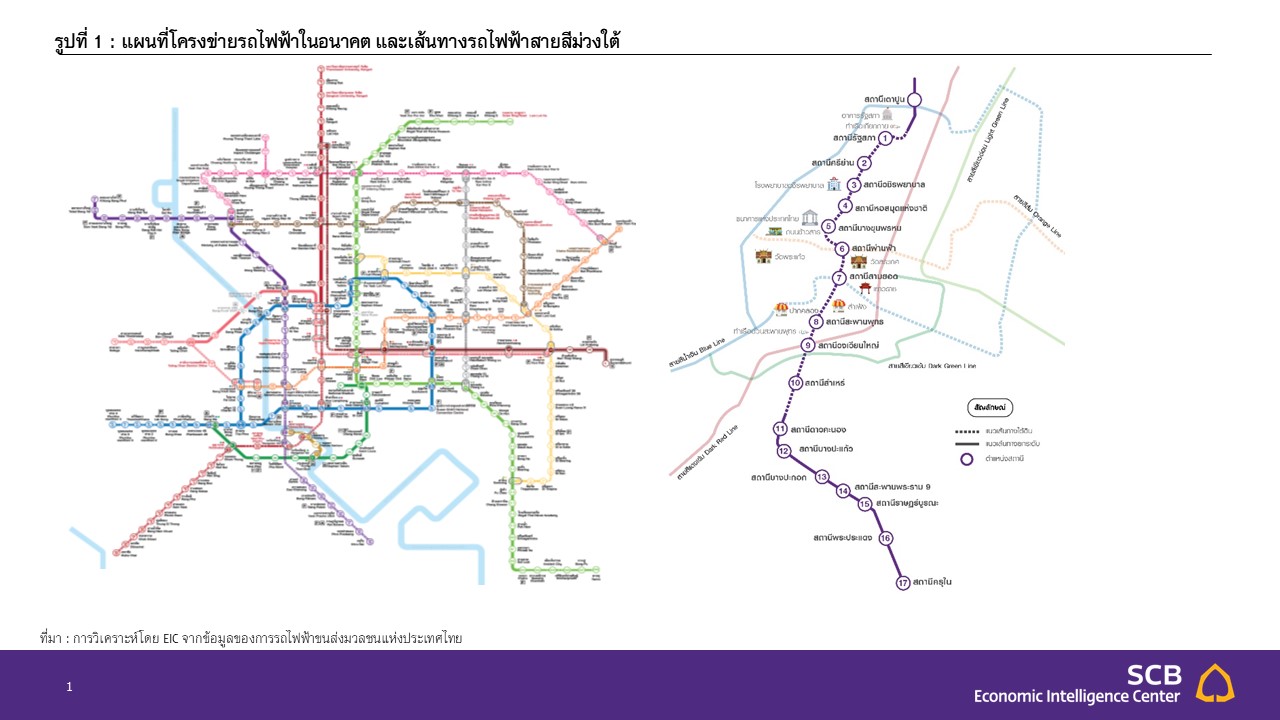
What is the significance of the Purple Line South? <\/span>The Purple Line South plays a crucial role in promoting travel connections between various areas throughout Bangkok and its suburbs.<\/span><\/strong> The Purple Line project from Tao Poon to Rat Burana (Kanchanaphisek Ring Road) spans approximately 23.6 kilometers and includes a total of 17 stations, with 10 underground stations and 7 elevated stations. The route passes through diverse areas, including government offices, educational institutions, hospitals, commercial centers, tourist attractions, and residential areas.
The Purple Line South connects with other operational lines, including the light green line (Sukhumvit), the blue line (Tha Phra-Tao Poon-Lak Si), and the Purple Line North (Tao Poon-Bang Yai). The connection between the North and South Purple Lines will result in the entire Purple Line covering areas in three provinces: Bangkok, Nonthaburi, and Samut Prakan. Additionally, the Purple Line South will link with other planned lines for future construction, such as the red line (Hua Lamphong-Mahachai) and the orange line (Bang Khun Non-Cultural Center). It can be said that the Purple Line will play a significant role in enhancing convenient and rapid travel connections across Bangkok and its suburbs in the future.
Figure 1: Future subway network map and the route of the Purple Line South.<\/span><\/p>
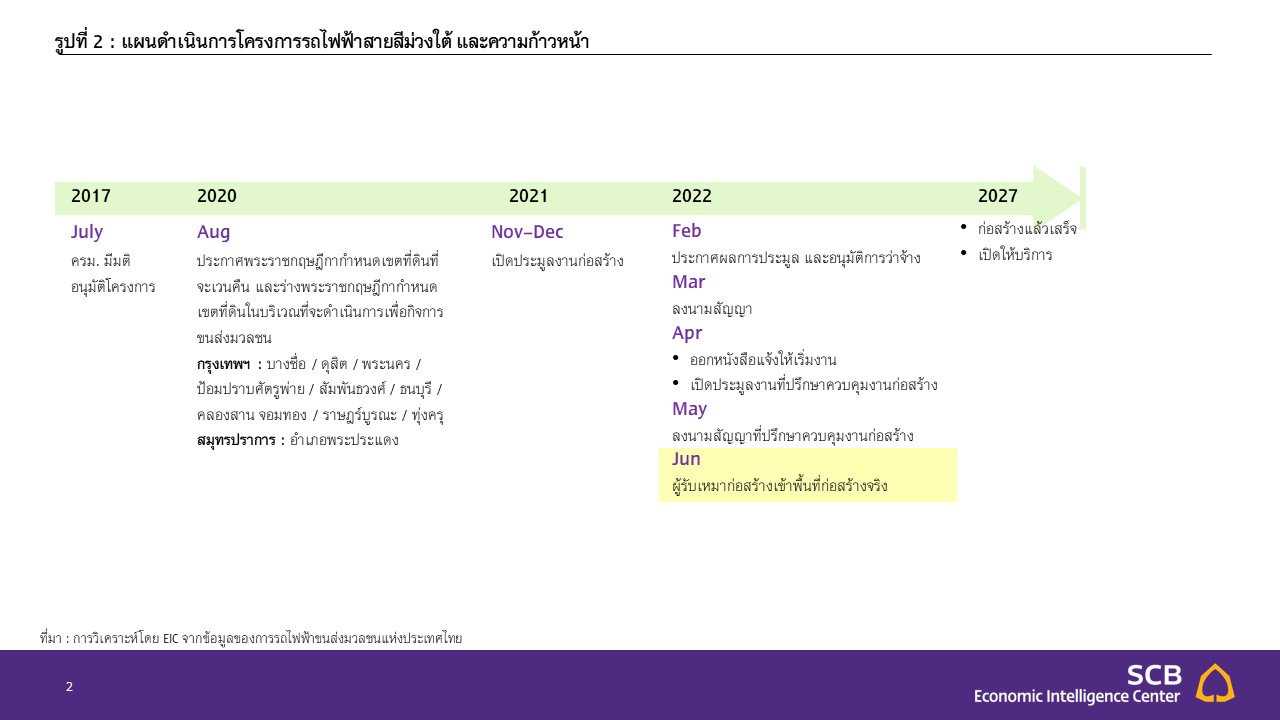
Source: Analysis by EIC based on data from the Mass Rapid Transit Authority of Thailand. Moreover, the Purple Line South plays a vital role in driving the economy, both in the construction sector and other businesses such as housing, retail, and tourism.<\/span> The Purple Line South project is divided into 6 contracts covering the construction of the route from Tao Poon station to Krung Thonburi station, with 5 contracts for the construction and 1 contract for the rail system installation along the project route. Currently, the Mass Rapid Transit Authority of Thailand (MRTA) is gradually handing over the land, and construction contractors have begun actual construction work, starting with the relocation of public utilities in public areas of various government agencies, such as roads and sidewalks, to clear the way for further construction. Figure 2: Implementation plan for the Purple Line South project and progress.<\/span><\/p>
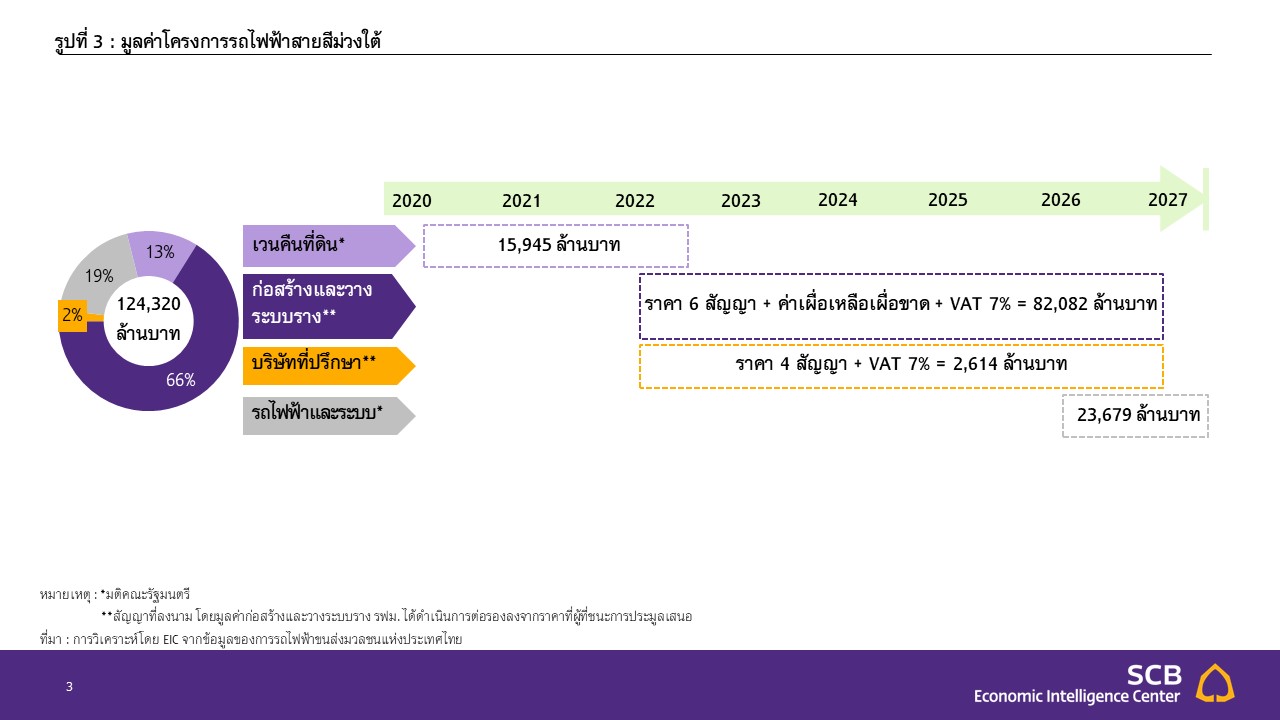
Source: Analysis by EIC based on data from the Mass Rapid Transit Authority of Thailand. The Purple Line South is a mega transportation project with a total project value of approximately 124.32 billion baht. Of this, over 66% of the total project value, or 82.08 billion baht, is allocated for construction and rail system installation. Following that, 19% of the total project value, or 23.68 billion baht, is for the electric train and system, 13% for land expropriation and property surveys, amounting to 15.95 billion baht, and another 2% of the total project value, or 2.61 billion baht, is for consultancy fees covering project management/construction supervision and project operation oversight. Figure 3: Value of the Purple Line South project.<\/span><\/p>
Note: *Cabinet resolution Source: Analysis by EIC based on data from the Mass Rapid Transit Authority of Thailand. It can be said that the Purple Line South plays a crucial role in driving the economy, from construction and rail system installation, which will see financial flow into the construction sector from 2022 to 2027. Additionally, other businesses will benefit from the development of the subway in the future, whether in the housing market, both horizontal and condominium developments along the subway route and nearby areas, which are likely to stimulate demand for housing from both real demand and investors. This presents an opportunity for developers to sell off existing housing stock or develop new housing projects. Furthermore, land prices along the subway route and nearby areas are expected to rise due to area development, indicating that the Purple Line South will play a significant role in stimulating the housing market along the route amidst the slow recovery of the overall housing market. Moreover, in 2018, the MRTA estimated that once the Purple Line South is operational, it is expected to have no less than 200,000 passengers per day. The diverse areas along the route, including government offices, state enterprises, educational institutions, hospitals, commercial centers, tourist attractions, and residential areas, along with convenient connections to other subway lines, will undoubtedly benefit businesses along the subway route and nearby areas, especially retail and tourism businesses, from the increased number of travelers. How does the construction sector benefit from the Purple Line South project? <\/span> <\/span> The bidding process for construction and rail system contracts for the Purple Line South has requirements regarding the qualifications of bidders in various aspects, such as minimum registered capital, average project construction value per year over the past three years, and experience as a main contractor for government construction projects. These requirements provide opportunities for large construction contractors to bid as the main contractor for the project, with winning contractors comprising both single companies and joint ventures. Figure 4: Information on the Purple Line South project and winning bidders for each contract.<\/span><\/p>
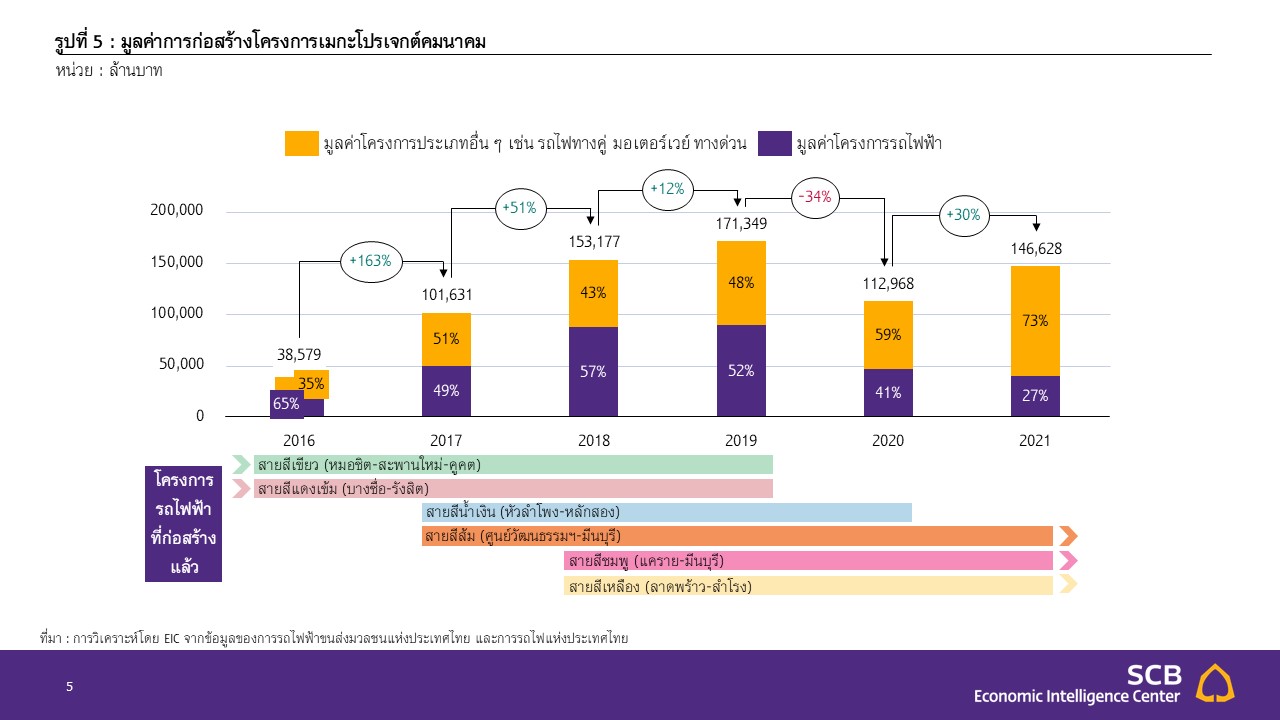
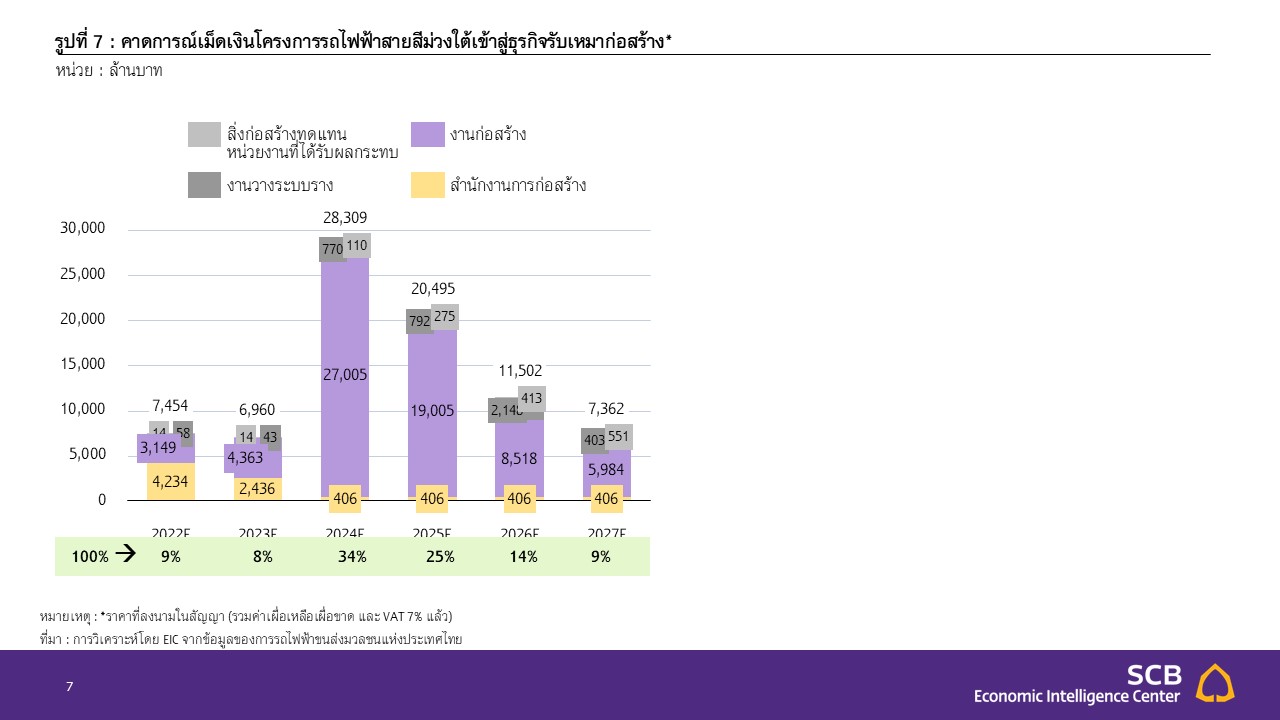
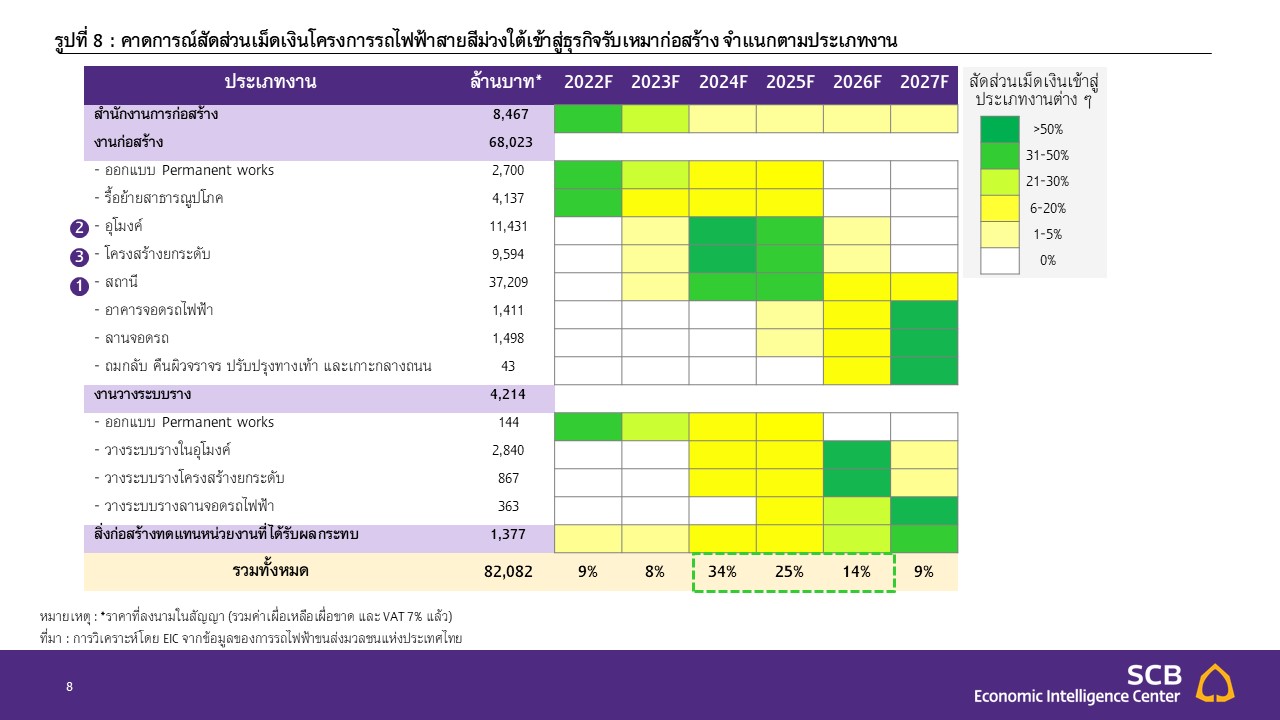
Note: *Contract prices signed (including contingencies and VAT 7%). Source: Analysis by EIC based on data from the Mass Rapid Transit Authority of Thailand. EIC believes that the construction of the Purple Line South will continuously support the value of mega transportation project construction.<\/span> In the past, the value of subway construction projects accounted for more than half of the value of mega transportation project construction. The construction of subway projects has played a significant role in supporting the growth of mega transportation project construction values from 2017 to 2019, as this was a period when multiple subway lines were under construction simultaneously, including lines that continued from previous projects, such as the green line (Mo Chit-Sapan Mai-Khukhot) and the dark red line (Bang Sue-Rangsit). In 2017, construction began on the blue line (Hua Lamphong-Lak Si) and the orange line (Cultural Center-Min Buri), and in 2018, construction also began on the pink line (Kra Yai-Min Buri) and the yellow line (Lat Phrao-Samrong). The construction of these various subway projects significantly boosted the overall value of mega transportation project construction during 2017-2019. EIC anticipates that the commencement of construction for the Purple Line South will continue to support the value of mega transportation project construction in 2022. Furthermore, it is expected that in 2023, there will be progress in the construction of the orange line (Bang Khun Non-Cultural Center) and the bidding for several routes of the red line, both dark red and light red. The bidding and construction of these subway projects will continue to play a crucial role in supporting the growth of mega transportation project construction values in the future. Figure 5: Value of construction for mega transportation projects <\/span>Unit: million baht. Source: Analysis by EIC based on data from the Mass Rapid Transit Authority of Thailand and the State Railway of Thailand. The construction of the Purple Line South will generate financial flow into the construction contracting business, especially during the period <\/span>2024-2026. EIC estimates that approximately 60.31 billion baht will flow into the construction business, accounting for 73% of the value of construction and rail system installation, due to the accelerated pace of construction progress.<\/span> Based on the progress of previously completed subway construction projects, it has been observed that the construction progress tends to accelerate in the middle of the project. For example, the blue line (Hua Lamphong-Bang Khae, Bang Sue-Tha Phra), which has a construction period of about 8 years, had a construction progress rate of 65% during years 3-6 of the overall construction volume. The green line (Mo Chit-Sapan Mai-Khukhot), which has a construction period of about 5 years, had a construction progress rate of 80% during years 3-4 of the overall construction volume. If we consider the progress of subway construction projects that are nearing completion, such as the yellow line (Lat Phrao-Samrong), the orange line (Cultural Center-Min Buri), and the pink line (Kra Yai-Min Buri), it is found that the progress rate in the middle of these projects accounts for 47-50% of the overall construction volume. Figure 6: Progress rate of construction for various subway projects <\/span> Unit: % of overall construction volume. Note: *Still under construction. Source: Analysis by EIC based on data from the Mass Rapid Transit Authority of Thailand. Financial flow from the construction and rail system of the Purple Line South will gradually enter the construction contracting business according to the construction activities completed. The project has a construction period of about 6 years, so it is expected that the construction progress will accelerate in the middle of the project, specifically during years 3-5 of the project implementation plan, or during 2024-2026. In the initial phase of the project, or during 2022-2023, most of the funds will be allocated to office construction work, as well as permanent works and the relocation of public utilities to clear the way for further construction. Subsequently, during 2024-2026, which is the middle phase of the project, construction progress will accelerate, and financial flow into the construction contracting business will account for approximately 73% of the value of construction and rail system installation, primarily for tunnel construction, elevated structures, and stations, with some rail system installation work beginning. In the final phase of the project, or in 2027, it is expected that most of the funds will be allocated to construction work for electric train parking lots, parking areas, as well as road resurfacing, sidewalk improvements, and median strips. Figure 7: Projected financial flow from the Purple Line South project into the construction contracting business.<\/span>*<\/span> Unit: million baht. Note: *Contract prices signed (including contingencies and VAT 7%). Source: Analysis by EIC based on data from the Mass Rapid Transit Authority of Thailand. Figure 8: Projected proportion of financial flow from the Purple Line South project into the construction contracting business, categorized by type of work.<\/span><\/p>
Note: *Contract prices signed (including contingencies and VAT 7%). Source: Analysis by EIC based on data from the Mass Rapid Transit Authority of Thailand. In addition to generating financial flow to large construction contractors, EIC estimates that approximately 63.88 billion baht will be distributed to SMEs in the construction sector, as well as construction material businesses.<\/span> The construction costs for public sector projects consist of material costs, subcontractor fees, labor costs, machinery costs, and various operational costs. In the construction of the Purple Line South, not only will it generate financial flow to large construction contractors as the main contractors of the project, but it will also distribute funds to SMEs through subcontracting, as well as to construction material businesses, including manufacturers and traders of construction materials, through the procurement of materials for construction. EIC estimates that the total financial flow will be around 63.88 billion baht, or 78% of the value of construction and rail system installation, with approximately 28.62 billion baht, or 35% of the value of construction and rail system installation, distributed to SMEs, and around 35.26 billion baht, or 43% of the value of construction and rail system installation, allocated to manufacturers and traders of construction materials. Large construction contractors subcontract less complex construction work to SMEs.<\/span> As the main contractors of the project, large construction contractors have the capability to handle complex construction types that require advanced construction engineering technology and specialized expertise, including tunnel construction, elevated structure construction, and rail system installation, with a combined construction value of 25.24 billion baht. In some contracts, construction operations are conducted in the form of joint ventures between contractors with specialized expertise, which further enhances the efficiency of construction operations. However, due to the diverse construction activities of the Purple Line South, large construction contractors subcontract certain types of construction work to SMEs, particularly less complex tasks that utilize general construction technology and do not require specialized construction expertise, such as office construction, utility relocation, station construction, electric train parking lots, parking buildings, road resurfacing, sidewalk improvements, and median strips. This means that part of the financial flow for these construction activities will be distributed to SMEs, providing them with opportunities to take on construction work as subcontractors. Figure 9: Types of construction work for the Purple Line South and the capabilities of construction contractors.<\/span><\/p>
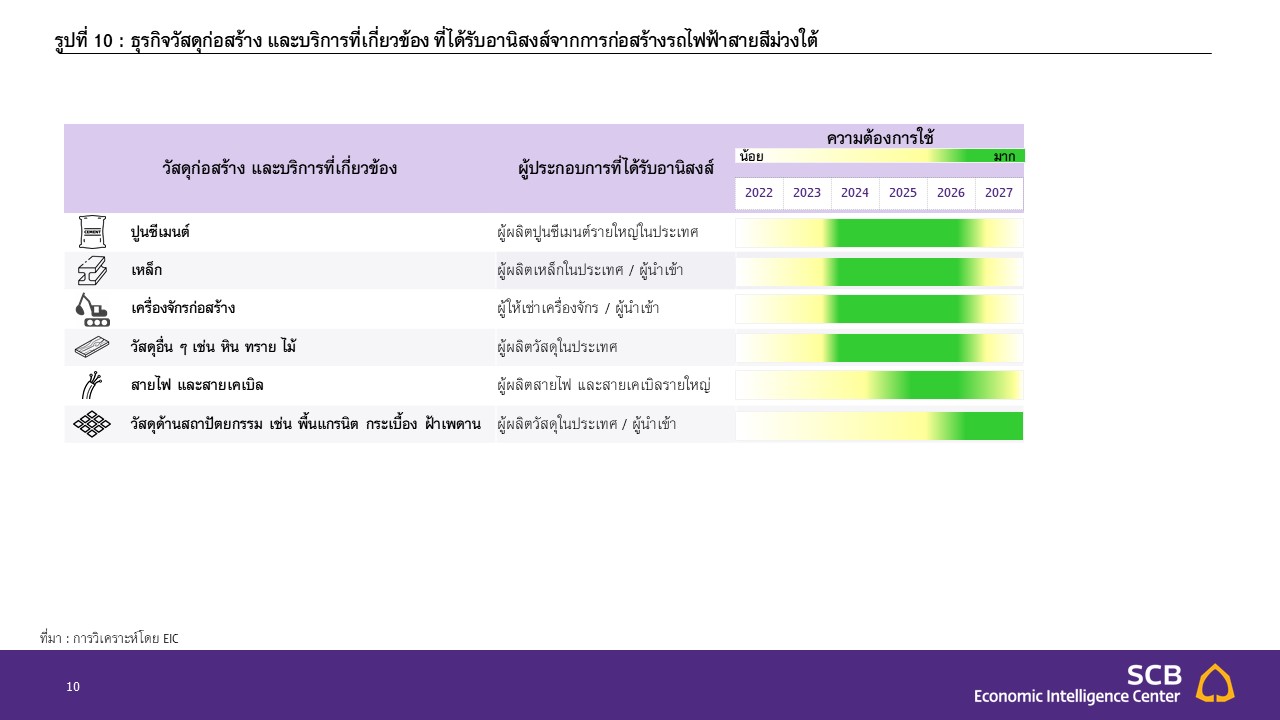
Source: Analysis by EIC based on data from the Mass Rapid Transit Authority of Thailand. Additionally, manufacturers and traders of construction materials benefit from the construction of the Purple Line South.<\/span> As a mega transportation project with a high construction value, there will be a significant demand for construction materials during the construction phase. EIC believes that the demand for construction materials, especially key materials such as cement, steel, and other materials, as well as construction machinery services, will be substantial during 2024-2026, following the acceleration of construction progress, particularly in tunnel construction, elevated structures, and stations, as well as the initial rail system installation work. Furthermore, the demand for electrical wires and cables will be high during 2025-2026 for rail system installation work. In the final phase of construction, or during 2026-2027, there will be a demand for architectural materials to prepare the site for service commencement. Large construction contractors' contracts for bulk material purchases will give them significant bargaining power regarding prices and order volumes, presenting challenges for manufacturers and traders of construction materials amidst high material costs driven by energy prices. This means that manufacturers and traders of construction materials must focus on effectively managing selling prices and controlling costs to maintain profit margins for the construction materials used in the Purple Line South project. Figure 10: Construction material businesses and related services benefiting from the construction of the Purple Line South.<\/span><\/p>
Source: Analysis by EIC. What are the opportunities and challenges in constructing the Purple Line South? <\/span> <\/span> EIC believes that the construction of the Purple Line South will provide large construction contractors with additional backlog, generate revenue for their businesses, and enhance their experience in large-scale project construction.<\/span> In the past, private sector construction projects have been sluggish due to the impact of COVID-19, prompting large construction contractors to focus more on bidding for government construction projects. The construction of the Purple Line South, which has a construction period of about 6 years, will provide large construction contractors with additional backlog and enable them to generate revenue according to the construction progress in the future, especially as the private construction sector may still recover slowly. Additionally, the construction of the Purple Line South will enhance large construction contractors' experience in large-scale project construction, which will support their future bids for large public projects, particularly subway projects that will see several investment bidding opportunities in the form of PPP. It also presents opportunities for large construction contractors to take on maintenance work in the future. Furthermore, domestic construction material manufacturers benefit from both the increased demand for construction materials <\/span>and the <\/span>Made in Thailand <\/span> policy, which emphasizes the use of domestically produced materials, requiring government agencies to procure at least 60% of materials used from domestic sources. In construction work, it is mandated that at least 90% of the value or quantity of steel or iron used in all construction work must be sourced from domestic production.[1]<\/a> In terms of various construction projects by the Ministry of Transport, including the Purple Line South project, it is expected that the Made in Thailand policy will also be applied in procurement practices. This presents opportunities for domestic construction material manufacturers. EIC believes that the demand for steel from the construction of the Purple Line South will encourage steel manufacturers to increase their production capacity from currently low levels, which still rely heavily on imported steel. Cement manufacturers will also benefit from increased demand, although the Made in Thailand policy may not significantly impact them as they primarily use domestic sources already. However, construction contractors may face challenges in constructing the Purple Line South due to rising construction costs and delays in construction operations.<\/span><\/strong> The impact of the conflict between Russia and Ukraine has caused construction material prices to surge in 2022, particularly steel and cement, leading to a projected increase in construction costs for contractors of no less than 14% compared to the previous year. Nevertheless, EIC believes that the demand for construction materials in the Purple Line South project is relatively certain according to the construction plan, allowing contractors to plan for material procurement in advance, thus enabling them to manage material cost prices to some extent. Additionally, some large contractors have affiliated companies that produce construction materials, which can mitigate some of the impacts of rising material costs. Moreover, construction contractors are still facing a reduced number of foreign laborers in the construction sector since the COVID-19 pandemic, which has not returned to pre-pandemic levels. This has led to a continued upward trend in labor costs in 2022 compared to 2021, which may persist throughout the construction of the Purple Line South. However, the development of engineering techniques and increased use of construction technology, particularly precast components, will enhance operational efficiency, reduce costs, shorten construction timelines, and alleviate labor shortages in construction. Additionally, subcontractors, mostly SMEs, who have not widely adopted construction technology may also begin to utilize Building Information Modeling (BIM) to manage construction more efficiently. Furthermore, delays in construction operations, particularly in land delivery, remain a significant challenge for mega projects. For the Purple Line South project, construction will pass through numerous government and state enterprise sites, necessitating close monitoring of land delivery issues, especially in areas under government agencies in Bang Sue and Dusit, which are the starting points for tunnel construction that may be delayed. This could result in overall project construction delays and deviations from the planned timeline. Additionally, as the Purple Line South project will be constructed in historically significant areas, particularly in the inner Rattanakosin Island area of Phra Nakhon, there may be archaeological discoveries during underground construction, which could further delay construction during government agency investigations. Analysis by... https://www.scbeic.com/th/detail/product/purpleline-14072<\/a><\/p>
 <\/p>
<\/p>
 <\/p>
<\/p>
 <\/p>
<\/p>
**Contracts signed with negotiated construction and rail system installation costs from the winning bidders.
The Purple Line South project has made significant progress in its implementation, with over 66% of the total project value, or 82.08 billion baht, allocated for construction and rail system installation. Thus, it can be said that the construction sector will be one of the first businesses to benefit from this project. The construction sector has a diverse supply chain involving various businesses, such as construction contracting, manufacturing and trading of construction materials, construction machinery services, and consultancy firms. This means that the construction of the Purple Line South will generate economic activity and distribute financial flow to these businesses, as well as create jobs from 2022, the year construction begins, until 2027, when construction is completed and the service commences. <\/p>
<\/p>
 <\/p>
<\/p>
 <\/p>
<\/p>
 <\/p>
<\/p>
 <\/p>
<\/p>
 <\/p>
<\/p>
 <\/p>
<\/p>