
Analysis of the Israel-Palestine Conflict
Analysis and prepared by Mr. Thammarut Khunhirun and Mr. Yanaphat Suksaran
Economic Stability Analysis Division, Macroeconomic Policy Office, Fiscal Policy Office
#This article reflects the personal opinions of the authors and does not necessarily align with the views of their affiliated agencies.
1. Causes of the Conflict
The Israel-Palestine conflict has been ongoing for nearly 100 years. The latest round of conflict began on May 8, 2021, with clashes at the Al-Aqsa Mosque between Israeli police and Palestinian civilians. This led to Hamas deciding to retaliate from its base in Gaza by launching numerous rockets targeting various locations across Israel. In response, Israel retaliated, resulting in reports on May 18, 2021, of two Thai workers in Israel being killed by rockets fired by Hamas from Gaza across the border into southern Israel.
2. Impact on the Thai Economy
2.1 Export-Import Ratio between Thailand and Israel
Israel is one of the top countries with potential for economic growth in the Middle East region. Israel joined the Organisation for Economic Co-operation and Development (OECD) in 2010 and ranks among the top countries globally for investment in research and development, as well as for its high levels of economic, technological, and industrial development, making it one of the leading countries in terms of business agility.
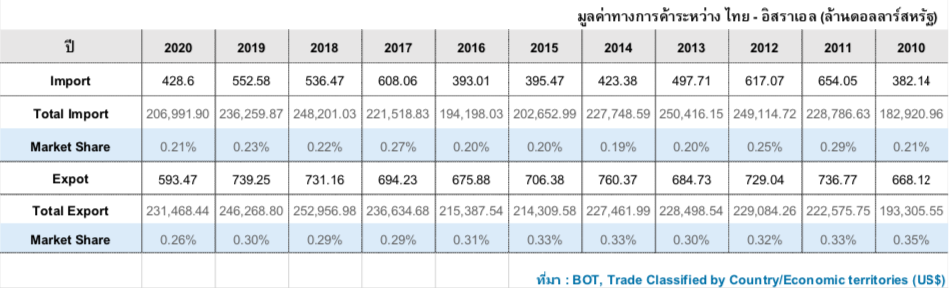
In 2020, the total trade between Thailand and Israel was valued at 1,022.1 million USD, a decrease of -19.7% from the previous year, with exports valued at 593.5 million USD. Key exports included gems and jewelry, plastic pellets, rice, rubber products, computers, equipment and components, and electrical circuit boards. Imports were valued at 428.6 million USD, down -22.5% from the previous year, with key imports including military equipment, electrical machinery, medical science-related tools and components, machinery and components, and electrical circuit boards.
Israel ranks as Thailand's 41st trading partner in terms of export value and 39th in terms of import value in the global market. (When considering 15 countries in the Middle East, Israel ranks 4th in export value and 6th in import value for Thailand.)1

However, the proportion of imports and exports between Thailand and Israel, compared to Thailand's overall foreign trade volume, remains low, with a market share of only 0.21% for imports and 0.26% for exports in 2020 (details in the table below).
2.2 Thai-Israeli Investment
Currently, Thai investors are still investing very little in Israel, despite the fact that Israel is open to foreign investors who can hold 100% ownership (except in military and security sectors). The sectors that the Israeli government particularly supports include organic chemistry, medical instruments, bioenergy, telecommunications, and ICT. The main concerns for Thai and foreign investors are safety from war and high investment costs, including minimum wage (53,000 THB/month in Israel), rental costs, utilities, and other expenses.
As for Israeli investment in Thailand, data from the Board of Investment (BOI) indicates that from 2013 to 2020, there were 15 investment projects from Israel promoted by the BOI, with a total investment value of approximately 366 million THB, mostly in the electrical and electronics industry, software, and diamond cutting businesses.
2.3 Thai Labor in Israel
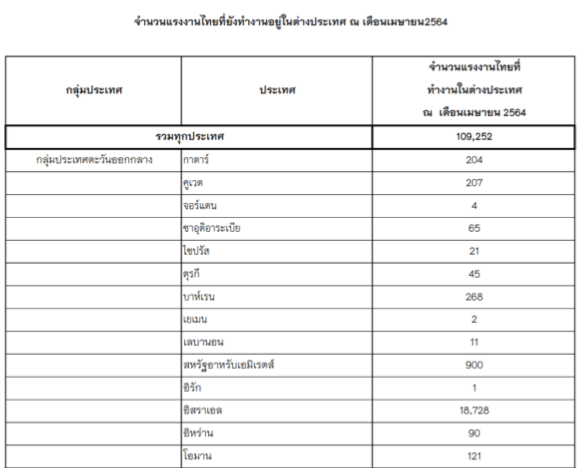
Israel is one of the top ten foreign labor markets for Thai workers. As of April 2021, there were 18,728 Thai workers (accounting for 17.1% of all Thai workers abroad), with most working in Israel's agricultural sector. Following the attacks in the Gaza Strip on May 18, 2021, two Thai workers residing in the Ohad agricultural industrial zone near Gaza were killed. The Thai embassy has evacuated some of the approximately 4,000 Thai workers in the industrial zone near Gaza.
2.4 Thai-Israeli Tourism (Before the COVID-19 Pandemic)
Before 2019, the number of Israeli tourists traveling to Thailand was among the highest from Middle Eastern countries and had been increasing over the years. In 2019, there were 195,856 Israeli tourists (accounting for 0.49% of the total foreign tourists entering Thailand, which was 39.92 million that year). Thailand earned 518.2 million USD from tourism in that year (accounting for 0.84% of total tourism revenue from foreign tourists, which was 61,572.9 million USD). The average revenue from Israeli tourists was 82,156 THB/person, higher than the average revenue from all foreign tourists, which was 47,896 THB/person, indicating that Israeli tourists are high-value tourists.