
Chokepoint: Strategic Narrow Channels
Following the news about a cargo ship blocking the Suez Canal, maritime traffic and the transportation of goods through the Suez Canal were halted for nearly a week. It took some time for all the waiting ships to pass through and for traffic to return to normal. The Suez Canal is crucial as a connector between the Mediterranean Sea and the Indian Ocean, playing a significant role in global maritime shipping routes. Today, we will discuss chokepoints or strategic narrow channels that are vital for transportation around the world.

Source: bbc.com
Suez Canal
Let’s start with the recently discussed Suez Canal, which is a man-made canal under the jurisdiction of Egypt. This canal was dug to reduce travel time, eliminating the need for ships traveling from Europe to Asia to go around the Cape of Good Hope in South Africa. The Suez Canal shortens the distance by up to 8,900 kilometers. In 2020, a total of 18,880 ships passed through the Suez Canal.

Source: researchgate.net
Panama Canal
The Panama Canal is an 82-kilometer-long man-made canal that connects the Pacific Ocean and the Atlantic Ocean, managed by Panama with the support of the United States. This canal was constructed rapidly within 10 years, allowing cargo ships to avoid the risks of navigating around Cape Horn at the southern tip of South America. A notable feature of the Panama Canal is its sections that cross mountains, creating chambers with varying water levels, allowing ships to transit through different elevations.

Source: marketwatch.com
Strait of Hormuz
The Strait of Hormuz connects the Persian Gulf and the Gulf of Oman, leading out to the Indian Ocean. This strait is crucial for transporting oil from Middle Eastern countries through the Persian Gulf to the world. With a width of only three kilometers, it is a strategically important point, as seen during the conflict between Iraq and Iran from 1980 to 1988, where both sides attempted to disrupt each other's oil transport.
Source: wikipedia
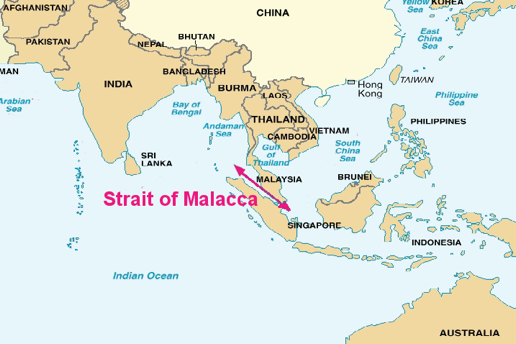
Strait of Malacca
Another important trade strait is the Strait of Malacca, which is over 900 kilometers long, connecting the Indian Ocean and the Pacific Ocean. More than 100,000 ships travel through this strait, making it a vital route for oil transportation, especially for shipping oil from Africa and the Middle East to China.