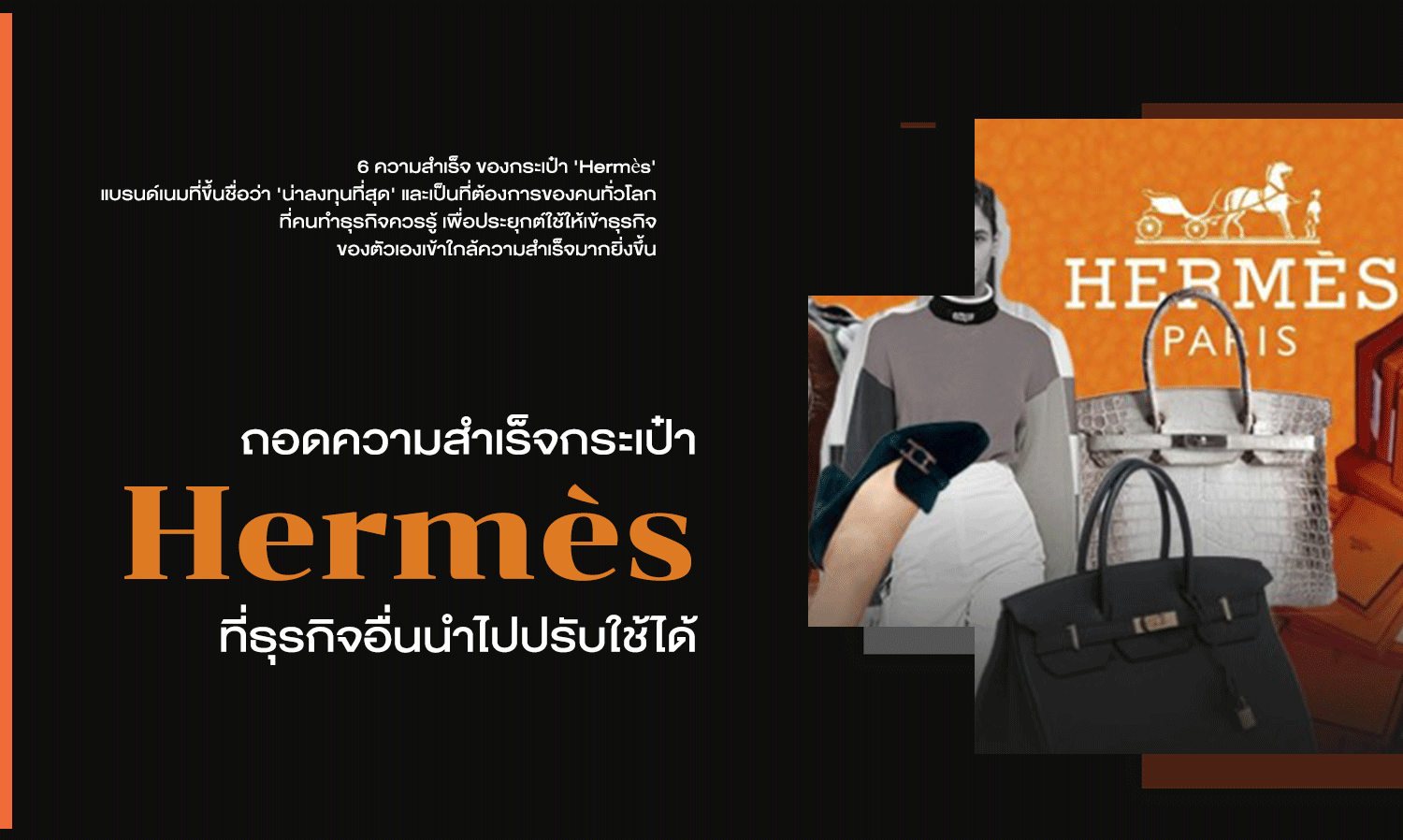
Decoding the Success of 'Hermès' Bags That Other Businesses Can Apply
6 Success Factors of 'Hermès' Bags, the Luxury Brand Known as 'The Most Worthwhile Investment' and in High Demand Worldwide, That Business Owners Should Know to Adapt for Their Own Success
When discussing "luxury bags", one name that cannot be overlooked is "Hermès". This is the bag that every bag lover dreams of owning. Moreover, Hermès is also a bag that "investors" have their eyes on due to its continuously increasing value, high demand, and liquidity.
Of course, Hermès did not achieve its global success overnight. The renowned products and the legacy passed down through generations did not come from mere trends or coincidences.
Bangkok Business Online takes you through the success of Hermès bags, crafted meticulously over generations, which can be adapted by any brand or business. Here are 6 key points:
1. A Unique Story
It is undeniable that the "story" behind a product is something customers want to know, such as the brand's origins, the materials used, and the production process. All these factors significantly influence purchasing decisions, and this is one of Hermès' strengths that has persisted for 183 years.
Hermès enthusiasts know well that a single "Birkin" bag takes 48 hours to make, or 6 consecutive days (since the artisans work 8 hours a day). Furthermore, it must be crafted by an "atelier", meaning an experienced artisan who has been trained in Hermès' techniques, ensuring that the quality, durability, and beauty are never compromised.
Presenting a unique, distinctive story about products or services is another aspect that brands should communicate to their target customers to enhance awareness. These elements can foster loyalty towards the brand in the future.
2. Consistency
A key strength of Hermès is its consistent business operations, reflected in its long-standing history of 183 years, which is unparalleled by any brand in the world that has maintained its business for nearly two centuries.
The clear image is that Hermès today is vastly different from its early days. Looking back, we see that throughout its business journey, Hermès has continuously strived to improve and develop its products. While the brand does not chase after ever-changing fashion trends, it does not ignore social currents to seize opportunities as they arise.
Consistency is where many businesses falter. Some invest heavily only in the early stages, while others only work hard during peak sales periods. However, the hidden advantage of "doing things consistently" is that it yields long-term returns.
Consistent efforts not only help create a rich business experience but also allow target customers to better perceive what the brand wants to communicate. In contrast, businesses that do not prioritize consistency, that operate sporadically, or lack clarity, will find it harder to communicate with customers.
Consistency in product development and communication is something business owners should not overlook, as it is part of the success of "building a brand" that requires time and serious dedication.
3. Unique Identity
Products with a "unique identity" are what make a brand and its offerings stand out from competitors in the market, whether it be materials, shapes, designs, or usability. From a distance, one can easily recognize the design of Hermès, which has conveyed its "unique identity" to the point of becoming a "trust" every time it is seen.
The identity that many adore is the meticulousness in sourcing leather for their bags.
Some bag models require crocodiles to be raised in marble ponds to avoid any blemishes on the leather used for the bags, ensuring the most perfect bags as intended by the brand, crafted with strictly controlled sewing processes that make buyers feel like they own a piece of "artistry".
In addition to popular models like "Birkin" and "Kelly", Hermès has created a unique identity in every bag that evokes a lasting impression: meticulous craftsmanship that meets usability, simple yet luxurious at the same time.
Viewing this as a piece of the puzzle for success, creating a "unique identity" for a brand or service can also be applied by small businesses, especially in an era where online commerce has flooded the market with similar products. Establishing a unique identity to target niche markets can be a business opportunity that adds significant value.
4. Not Everyone Can Buy!
Hard to buy! This is a characteristic that everyone talks about when wanting to own a popular Hermès "Birkin" bag. According to the experiences of Hermès fans, "not everyone can buy it" and "just having enough money doesn't guarantee a purchase".
Kanyarat Pladitsai, a real estate executive and a devoted Hermès bag fan, shared in the course Alternative Investment Season 1: Navigating the Crisis with Alternative Assets in the topic “Collecting Luxury Bags: Creating Emotional Value, Which Models Are Worth Keeping” that acquiring a popular Hermès bag is not as simple as walking in and buying it. Typically, sellers will offer bags to buyers after assessing their loyalty to the brand and genuine enthusiasm for Hermès, such as having consistently purchased other products from Hermès or buying in large quantities. Each case varies by country, and there are no fixed rules on how to acquire a luxury bag.
The reason not everyone can simply walk in and buy is not just marketing; it also aims to reduce the chances of buyers flipping the bags for profit. This policy has become a unique "charm" of Hermès, making customers who can purchase feel proud and even more loyal to the brand. However, brands that can manage the charm of "selecting customers" must start with strong products and services that can successfully turn "customers" into "devotees".
5. Durability
Although Hermès bags are priced at a premium, many still aspire to own one. What drives these individuals to spend no less than six figures for a single bag is the feeling of "value" and "usability".
The "Birkin Bag" was designed to address the pain points of the famous actress "Jane Birkin", who liked to carry a basket during weekend getaways but faced issues with items falling out during travel. This sparked the idea for Hermès' management to design a large bag that could hold a lot, be secure, yet look elegant, leading to the creation of a hit bag that remains popular today.
Another selling point of Hermès is its choice of various durable animal leathers suitable for bag-making, combined with designs that allow for ample storage, ensuring long-lasting use (depending on maintenance). It can be said that these bags are not only functional but also convey a sense of status. Moreover, if a bag gets damaged, it can be sent back to France to the atelier that crafted it, where artisans familiar with the bag can provide repairs.
It is evident that producing high-quality, durable products that last makes customers feel their expenditure is worthwhile, significantly influencing their purchasing decisions, leading to word-of-mouth referrals or repeat purchases.
6. Intrinsic Value
Hermès bags have transcended being mere "fashion items" to becoming "assets" that investors are keenly interested in. This is part of why the "Birkin Bag" has maintained its demand for purchase and collection for nearly a century.
In addition to luxury and usability, there is also the factor of high Demand (buying interest) exceeding Supply (selling interest), as the Birkin Bag is considered a "Craftsmanship" that takes 6 days to produce by experienced artisans, resulting in limited production compared to other brands that use industrial processes.
With limited availability, difficulty in acquisition, and high demand, Hermès has become an item with "intrinsic value". According to Baghunter, the Hermès Birkin bag is considered a better annual investment than gold and stocks in the S&P 500.
From 1980 to 2015, S&P 500 stocks had an average return of 8.65%, while the Birkin Bag's value increased by an average of 14.2% per year over the same 35 years, totaling a 500% increase.
In January 2020, the prices of the Togo Birkin bags in sizes 25, 30, and 35 inches in Europe increased by an average of 3%, 2.65%, and 0%, respectively.
While creating added value is extremely challenging for most brands or startups, the transition from being an ordinary handbag to an asset that investors target stems from various elements that harmoniously combine, clearly reflecting that
These elements are the steps that lead businesses to success when any business prioritizes them, just as "Hermès" is currently doing!
SOURCE: www.bangkokbiznews.com