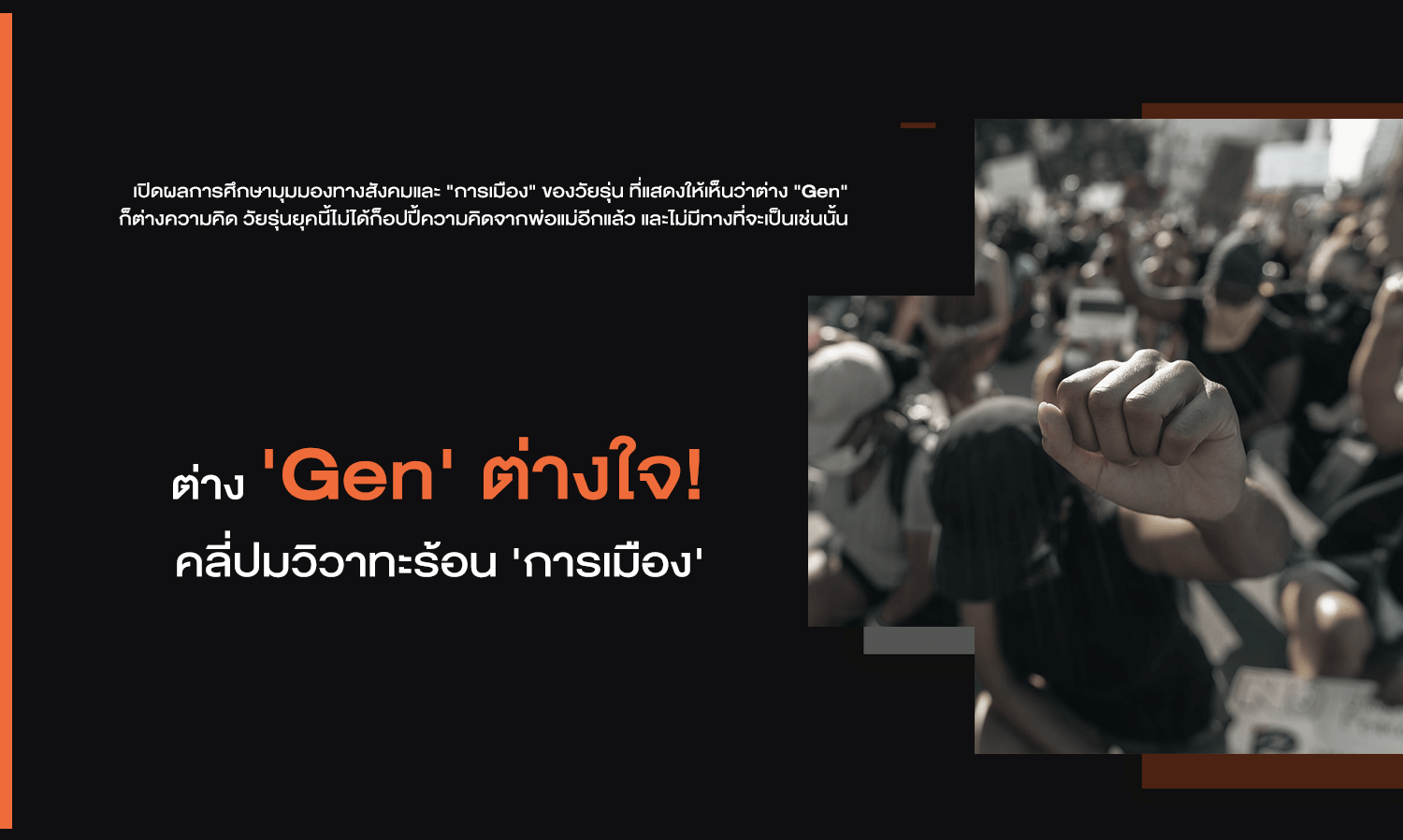
Different 'Gen', Different Hearts! Unraveling the Heated Debate on 'Politics'
A study reveals the social and political perspectives of today's youth, showing that different generations have different thoughts. Today's teenagers no longer copy their parents' ideas, and there's no way they will.
We should not expect to paint with the same brush.
...............................................
It is believed that many adults are emotionally involved with the current political situation and are very dissatisfied with the movements of students, leading to insults, criticisms, and even threats and hostility flooding social media.
The conflict of ideas and political expression today has made it clear to Thai society that there is a generational divide, with one side affirming its traditional status while the other clings to the right to determine its own future.
Undoubtedly, the first group consists of adults, the parents' generation. They often claim that their role as parents is to provide or offer good things to their children, including teachings that must be followed because every lesson is based on countless knowledge and experiences. Therefore, do not reject what parents teach.
At the same time, many adults often assert their ownership rights. Anyone who touches, changes, or reconstructs what they have always believed will immediately react like a raging demon.
The younger generation, as we see, is energetic, highly engaged, loud, and straightforward, making simple proposals without wasting time on convoluted interpretations. This intensity often provokes irritation among older generations who do not understand why they are protesting.
Insults like "You’re just a child whose parents didn’t teach you well" or "If you could think just a fraction like your parents, it wouldn’t be like this" stem from the assumption that the apple doesn’t fall far from the tree, including thoughts on social or political issues that are often transmitted from parents.
In the past, or with the parents' generation when they were teenagers, this assumption held true. Even ten years ago, it still applied. For instance, a 2005 Gallup survey of American teenagers found that 1 in 5 (21 percent) identified as more liberal than their parents, while 7 percent identified as conservative, and 7 in 10 (71 percent) said their social and political ideologies were similar to their parents.
However, over the past decade, everything has changed rapidly, especially communication technology, making knowledge easily accessible.
The American Sociological Review presented a survey in 2015 showing that more than half of teenagers do not recognize or relate to their parents' political ideologies. In simple terms, today’s youth no longer care about their parents' ideologies.
This study shows that teenagers no longer copy their parents' thoughts because they have access to diverse sources of information. They have a strong sense of individuality and can establish their own frameworks of thought, choosing to separate from their parents in their own way.
Nevertheless, the report suggests that rejecting being like one’s parents or searching for one’s identity is a natural part of growing up. If your children grow up this way, parents should take pride in having raised them correctly.
Thus, “just because they are young” is not a reason to automatically dismiss their beliefs as wrong. Listening to the voices of young people is essential; we should not discriminate against them simply because of their age.
Although this study originates from America, it can effectively explain the phenomena occurring in our country. At the very least, the term “mold” often used to keep children and youth in the shape that adults desire may need to be reconsidered to see what is appropriate for the current era.
Adults should not deceive themselves into thinking they are more capable; today’s youth are much more skilled than we are. If you can’t recall how they are skilled, just think about the days you helped your child with homework. Many parents must have been astonished, never expecting their children to learn such things, and of course! We have never been able to help them solve such difficult problems.
Not to mention the use of complex applications on mobile phones or the impressive video editing skills that are rare among the older generation but are basic skills for today’s youth.
Therefore, from now on, it is their time. Adults are merely the past that children can learn from and move beyond. We should not expect our children to fit into a single mold, as it is outdated and not conducive to their future lives.
Moving forward, we cannot predict how much the world will change. Clinging to a decaying old world that does not support the lives of future generations is quite selfish, especially when preserving it brings no benefits. It’s just counting down the days until it fades away.
The beautiful and appropriate path is to support our children in taking confident steps, listening to them maturely, and engaging in constructive dialogue.
The future belongs to them; we are merely observers.
SOURCE: www.bangkokbiznews.com