Tracing 4 Symbols of 'Modern Protest' Around the World
Protests today are vastly different from those of the past. Activists have devised more creative and impactful "symbols" to make their demands powerful and attract attention. Bangkok Business would like to highlight 4 protest symbols from around the world that many may still remember.
It is widely acknowledged that many people today have a shorter attention span than before, as we live in an era where new media, particularly “social media”, allows for quick messaging and news feeds limited to 280 characters.
As a result, activists in democratic societies have had to organize their activities in new ways, using symbols or tools to capture attention and make their messages memorable. Clearly, it is no longer just about holding up signs and shouting slogans like in the past.
Recent examples include the protests of the “Yellow Vests” in France and the “Umbrella Movement” in Hong Kong, which used their distinctive symbols to send messages to those in power and raise global awareness.
In the past 20 years, four political movements can be considered quite successful in terms of creating recognition and presenting their demands through powerful “symbols”.
- Yellow Vests (France, 2018-2019)
The “Yellow Vests” protests occurred in multiple waves across France and lasted over 2 months from late 2018 to early 2019, blocking highways from Provence to Normandy and resulting in riots in Paris, leading to at least 10 deaths and thousands of injuries from the violence.
The movement began as a protest against President Emmanuel Macron's planned fuel tax increase, which would raise the cost of living, and called for his resignation.
Ultimately, Macron backed down by announcing the cancellation of the fuel tax increase, part of the 2019 budget law, leading to a gradual calming of the nationwide protests.
Even after the protests ended, the “Yellow Vests” became a symbol of public discontent with Macron's government policies, as they were associated with the working class and were easily accessible.
Additionally, French law requires drivers to carry emergency vests, which are mostly yellow, in their vehicles for use in case of breakdowns or emergencies, in an effort to reduce the country's relatively high accident rate.
- Umbrella Movement (Hong Kong, 2014)
Historically, umbrellas were used primarily for sun and rain protection, but since 2014, “umbrellas” have become a symbol of the major protests in Hong Kong against the central Chinese government’s decision to limit the nomination rights for the Chief Executive of Hong Kong to candidates who are pro-Beijing.
While protesters used umbrellas mainly to shield themselves from tear gas, pepper spray, and rubber bullets from the police, the umbrella ultimately became a key part of the political movement known as the “Umbrella Movement”.
However, this was not the first time umbrellas were used as a protest symbol; in 2007, a movement in Latvia was later dubbed the “Umbrella Revolution”, where protesters gathered in the rain to express their opposition to government corruption and austerity measures following the global financial crisis, leading to the resignation of the then Prime Minister.
- Guy Fawkes Masks (Worldwide, 2011-2012)
The “Occupy Movement” began with protests by citizens in Zuccotti Park near Wall Street in New York City in September 2011, aiming to oppose income inequality, corporate greed, and the influence of money in politics.
The early protests on Wall Street had the slogan “We are the 99%”, highlighting income inequality and wealth distribution in the U.S. between the wealthiest 1% and the rest of the population.
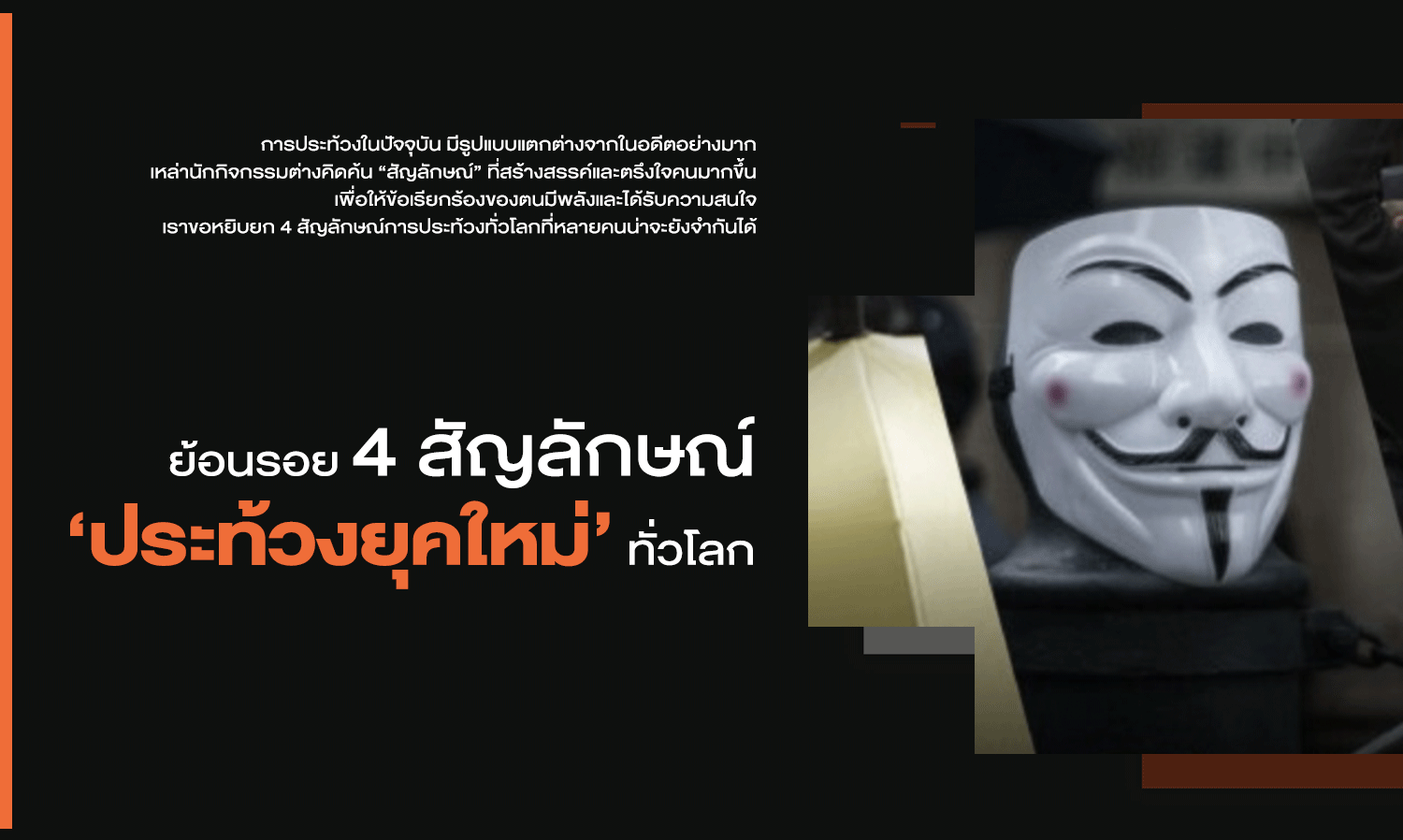
Subsequently, the Guy Fawkes mask became a symbol of this movement and others around the world, as protesters in various countries showed their support for the Occupy Wall Street movement by wearing the masks and joining in.
The movement drew influence from Guy Fawkes, also known as Guido Fawkes, an English Catholic who attempted to blow up the House of Lords in London and plot to assassinate King James I but failed in 1605.
Over 400 years later, the Guy Fawkes mask gained fame from the literature adapted into the film “V for Vendetta” and became a widely recognized symbol of resistance since the film's release in 2006.
The mask first played a significant role in protests in 2008 by the hacker group “Anonymous”, known for cyber-attacks against governments, state institutions, government officials, corporations, and the Church of Scientology, with members always wearing the mask to conceal their true identities.
Today, the Guy Fawkes mask is widely used in political protests in many countries and territories, including anti-government rallies in Hong Kong.
- Pots and Pans (South America 2001, 2012, 2019)
Pots or pans in Spanish are referred to as Cacerolazo, derived from Cacerola, meaning stockpot/stew pot, while Cacerolazo translates to banging pots/pans, which became a form of protest using pots, pans, or other kitchenware to create loud noise, symbolizing protests in Argentina during the financial crisis in 2001 and again in 2012.
The reason pots or pans were used in this context was to ensure that the content of the protest reached the awareness of the upper class or ruling class in society.
In October last year, Chileans used the method of banging pots/pans to protest the government after announcing a subway fare increase during peak hours to about 35 pesos, citing the need for the state to bear high energy costs and a depreciating peso.
This plan led to widespread dissatisfaction among the public, especially among students and high schoolers, prompting many to decide to take to the streets and protest loudly with pots and pans.
During this time, Chilean President Sebastián Piñera declared a state of emergency following the protests over the subway fare increase, which significantly impacted the cost of living for citizens, escalating in intensity.
After declaring a state of emergency, Piñera also allowed military forces to maintain order in various areas of the city.
This form of pot-banging protest is also prevalent in other countries, particularly in Venezuela, Uruguay, Ecuador, Cuba, Peru, Brazil, and Puerto Rico.
Today, the Cacerolazo or pot/pan banging protest has gained popularity in other regions, including Spain, Canada, and Iceland, and what sets this form of protest apart from others is that protesters can express their stance by banging pots/pans from home.
SOURCE : www.bangkokbiznews.com