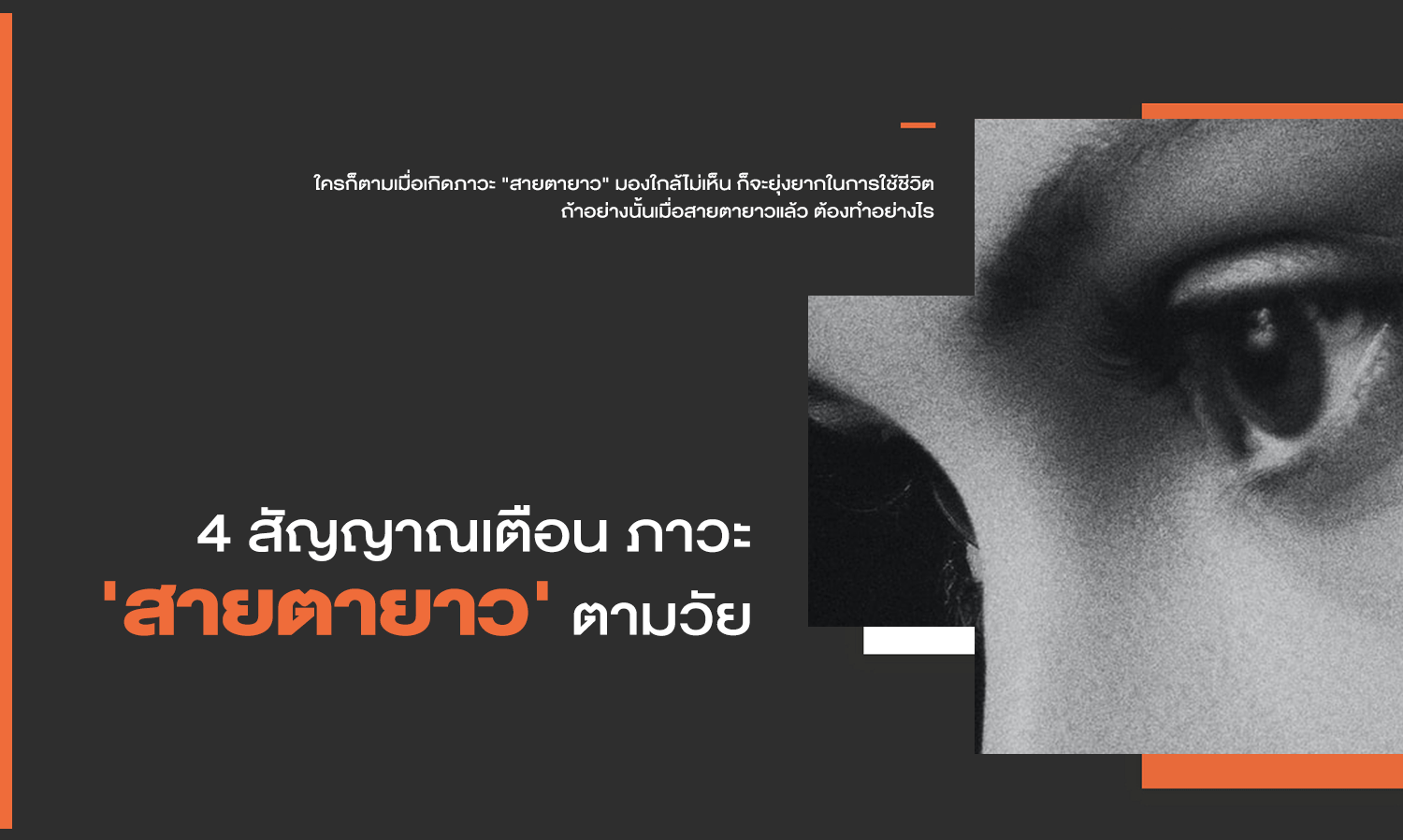
4 Warning Signs of Age-Related Farsightedness
When someone experiences "farsightedness" and struggles to see things up close, it can complicate daily life. So, what should you do when you develop this condition?
Many people may not realize they have a vision problem, even if they have never had any issues before. However, as you approach your 40s, you might encounter “age-related farsightedness” as well.
Most people often confuse farsightedness with presbyopia, but they are not the same. Essilor, a leader in vision correction, provides information to help you take care of your eye health properly.
Farsightedness comes in two types. The first type is congenital farsightedness, which is caused by genetics. If someone in your family has this issue, it is likely that you may experience it too. One cause of congenital farsightedness is that the eyeball is shorter than normal, causing unclear vision because light focuses behind the retina instead of on the retina itself.
The other type, which almost everyone will face naturally, is age-related farsightedness. Symptoms typically begin to appear as you near 40 years of age, and the onset can vary from person to person. Symptoms become more pronounced as the lens of the eye hardens due to natural aging, making it difficult to focus and see objects up close clearly, as the lens's flexibility decreases.
Age-related farsightedness is a natural occurrence, not a disease, and it cannot be prevented. However, you can recognize it through the following 4 warning signs:
Headaches may occur, along with discomfort in the eyes or headaches after prolonged use of your vision, especially when focusing on nearby objects for extended periods, such as reading, sewing, knitting, or drawing.
Eye fatigue or strain happens because the eyes must work harder to focus on nearby images, leading to tiredness that makes it difficult to adjust focus. Some may also experience headaches as a result.
Difficulty seeing up close may require squinting to see details of nearby objects. You might start having trouble reading books or small numbers at arm's length (about 1 foot), necessitating holding them further away or extending your arm to see clearly.
Poor vision in low light is another sign, as some people require more light than others to see things clearly. This symptom becomes more evident as age-related farsightedness develops.
There are two main solutions for age-related farsightedness: the easiest, quickest, and safest method is to wear prescription glasses as recommended by eye care professionals, which allows for immediate clarity without surgery.
Currently, there are innovative lenses that provide a complete solution in a single pair of glasses: progressive lenses. These seamless lenses allow for clear vision at all distances, addressing the needs of those with age-related farsightedness who previously had to carry multiple pairs of glasses and switch between them for near and far vision.
Some may use reading glasses for close-up tasks and look over the lenses for distance, while those with nearsightedness may need to remove their glasses for close work, which can affect their appearance.
Progressive lenses thus offer a solution for those needing multiple prescriptions in one lens, enabling a confident and convenient lifestyle without the hassle of switching glasses. Eye surgery to correct light refraction involves reshaping the cornea, the surface of the eye, and adjusting focus at the root of congenital farsightedness.
It is not recommended to use surgery to correct age-related farsightedness because vision can change over time with aging, making it not a long-term solution, as surgery cannot be performed every time your prescription changes.
SOURCE: www.bangkokbiznews.com