
Research Findings on Investment Decisions for Creating Passive Income Among Real Estate Investors: Expected vs. Actual Returns
Today, many people are likely familiar with the term passive income, as they seek to have their money work for them. They desire to become wealthy easily and quickly, without hard work, wanting more time to enjoy life and to retire early. Especially in this era of very low interest rates, people hope to get rich quickly through real estate investments, often setting targets for returns of 7% or 10%. This is significantly higher than returns from other types of investments. But is this actually achievable?
Associate Professor Dr. Niti Rattanapreechawech, a faculty member at the Faculty of Commerce and Accountancy at Thammasat University, along with Dr. Monthinee Theeramangkalana, from the Pridi Banomyong International College at Thammasat University, have published research titled “Investment Decisions for Creating Passive Income Among Real Estate Investors: Expected vs. Actual Returns” This research article has been published in the international academic journal Cogent Business and Management Vol.1, Issue. 1. It aims to study the decision-making of investors in real estate and their attitudes towards income and the expected versus actual returns. From a sample of 334 individuals, it was found that 35.3% invest directly in real estate, particularly condominiums, 27% invest in single-family homes and townhomes, with other types of real estate investments spread out. For indirect investments in real estate, 34.4% invest in real estate mutual funds, 29.2% invest in real estate company stocks, and 25.5% invest in REITs. Additionally, 26.5% of the sample group invest in bank deposits, 24.2% in stocks, and 16% in lottery deposits.
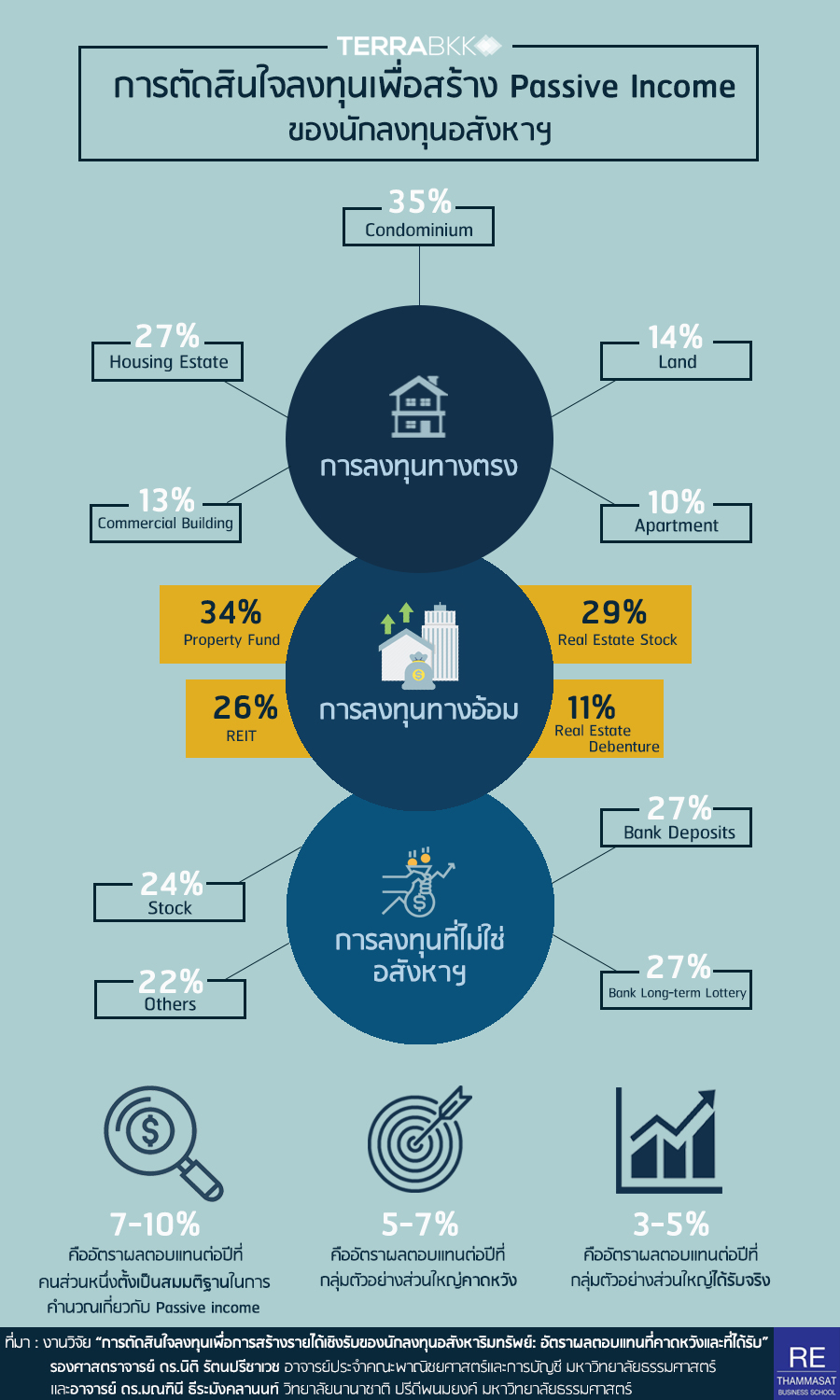
The research results indicate that while direct real estate investments, such as renting out properties, are more complex than other types of investments, they remain popular among investors. For all types of real estate investments, both direct (where investors own tangible assets such as condominiums, single-family homes, townhomes, land, commercial buildings, apartments, etc.) and indirect (investing in financial assets like real estate mutual funds, bonds, common stocks, etc.), the returns received are not as high as investors expect. This suggests that the ultimate goal of financial freedom for most investors may not be achievable. This research indicates that investors should not expect excessively high returns, which sometimes exceed reality, as this can lead to unrealistic investment goals and a longer payback period than planned due to actual returns falling short of expectations.
The returns that most investors receive are around 3-5% per year from generating passive income, which is considered challenging because passive income investment strategies often estimate returns above 10% and emphasize the power of compound interest. However, in reality, achieving high returns is difficult. Nevertheless, the research shows that while it is challenging to achieve a 7% return, there are a few investors who can do so.
From these points, it can be concluded that achieving financial freedom through passive income investments is difficult, especially when the initial investment is small. This study can provide guidance for investors seeking financial freedom. First, investors should assess their investment potential based on past returns, avoid setting unrealistic investment goals, accept the reality of lower return opportunities, and evaluate the risks they can tolerate.
Although direct investment in real estate typically yields higher returns than other types of investments, investors should consider responsibilities such as managing tenants, property depreciation, occupancy rates, and maintenance, as well as liquidity and other issues. These are the challenges faced by real estate investors.
Ultimately, TerraBkk believes that investing in real estate or other types of investments carries risks. Investors should thoroughly research information before making investment decisions, understand the risks associated with each type, and find ways to mitigate those risks, including diversifying their investments.