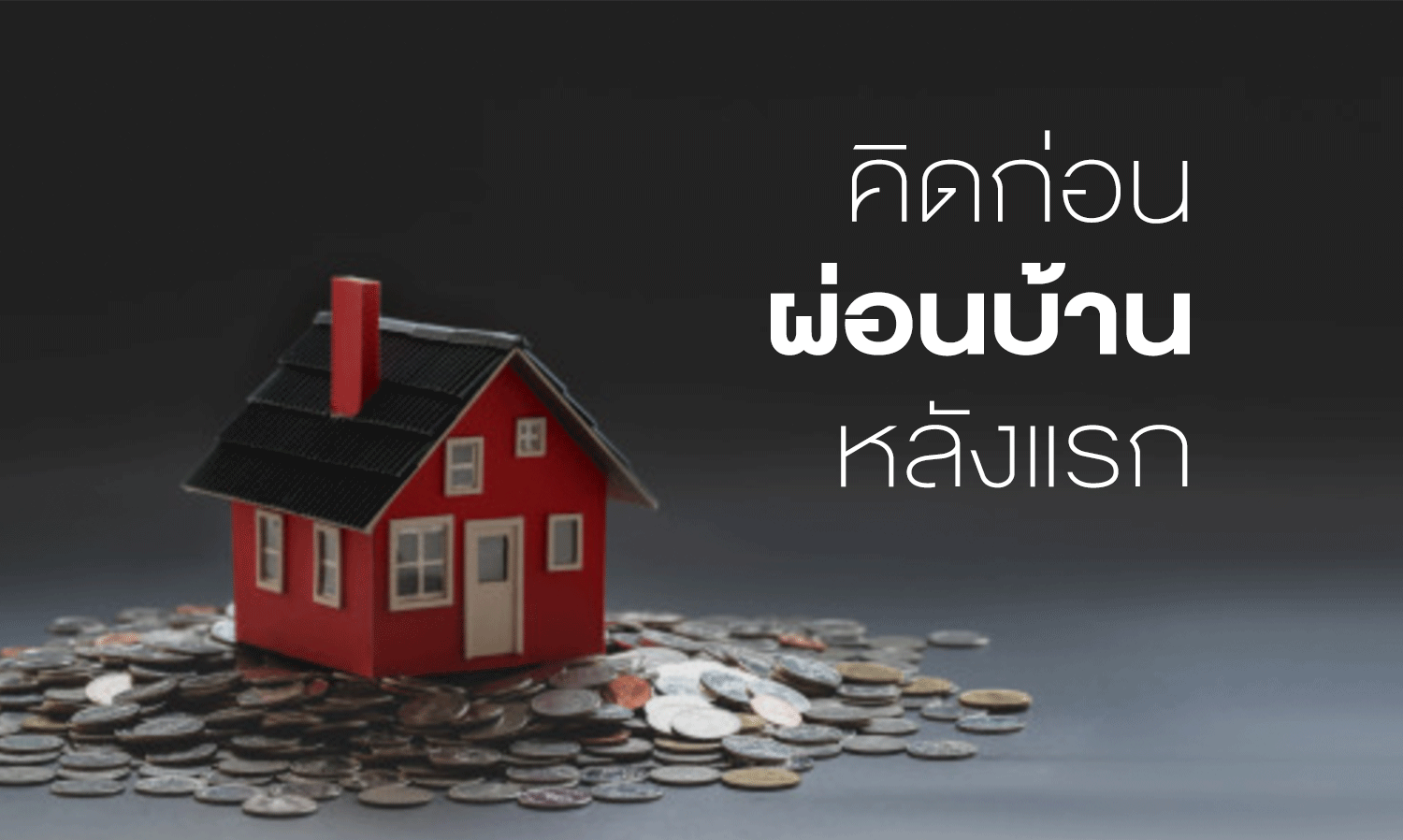
Think Before Financing Your First Home
"Home" is a basic necessity for living. Therefore, when people have stable jobs and income, many aspire to fulfill their dream of owning a home. The common method of purchasing a home is to apply for a loan from a commercial bank, which typically has a longer repayment period than other types of loans, up to a maximum of 30 years. This means that if you decide to buy a home, you will have a repayment obligation for a significant part of your life.
Thus, when deciding to finance a home, especially if it’s your first one, it’s crucial to think carefully. A mistake could lead to a longer time to resolve issues than anticipated.
1. Assess Your Financial Status
“Income” and “expenses” will determine your ability to repay debts. According to financial planning principles, total monthly debt obligations should not exceed 40% of your income. For example, if your salary is 45,000 Baht, your total debt payments should not exceed 18,000 Baht. Therefore, if you have other debts, such as car loans or credit card debts, it may reduce the amount you can borrow for a home.
For instance, if you pay 6,000 Baht per month for a car loan and 2,000 Baht for credit card debt (totaling 8,000 Baht), it means you can afford to pay another 10,000 Baht for a home loan (18,000 - 8,000). Hence, before buying a home, you should evaluate your income to determine what price range is suitable for you and assess your expenses to understand your monthly repayment capacity.
2. Buy a Home at a Reasonable Price
Once you know your financial status and monthly repayment capacity, you will understand what price range is appropriate for your home purchase to avoid excessive burden. The basic principle for assessing a commercial bank's loan amount is calculated based on how much the borrower can afford to pay each month. For example, a monthly payment of 8,000 Baht corresponds to a debt of 1 million Baht. This means if you can pay 8,000 Baht per month, the bank will lend you 1 million Baht. If you can pay 16,000 Baht per month, you can borrow 2 million Baht, and so on.
Maximum loan amount = (1,000,000 x monthly repayment capacity)
8,000
For example, if you can afford to pay 10,000 Baht per month, you can borrow up to 1,250,000 Baht. However, this is a rough calculation. To know exactly how much you can borrow, you should consult with a bank officer, as the amount you can borrow also depends on other conditions such as the repayment period, interest rates, or whether you have a co-borrower.
3. Save for a Larger Down Payment
When planning to buy a home, you need to have money for a down payment, typically around 5-20% of the home price. The remaining amount can then be financed through a bank loan. Many people choose to make the smallest down payment possible. The advantage is that it requires less of your own money upfront, but the downside is that it results in higher interest payments. Therefore, if possible, you should prepare to make a larger down payment, such as 20% or 30%, to save on interest costs.
For instance, if you buy a home for 1,500,000 Baht and make a 10% down payment (150,000 Baht), you would need to borrow 1,350,000 Baht from the bank. Assuming a 6% annual interest rate over 25 years, your monthly payment would be 8,698 Baht, and the total interest paid would be 1,259,421 Baht. However, if you make a 30% down payment (450,000 Baht), you would only need to borrow 1,050,000 Baht, resulting in a monthly payment of 6,765 Baht and total interest of 979,548 Baht.
Since the down payment will be a substantial amount, preparing funds in advance for your first home can ease the financial burden. One way to do this is to set aside a portion of your salary for investment, such as investing 1,000 Baht monthly with an average return of 7% per year. After 10 years, this investment could yield around 173,084 Baht, which can be used as a down payment. However, this amount may be low, so you might consider adding more funds to increase your down payment.
4. Increase Monthly Payments
In the early stages of your career, when your salary is not high, you should opt for the longest repayment period possible, such as 25 or 30 years, to reduce monthly expenses. However, whenever your salary increases or you have additional income, you should raise your monthly payments. You could use a step-up approach, for example, paying 6,765 Baht this year, 7,765 Baht next year, and 8,765 Baht the following year. This strategy will help you save on interest and pay off your debt faster.
Thinking about owning a home can be a significant decision for many. Some may feel confused about how to start or worry about not being approved for a loan. However, with careful planning and preparation, owning a home can become a much more manageable goal.
SOURCE: www.scb.co.th