Summary of Real Estate: Key Economic Indicators 2020
Today, Terrabkk summarizes the important topics and issues from the annual seminar held in 2020, titled Real Estate: Key Economic Indicators 2020, organized by the Thai Condominium Association, the Housing Business Association, and the Thai Real Estate Association on February 25, 2020, at the Anoma Grand Hotel, Ratchaprasong, Bangkok. The key points are as follows:
“Government Economic Policies to Build Confidence in the Real Estate Business”
Mr. Parinya Patthanapakkadee, Chairman of the Government Housing Bank, who presided over the ceremony, stated that real estate is a crucial sector of the economy, interconnected with other sectors such as employment, construction, and financial institutions. Therefore, the government must support and instill confidence in the business. Currently, there are real estate policies such as the self-housing policy, tax measures, and the Good House with Down Payment project. Additionally, the government is working to build confidence through various direct and indirect factors, including interest rate adjustments regulated by the Bank of Thailand, commercial banks, and specialized banks, as well as infrastructure development. The government must participate in investment development to ensure that real estate plays a role in driving the economy.
“Economic Trends, Money Market, Capital Market, and Impact on the Real Estate Market in 2020”
Dr. Sompravin Manprasert, Head of Research at Krungsri Bank, stated that the economic outlook for 2020 predicts a slowdown in the Thai economy due to three negative factors affecting supply and income, which also reduce economic confidence and slow down economic growth. The factors are as follows:
- Delays in Investment Budgets have led to a slowdown in public construction investment, resulting in a loss of investment value of 150 billion baht, which could reduce GDP by approximately 0.9%.
- Covid-19 Outbreak Krungsri Research predicts that the virus outbreak will peak in March and gradually decline by May. The impact of the coronavirus outbreak may spread to the global economy, affecting the tourism sector worldwide, as one in five dollars circulating in the tourism system comes from China. The Thai economy is expected to be heavily impacted in the first half of 2020, with GDP projected to decrease by about 0.4% due to a 4-5% drop in tourists and an expected 0.8% decline in Thai exports.
- Severe Drought due to prolonged drought and low average rainfall, which will impact the agricultural industry due to rising production costs.
The overall housing market in 2020 saw an increase in supply in 2019, partly due to the impact of the LTV measures announced in 2018. However, demand slowed in 2019 as it could not absorb the accumulated supply. It is predicted that the stock of housing projects will sell out within one and a half years if demand remains stable.
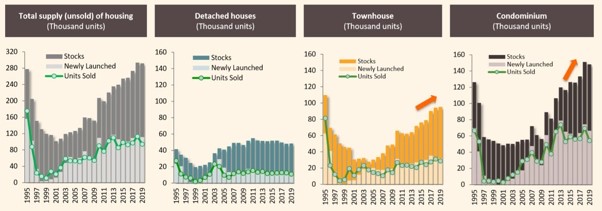
Source: AREA, Krungsri Research
“Policies, Laws, Regulations, and Rules Affecting Thai Real Estate Development Business in 2020”
This topic featured a discussion among Mr. Chumphon Suwanakijbhan, Secretary-General of the Fiscal Policy Office, Mr. Tumsiri Chongpunphol, Director of the Air Quality and Noise Management Division, and Dr. Vichai Wiratthakhan, Bank Inspector and Acting Director of the Real Estate Information Center, covering the following points:
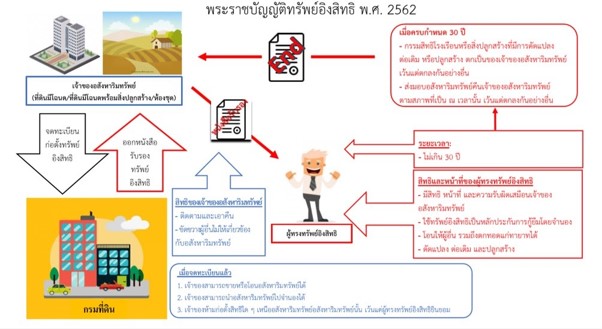
The Property Ownership Act of 2019 came into effect on October 27, 2019, stipulating that property owners must be landowners with title deeds and condominium owners only, with a maximum duration of 30 years. The property owner has rights, duties, and responsibilities akin to those of real estate owners. The rights of property owners differ from regular tenants, as the law allows them to lease, sell, or transfer their property to create value. This legislation is expected to encourage and instill confidence in investors, allowing them to utilize their real estate rights more conveniently, especially for property lessors and sub-lessors.
The consideration of the environmental impact assessment (EIA) report in Bangkok summarized the EIA report review results from the Environmental Impact Assessment Committee in Bangkok from October 2, 2016, to December 26, 2019. A total of 377 projects passed the EIA review, while some projects did not pass due to reasons such as: 1) social and public participation, 2) measures to prevent and mitigate environmental impacts, 3) sunlight obstruction and wind direction, 4) traffic, 5) air quality, noise, and vibration, 6) fire prevention and suppression, and 7) construction permits.
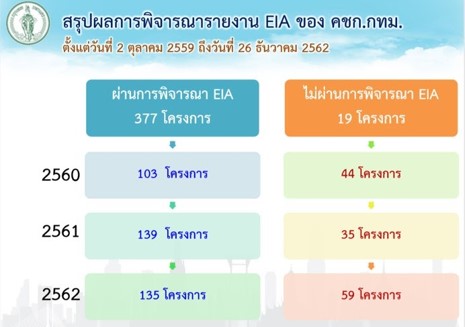
Regarding the issue of projects not passing the EIA, it was suggested that before developers purchase land, they should submit an EIA request first, making a preliminary purchase agreement. Once the EIA is approved, they can proceed with the land purchase and development, which would help resolve construction delays and project cancellations due to EIA failures.
“Real Estate Market Trends in 2020”
Dr. Apakorn Attaboonwong, President of the Thai Condominium Association, discussed the factors affecting the real estate business in 2020, both positive and negative:
Positive Factors include more relaxed LTV measures and government purchasing power stimulus measures, the new city planning allowing for better land utilization, increased transportation systems, urban expansion leading to higher demand, and stable housing prices facilitating ownership.
Negative Factors include the trade war and global economic slowdown affecting foreign purchasing power, high household debt levels, stricter loan assessments for home buyers by banks making it harder for people to own homes, and high development costs for developers due to rising land prices.
Furthermore, the outlook for the real estate market in 2020 predicts:
- Developers will launch fewer new projects due to existing accumulated supply.
- Ready-to-move-in condos will see increased price competition.
- New condos will target middle to lower market segments more.
- Developers will intensively control costs.
- There will be opportunities for real demand in condo purchases, leading to a softening of the investor segment.
- Condo buyers will prioritize health, environmental and social factors, energy savings, and technology.
Mr. Wasan Kheangsiri, President of the Housing Business Association, stated that developers should consider various factors, including consumer purchasing power, LTV measures, land and property taxes, and household debt. They should adapt to these constraints. Despite the current situation, there are still opportunities for developers, such as low-interest rates and new transportation infrastructure. They should also focus on technology, especially Big Data, to reduce business risks by implementing SALE (Selective, Accuracy, Live, Efficiency).
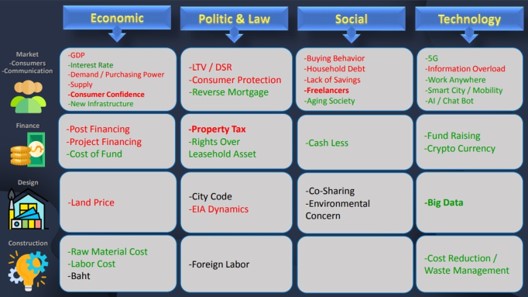
Factors that real estate developers should consider
Dr. Apakorn Attaboonwong suggested that credit bureaus should not only disclose information to banks but also to developers. This would help filter clients who can make payments more effectively, as clients often provide inaccurate information during the real estate sales process, leading to loan rejections.
Perspectives on the Real Estate Business
In the rental business, there are still good opportunities, but considerations should include break-even points, rental prices, and locations near job centers, as people need to work in cities. When purchasing housing in urban areas is not feasible, renting becomes essential.
In the long-stay business, there are opportunities from foreigners due to the relatively low cost of living in Thailand. However, there are business limitations. If developers see this market, they should study the constraints and adapt accordingly.
Mr. Wasan Kheangsiri advised that despite various factors impacting the real estate business leading to a market slowdown, developers should not remain idle. They must prepare their organizations, enhance personnel efficiency, and study and implement new technologies in products and services to create productivity and compete effectively.