
"Time Management" - The Foundation of Successful People
Most people believe that the most valuable resource is "money", while successful individuals think otherwise. For them, the most valuable resource is "time". Successful people know how to manage their time, allowing them to work more effectively than others!!! After all, everyone has the same 24 hours in a day.
Typically, everyone's work consists of job-related tasks and personal or family-related tasks. Those who can manage their time effectively regarding each type of task will achieve success in their careers and enjoy their personal lives.
So, what are the principles of good time management? The simple principle of time management is to categorize tasks into four types, ranked by "importance" to understand which tasks should be prioritized based on their significance and "urgency". The details are as follows:
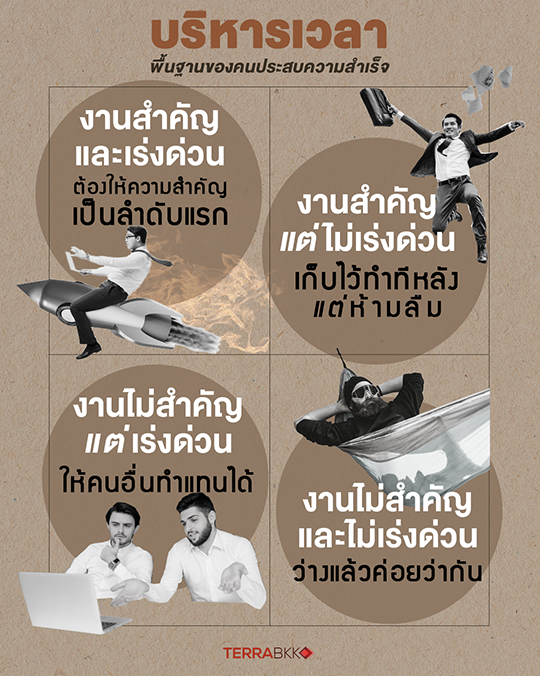
"Time Management" - The Foundation of Successful People
1. Important and Urgent Tasks are tasks that we must prioritize first.
If we don't complete these tasks promptly, it can negatively impact our careers or our families. For example, a report needed for a meeting tomorrow (must be finished today), meeting an important client to pitch a project in the afternoon (if we don't meet this client, we might lose them or potential income), or a family-related task like buying a gift for a loved one's birthday (if we don't prepare a gift, it might upset our partner).
2. Important but Not Urgent Tasks are indeed important but can be postponed because they are not urgent.
However, don't forget about them, or they may turn into important and urgent tasks instead. This group of tasks often requires significant time for planning, creative work, and team-building activities at work. Although these tasks are not urgent, completing them can lead to both short-term and long-term success. Remember, even if these tasks are not urgent, they are still important, such as a new project proposal for a meeting next month (this task is crucial for our careers, so it requires careful planning) or family-related tasks like planning a New Year's trip (this is important for spending quality time and enjoying life with family).
3. Not Important but Urgent Tasks are tasks that can be delegated to others.
If we can delegate these tasks, we should clear them as quickly as possible! These tasks do not significantly help us achieve our goals because they tend to interrupt our focus, such as minor meetings during the day or responding to detailed emails. If we cannot delegate these tasks, we should aim to complete them as quickly as possible.
4. Not Important and Not Urgent Tasks are tasks that should only be done in our free time.
This group of tasks can actually be skipped because they do not impact our goals and can waste our time. If we choose to do them, it's better to do so during our spare time or on days off, such as following trending hashtags or online shopping.
Initially, we may feel confused when categorizing tasks by importance, but with continuous practice, it will help us prioritize tasks better. This will undoubtedly lead to greater happiness in both our work and personal lives. --- TerraBKK