In-Depth Look at Senior Housing ...in the Land of the Rising Sun
In-Depth Look at Senior Housing ...in the Land of the Rising Sun
This is a summary of the key points from the seminar titled "In-Depth Look at Senior Housing...in the Land of the Rising Sun", which provided valuable insights into real estate projects for the elderly based on concepts from Japan. The seminar featured knowledge shared by Assoc. Prof. Trairat Jarutthas and Mr. Keiji Arai, a real estate expert from Japan, who effectively educated the participants on Saturday, December 14, 2019.
Assoc. Prof. Trairat Jarutthas, Faculty of Architecture, Chulalongkorn University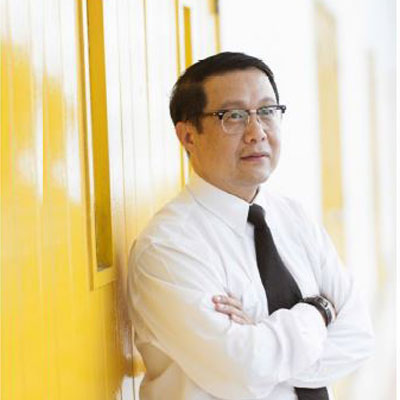
“Japan, Europe, and America have fully entered a super-aged society.”
“By 2050, the global population aged over 60 will reach 2 billion.”
“Thus, the elderly market is a significant segment of the real estate business.”
The aged society, as defined by the United Nations, is a country where the population aged 60 and over exceeds 10% of the total population. The levels of entering an aged society are categorized into three levels:
- Aging Society: This refers to a population where those aged 60 and over exceed 10% of the total population or those aged 65 and over exceed 7%.
- Aged Society: This refers to a population where those aged 60 and over exceed 20% or those aged 65 and over exceed 14%.
- Super-Aged Society: This refers to a society or country where those aged 65 and over exceed 20% of the total population, indicating that the country has fully entered an aged society.
Thailand entered the aged society in 2005, with 10.4% of the population being elderly. According to the 2015 population data, Thailand had 65,203,979 people, with 10,569,021 aged 60 and over, accounting for 16.2% of the total population. It is projected that by 2021, Thailand will fully enter the aged society, with over 20% of the population being over 60 years old. This situation results from advancements in technology and medicine, leading to increased life expectancy, alongside family planning policies that have reduced birth rates, causing a rapid increase in the elderly population in Thailand.
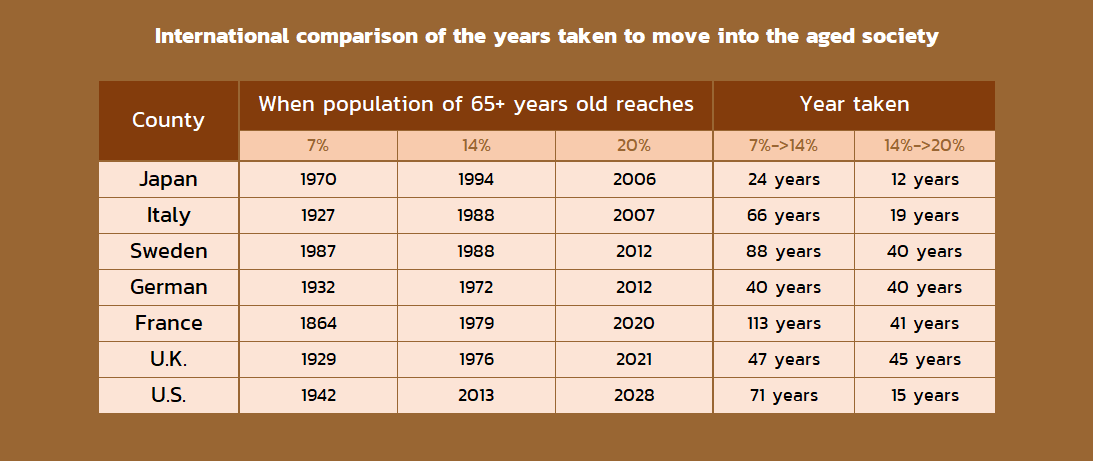
According to a comparison table of the transition into an aged society, Japan is an example of a country that has quickly entered a super-aged society, followed by Italy, Sweden, and Germany.
The average life expectancy worldwide from 2005-2010 shows that the populations in America, Europe, and Japan, considered developed countries, have the highest average life expectancy of 77.2-81.5 years, while countries in Africa, mostly developing countries, have an average life expectancy of only 41.5-50.7 years.

The number of elderly people worldwide is increasing, but developed countries also have high living costs, prompting many elderly individuals to move out of major cities to countries with lower living costs. Various countries see this as an opportunity and are targeting the elderly market. For instance, Malaysia's government has policies to promote the country as a global hub for elderly care services, supporting businesses related to the elderly and extending the long-stay visa for foreigners aged 50 and over from 1 year to 10 years to facilitate longer stays for elderly foreigners. Similarly, Thailand has recently extended the long-stay visa for foreigners aged 50 and over from 1 year to 10 years, applicable to 14 countries including Denmark, Norway, the Netherlands, Sweden, France, Finland, Italy, Germany, Switzerland, Australia, the United States, the United Kingdom, Japan, and Canada, requiring a bank account with a minimum deposit of 3 million baht to be held in a Thai bank for at least 1 year.
The long-stay elderly market has factors influencing the choice of country for long-term residence, including 1. Cost of living 2. Taxes 3. Crime and safety 4. English language usage 5. Entertainment 6. Environmental conditions 7. Expat community 8. Healthcare 9. Infrastructure 10. Ability to purchase real estate 11. Real estate restrictions 12. Leisure options 13. Housing options (items 7-13 are real estate-related factors).
For the Japanese elderly market, the target areas in Thailand that they are familiar with and interested in include Bangkok, Chiang Mai, and Phuket.
Data from a thesis on the Japanese elderly market in Thailand, collected over 15 years from a target group of 1,552 people, can be summarized as follows:
- Study the housing selection behavior of Japanese elderly tourists residing long-term: A case study in Chiang Mai province shows that the majority are male, aged 65-69, married, with a bachelor's degree, previously employed in companies, government positions, or personal businesses, financially stable, with most income from pensions, followed by savings, with an income of approximately 50,001-100,000 baht. They are in good health and enjoy activities such as golfing, primarily residing in condos on Huay Kaew Road and Nimmanhaemin Road in Chiang Mai. Factors influencing their housing choice include (1) Physical aspects such as public utilities, NHK Premium channels, and high-speed internet (2) Social aspects, preferring to live in communities with Thai people (3) Financial aspects, with condo rents ranging from 10,000-20,000 baht/month (4) House structure, requiring strong building structures with usable space and a kitchen (5) Project information, ensuring safety for life and property, and proximity to workplaces, shopping malls, and banks.
- Study the living conditions in rental projects for Japanese residents, case study in Sukhumvit Soi 41, Bangkok: The target group consists of 157 Japanese residents, mostly male, aged 41-50 (with some up to 75), holding bachelor's degrees, married, with some over 60 years old and single, in good health, with an income of 133,001-190,000 baht and expenses of 100,001-150,000 baht (mostly for housing and food). They primarily find housing through real estate agencies, with recommendations from friends, and rent costs range from 35,001-50,000 baht per month. Reasons for their choice include safety, proximity to communities, convenient transportation, and being near acquaintances. They mostly prefer one-bedroom apartments of about 60 square meters, with Japanese-style entrances, separate shower and bathtub areas, NHK channels, high-speed internet, and proximity to convenience stores and hospitals.
- Study the living conditions and health behaviors of Japanese residents in a multi-family building in Watthana, Bangkok: The target group consists of 134 Japanese residents, mostly female, aged 55-59, with bachelor's degrees, primarily working as managers in Bangkok. Their income comes from savings and an average salary of 200,001-300,000 yen, with average expenses exceeding half of their salary. They reside with spouses and one child. They gather information for housing selection from real estate agents, mostly living in apartments, followed by serviced apartments, with monthly rents exceeding 140,000 yen, and amenities including swimming pools, fitness centers, saunas, massage services, and playgrounds.
Mr. Keiji Arai, President & Representative Director, Green Life Co., Ltd.

“Currently, 73% of the wealthy in Japan are over 60 years old.”
“Thus, the elderly market in Japan is very interesting as it comprises a group with high purchasing power.”
Green Life is one of the top 10 elderly service industries in Japan, with over 68 elderly service facilities across the country, comprising 4,373 nursing home beds (with a utilization rate of 99%) and employing 2,748 caregivers. As Japan has over 20% of its population aged 65 and over, it has fully entered a super-aged society. The Japanese government allocates over 4 trillion yen (approximately 3 trillion baht) annually for elderly care, which is substantial. Therefore, the Japanese government has to allocate 11 billion baht for campaigns to promote healthy aging to reduce the number of elderly individuals needing medical and nursing services. Japanese seniors receive healthcare services through insurance with private health insurance companies and support from the government.
The health market in Japan has 5 million elderly individuals requiring long-term care services, with 35% needing nursing facilities and 65% requiring home care. Among the Japanese population with savings of 40 million yen, 73% are aged 60 and over, indicating that more than half of the elderly in Japan are financially stable. Thus, the elderly market in Japan is considered attractive due to its high purchasing power. The elderly care business (Continuing Care Retirement Communities: CCRC) is divided into 6 levels based on the elderly's ability to be self-sufficient: 1. In Home 2. Independent Living 3. Assisted Living 4. Alzheimer's Care 5. Nursing Home 6. Hospice Care. Investors can choose to develop one or multiple levels depending on their investment budget, space size, design, medical equipment, and facilities for the elderly, along with a team of medical professionals, nurses, and caregivers. Thailand has an advantage in terms of location for establishing large healthcare facilities with good medical care standards, but the main challenge is the need for personnel who can communicate effectively in Japanese and understand Japanese culture.
For Thai investors looking to establish elderly care services for Japanese seniors, it is advisable to find Japanese partners to help coordinate with Japanese clients. If the goal is to have Japanese individuals stay in Thailand for an extended period, creating a community system that includes both Thai and Japanese residents or volunteer groups would be beneficial. This is because seniors still desire social interaction, conversation, and shared activities such as cooking and karaoke.---TerraBKK