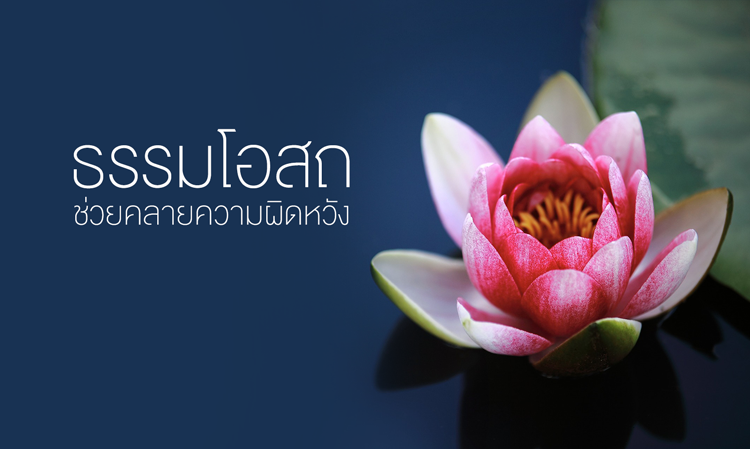
Dharma Medicine to Alleviate Disappointment
In today's society, many people are suffering from disappointment, unable to reach their goals despite their efforts. Some cannot accept the reality of their failures, leading to deep anguish as they cling to their disappointments. Buddhadasa Bhikkhu viewed this condition as a sickness of the mind, a spiritual ailment that can only be healed by Dharma medicine.
This spiritual illness is difficult to cure through conventional means because it is not a physical ailment. No medicine in the world can heal it; only positive perspectives can serve as a remedy to restore mental strength. In simple terms, it is about letting go of disappointment. This condition requires the nurturing of Dharma medicine.
The scriptures of Buddhism recount the story of a woman during the Buddha's time who suffered from a spiritual illness because she could not accept the truth that death is unavoidable. Kisagotami lost her young son and, unable to accept her disappointment, she desperately sought ways to bring him back to life.
She was the daughter of a once-wealthy merchant in Savatthi and married into another wealthy family to maintain her social status. She bore a son for her husband’s family, but her hopes for him to be a source of pride as a mother of the heir were shattered when he passed away unexpectedly.
Her hopes collapsed, yet she sought out healers to revive her son, still clinging to the hope that someone could help her. She carried her lifeless son around, drawing pity from those who encountered her.
She pleaded with people to help her revive her son until she reached the Buddha's residence, where she implored him to bring her son back to life.
The Buddha told her to bring him mustard seeds from a household where no one had died, and he would revive the child.
Kisagotami hurriedly searched for mustard seeds from various homes, but every house she visited had experienced a death. She then understood this truth.
The disappointment she could not accept began to ease in her heart. She remarked that no one escapes death, especially not a child who had lived only a few days before passing away.
She relinquished her son’s lifeless body and returned to the Buddha. He asked her about the mustard seeds she was to find. She replied that every home she visited had someone who had died, and now she understood that death is a universal truth.
The Buddha taught her that those who see birth and death, even if they live just one day, are more fortunate than those who have never witnessed it. This impermanence is not unique to any individual but is a universal truth. Kisagotami deeply understood this and chose to ordain as a nun in the Buddha's community.
Her healing from the spiritual illness came from accepting the truth. Her disappointment was completely released from her heart. The Buddha provided the Dharma medicine to alleviate her disappointment by allowing her to confront reality.
Buddhism teaches us to understand the truths of the world, to accept that nothing is permanent (anicca), that everything is subject to change (dukkha), and that nothing truly belongs to us (anatta). This understanding is the best solution to all problems and can significantly alleviate disappointment.
Information from the Buddha's methods for treating patients with mental disorders.