"Where do Thai SMEs Stand in the EEC and Global Market?"
The mega project known as the "Eastern Economic Corridor" (EEC) is an initiative by the government of General Prayuth Chan-o-cha aimed at elevating Thailand's industries and stimulating new private sector investments after a long stagnation since the economic crisis of 1997. This project can be compared to the investments during the "Chotichai Chatchai" era, which initiated the Eastern Seaboard project that led to the establishment of the petrochemical industry as a key driver of the economy at that time. The EEC focuses on 10 new industries, emphasizing digital and modern industries such as modern automotive, aviation and logistics, comprehensive healthcare, biotechnology, and smart electronics.
Currently, the bidding for projects and the issuance of related regulations are ongoing and becoming more tangible, divided into infrastructure components, including the development of U-Tapao Airport, high-speed rail connecting three airports, and the development of Laem Chabang deep-sea port and Map Ta Phut industrial port.
Another aspect focuses on benefits for target industries and the development of special economic zones, such as the Eastern Economic Corridor Innovation Zone (EECi) and the Digital Park Thailand (EECd).
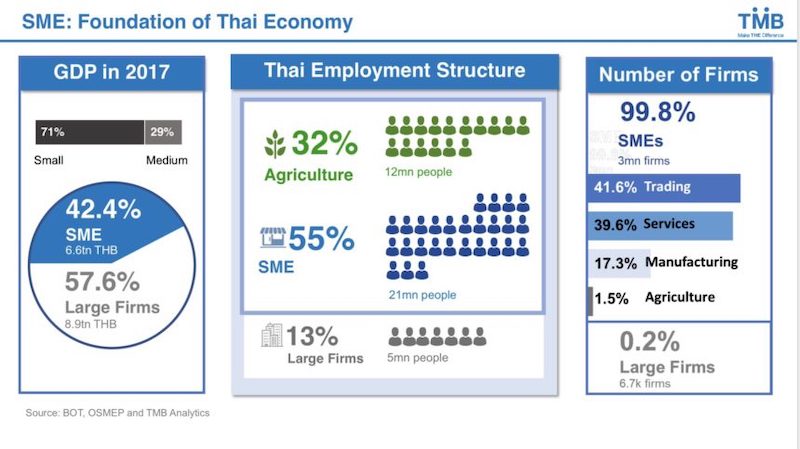
One important question is, under the benefits and infrastructure development in this Eastern Economic Corridor initiative, what will SMEs gain from the mega project investments? Especially considering the role of Thai SMEs, which are regarded as the backbone of the Thai economy, with approximately 900,000 businesses and accounting for over 80% of Thai employment.
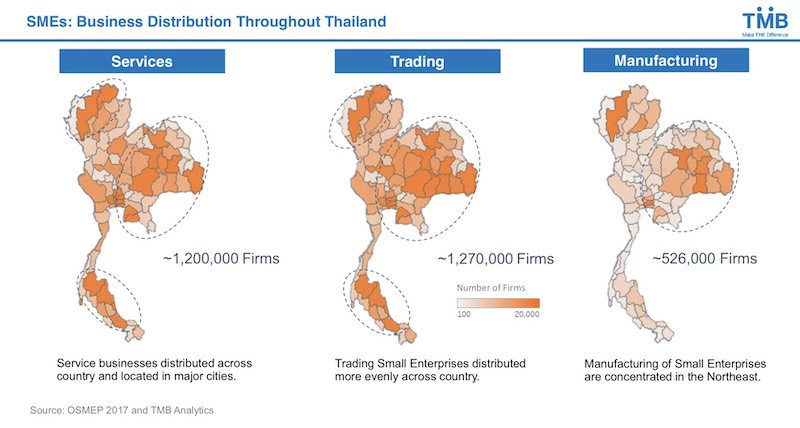
Previously, Thai Publica online news interviewed Mr. Naris Sathapholdej, Executive Officer at TMB Analytics, TMB Bank, about the study and analysis of Big Data concerning Thai SMEs, exploring their characteristics, locations, and potential for sustainable growth as a new driving force for Thailand.
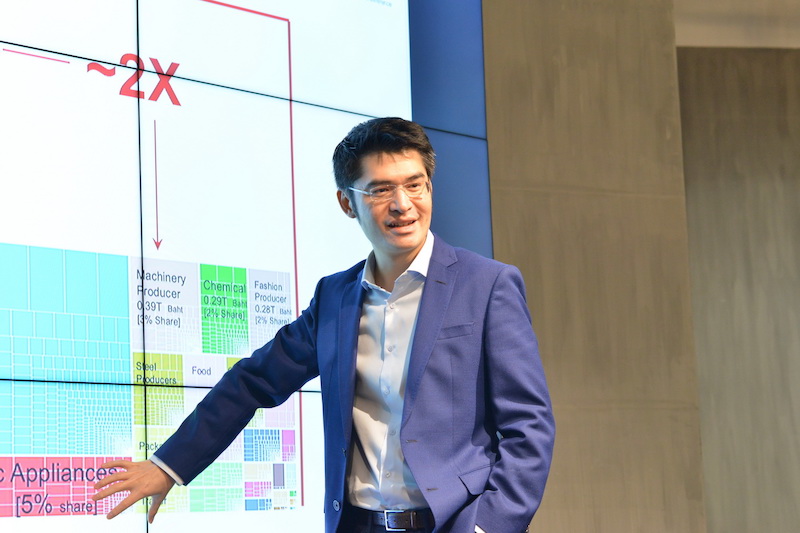
Mr. Naris Sathapholdej, Executive Officer at TMB Analytics, TMB Bank
- “Naris Sathapholdej” from TMB Analytics analyzes Big Data from 900,000 SMEs, noting that they operate without considering growth.
Recently, Thai Publica interviewed Mr. Naris Sathapholdej again to delve deeper into the structure and role of "Thai SMEs" to see if there is room for them to engage in transactions within the production chain or supply chain in the EEC, and whether they can connect with the global market or will be left behind once again.
Thai Business Income Concentrated – EEC Income 93% Concentrated Among Large Firms
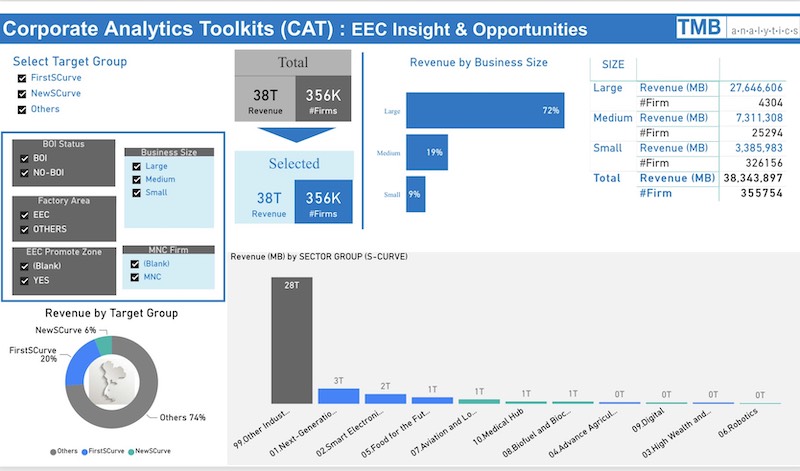
Mr. Naris described the overall picture of Thai businesses, stating that data from the Ministry of Commerce shows that there are 356,000 businesses still operating and reporting data, generating a total annual income of over 38 trillion baht. However, when categorized by business size, it is found that 72% of total Thai business income, or about 27.6 trillion baht, is concentrated in just 4,304 large companies. Meanwhile, medium-sized businesses account for 19% of total income, or about 7.3 trillion baht, with 25,294 firms, and small businesses contribute only 9% of total income, or 3.4 trillion baht, with 326,156 firms.
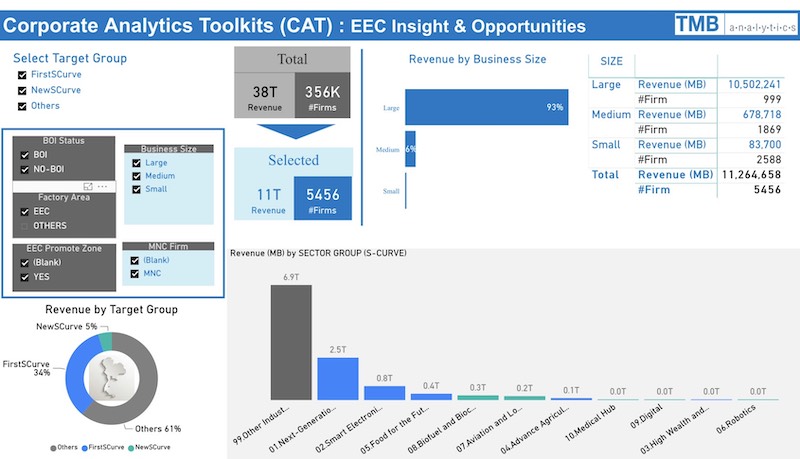
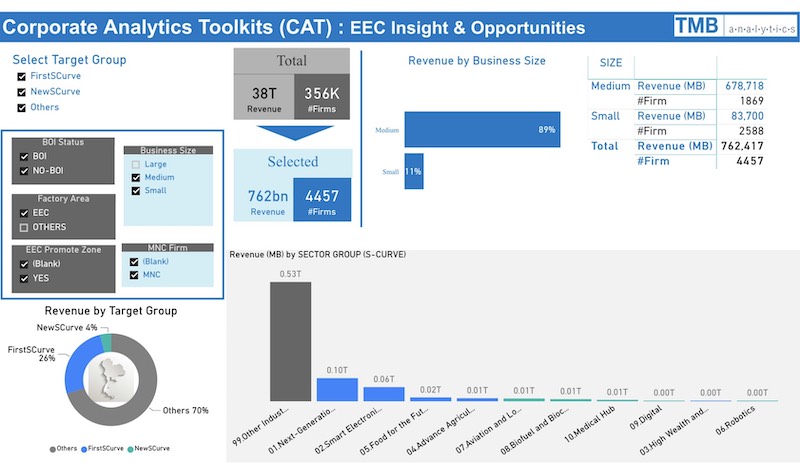
When examining the EEC area, there are only 5,456 businesses generating a total income of 11 trillion baht, divided into 999 large businesses that account for approximately 93% of total income in the EEC area, or about 10.5 trillion baht. In contrast, medium-sized businesses number only 1,869, generating 678.7 billion baht, and small businesses number 2,588, generating 83.7 billion baht, together accounting for only about 7% of total income.
“There are many issues, but today there is much discussion about the EEC. The question is, what do SMEs gain from the EEC? When looking at this structure, going to Chonburi or Rayong, when discussing the EEC with SMEs, they hardly show interest. They are only concerned about where to buy a condo for rental purposes, but they do not understand what the real benefits of the EEC project are. The EEC project is partly about infrastructure, which is okay when discussed externally (abroad), but when talking to SMEs, it feels distant. On the other hand, in terms of actual investment, it seems to favor large businesses. If we look at the industries with the most investment, such as the petrochemical sector, there are 1-2 large groups, and in automotive, there are Japanese companies, while tourism is starting to diversify a bit. This image has prompted TMB to create tools to see what opportunities exist for our SME clients and how we can help them engage more, to see that there are opportunities.” Mr. Naris stated.
“EEC” Benefits Not Linked to SMEs
Mr. Naris continued, from the data collected regarding business structure, a clear difference is observed. If we look at the business structure nationwide, the main industry is automotive, generating 4.4 trillion baht annually, followed by energy at 2.9 trillion baht, retail at 2.1 trillion baht, and petrochemicals at 1.7 trillion baht.
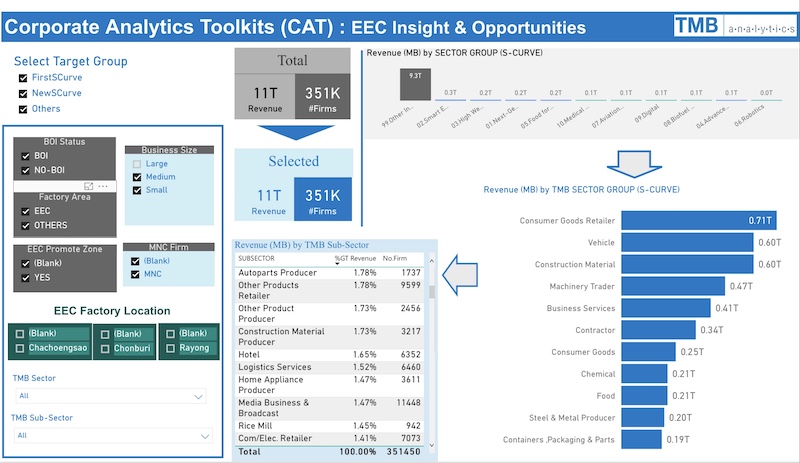
In contrast, the largest group of SMEs is in the retail industry, generating a total income of 710 billion baht annually, followed by the construction materials and automotive industries, each generating around 600 billion baht. Machinery trading generates about 470 billion baht, and services generate around 410 billion baht.
When focusing on the EEC area, the differences between businesses become even clearer. In the EEC area, the main industries are energy and automotive, each generating 2.6 trillion baht, followed by petrochemicals at 1.1 trillion baht, retail at 600 billion baht, and electronics and electrical appliances at 400 billion baht each.
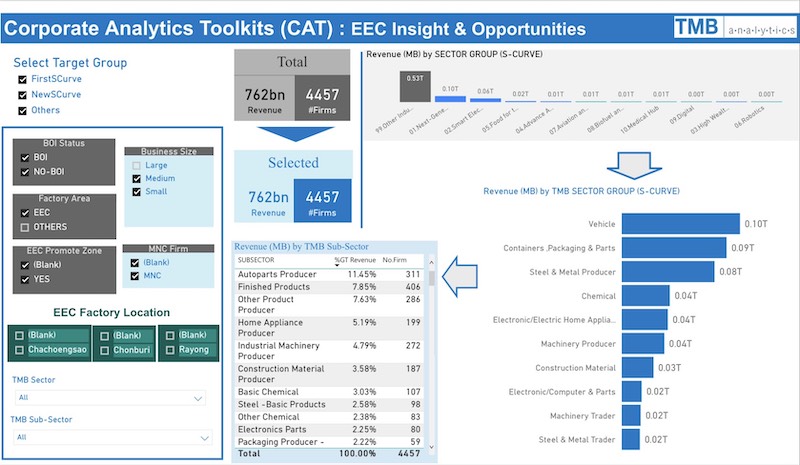
For SMEs in the EEC, the top income comes from the automotive industry at 100 billion baht, which is part of the automotive production chain, such as parts and components. However, looking at the next industries, the picture changes. Starting with the packaging industry, which has an income of 90 billion baht, it is expected to be a Thai industry, as it is unlikely that multinational companies will invest in opening plastic bag companies. Another group is the steel industry, generating 80 billion baht, such as producing bolts and steel components for machinery or construction, or the chemical industry, generating a total of 40 billion baht, which consists of medium-sized companies producing plastic parts, etc.
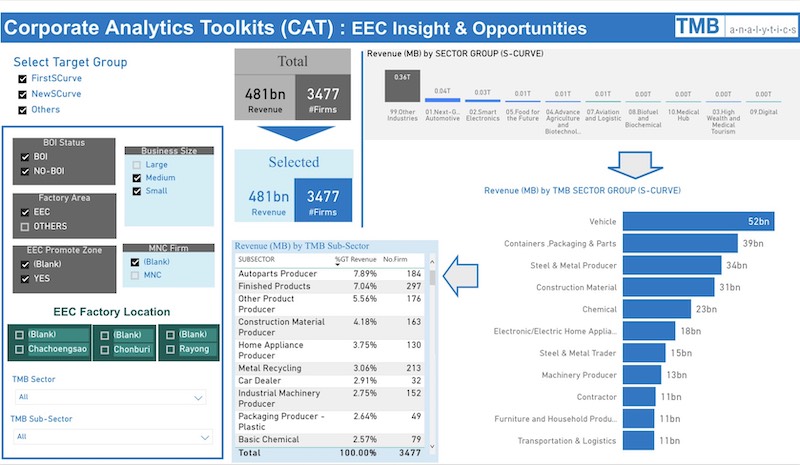
“It is evident that the picture is quite different. This is a problem with the structure of Thai SMEs. As mentioned above, the large businesses are in automotive, energy, large retail, and petrochemicals, but when looking at what the entire SME structure does, mainly they are in retailing commodities, which is buying and selling, doing construction materials. These groups are continuously facing competition from large companies, including e-Commerce. This raises the question of how SMEs, which make up half of the businesses, can survive in a buying and selling business. Therefore, I see that in the EEC project, there are still considerable opportunities for industrial businesses. There are at least 4,500 companies, and if we exclude foreign companies, there are still 3,477 Thai companies with a total income of 481 billion baht. We acknowledge that the income level is not the highest, but there is capital and opportunities for growth. If today your qualifications may not meet the EEC project criteria, there is still the question of how you should plan your business for the future, as you are in the EEC area. It is essential to create awareness that if not today, you must achieve this in the future. No one runs a business with the intention of closing down.” Mr. Naris stated.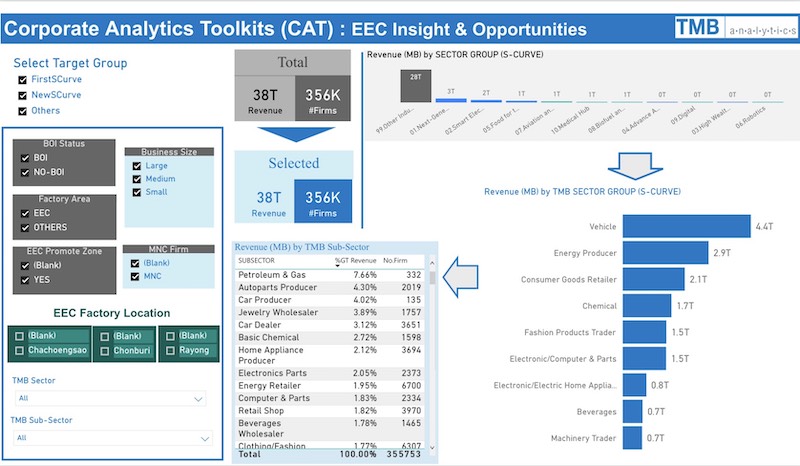
Encouraging the Government to Engage with SMEs – There is Still Much Room for Growth
Mr. Naris further discussed the benefits from the government, stating that investment promotion and being in special economic zones or target industries will receive corporate tax exemptions for 8-13 years, followed by another 3 years of reduced taxes by half, resulting in large companies enjoying a real tax rate of 7%, compared to SMEs in the system, which must pay a corporate tax of 20%.
“We roadshow the EEC project to foreign investors but do not roadshow the EEC project to Thai SMEs. I see this as a gap. Attracting foreign investors is necessary because the project requires substantial capital at the beginning. However, once that is achieved, I believe it is time to look inward. I am not suggesting selling the EEC project to noodle shops in Chonburi, but there are medium and small Thai companies that qualify and have potential, and we can elevate them. There are opportunities. We want to see SMEs grow, our clients improve, become larger, survive better, and receive equal benefits.” Mr. Naris stated.
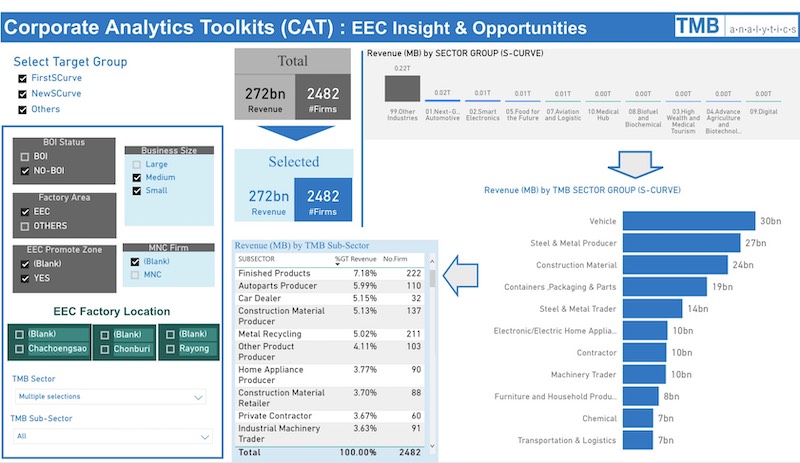
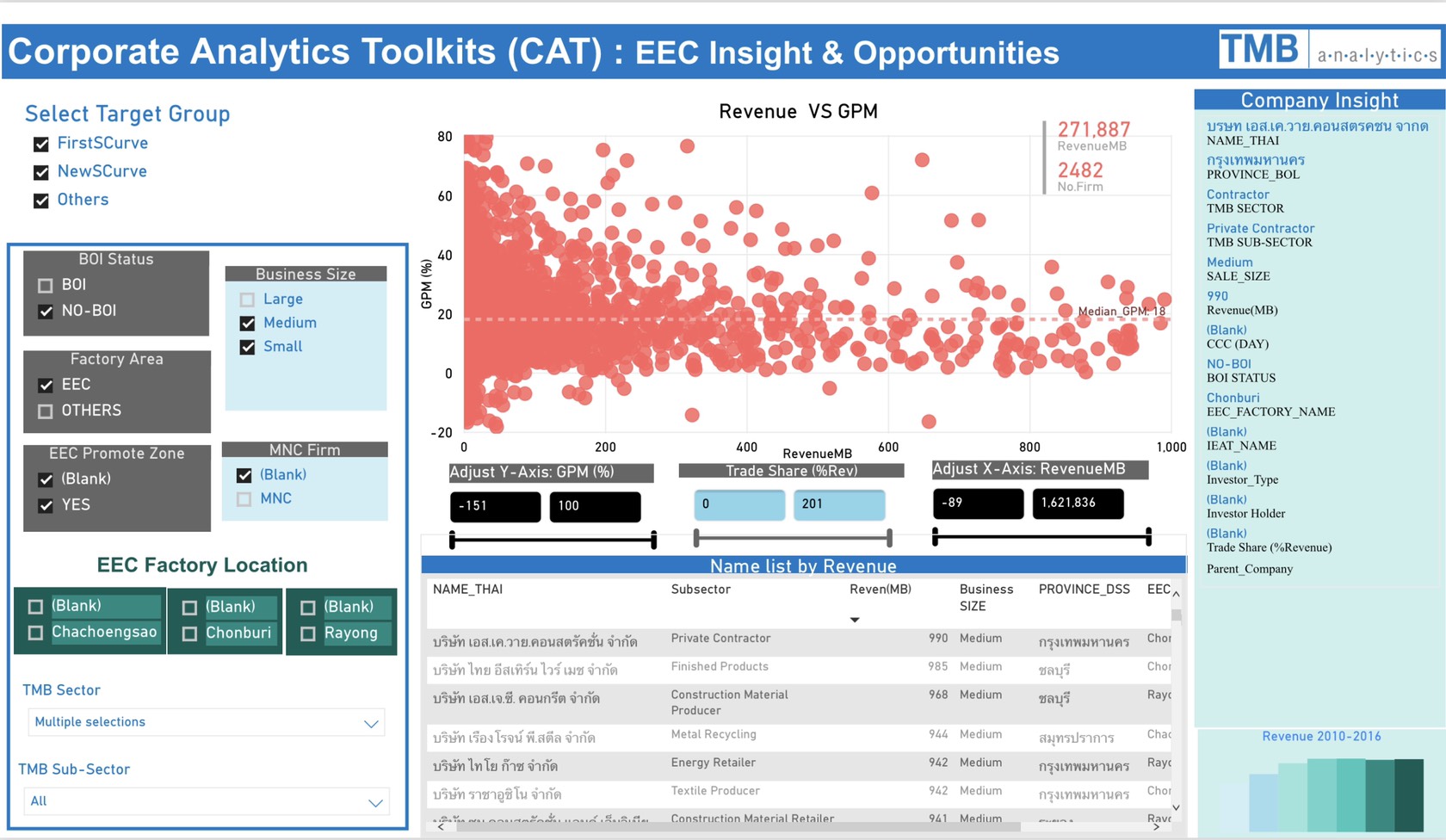
Data shows that there are 2,482 Thai SMEs in the EEC area that have not received investment promotion benefits, generating a total income of 271.887 billion baht, with the top industry being automotive, generating 30 billion baht, followed by the steel industry with 27 billion baht, construction materials with 24 billion baht, and packaging with 19 billion baht, among others (see data below).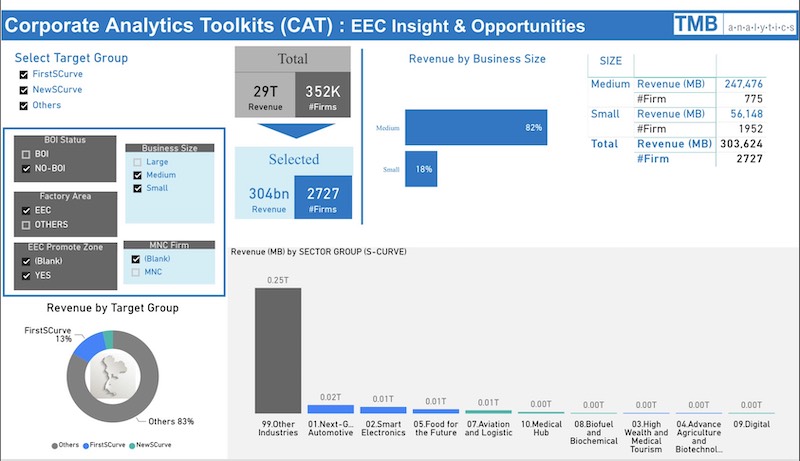
Structure of Thai SMEs – Buying and Selling, Focused on Imports for Exports, Not Linked to the World
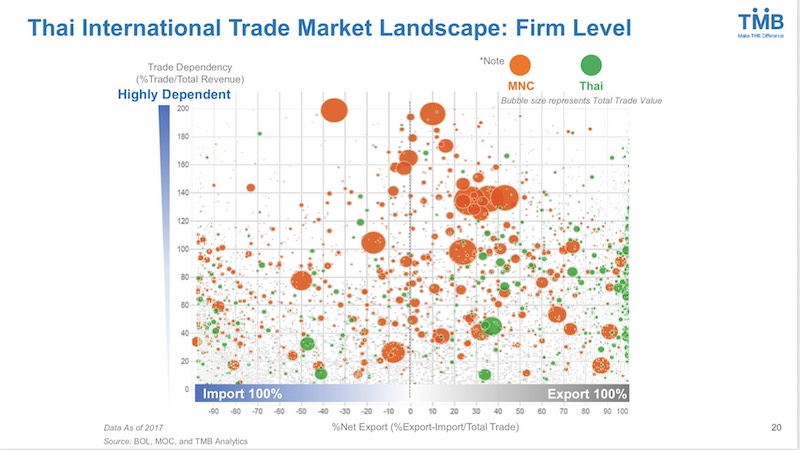
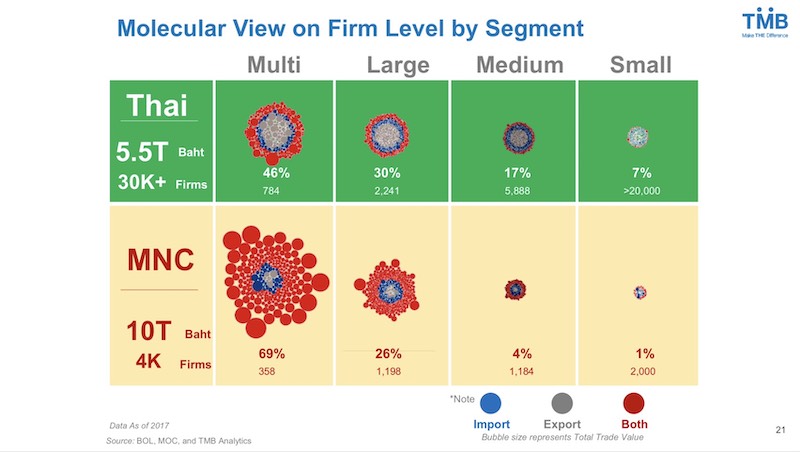
Mr. Naris continued, stating that another interesting point regarding the structure of Thai SMEs is their connection to the global market. Thailand is considered a country that relies on exports for over 70% of its national income, but the connection to the global market or access to international trade markets from the value of trade for Thai SMEs is minimal, at only 1.32 trillion baht from Thailand's total trade value of 15.5 trillion baht, or just 7-8% of Thailand's total trade value. If we look specifically at small SMEs, it drops to about 385 billion baht, or 2.5% of Thailand's total trade value.
“In comparison to multinational companies, which number only 358, but account for nearly 70% of total trade, approximately 10 trillion baht, while all Thai companies combined, regardless of size, account for only about 30%, or approximately 5.5 trillion baht. Thai SMEs have thus become increasingly marginalized and disconnected from the global trade market.” Mr. Naris stated.
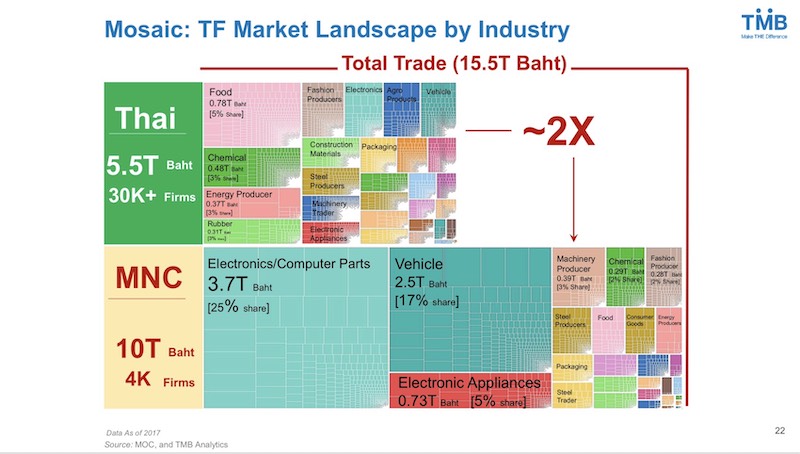
Mr. Naris continued that when examining the types of industries of Thai and foreign businesses, the differences become even clearer. About 47% of Thailand's total trade value, or approximately 7 trillion baht, comes from multinational companies in Thailand in just three industries: electronics at 3.7 trillion baht, or about 25% of Thailand's total trade value; automotive at 2.5 trillion baht, or about 17%; and electrical appliances at 730 billion baht, or about 5%.
In contrast, the top industry for all Thai businesses, including large, medium, and small, that trades with foreign countries is the food industry at 780 billion baht, or about 5% of Thailand's total trade value, followed by chemicals at 480 billion baht, or about 3%, energy at 370 billion baht, or about 3%, and rubber at 310 billion baht, or about 3% of Thailand's total trade value.
“All of this reflects back to the EEC area, where foreign businesses in Thailand that trade with the world are all located in the EEC area, including electronics, automotive, and electrical appliances, while Thai businesses have a much smaller share. The main businesses are not related to the EEC project. Therefore, the EEC project, which aims to promote automotive and electronics, primarily benefits foreign companies. Fundamentally, these businesses generate profits and send them back to their home countries. What will Thai companies do? The EEC project is designed for international trade, and investors are unlikely to produce high-end vehicles solely for the Thai market, as exports are already more than double. But what will Thailand gain? It becomes food, chemicals, energy, rubber, fashion clothing. So how can Thai SMEs access such markets?” Mr. Naris stated.
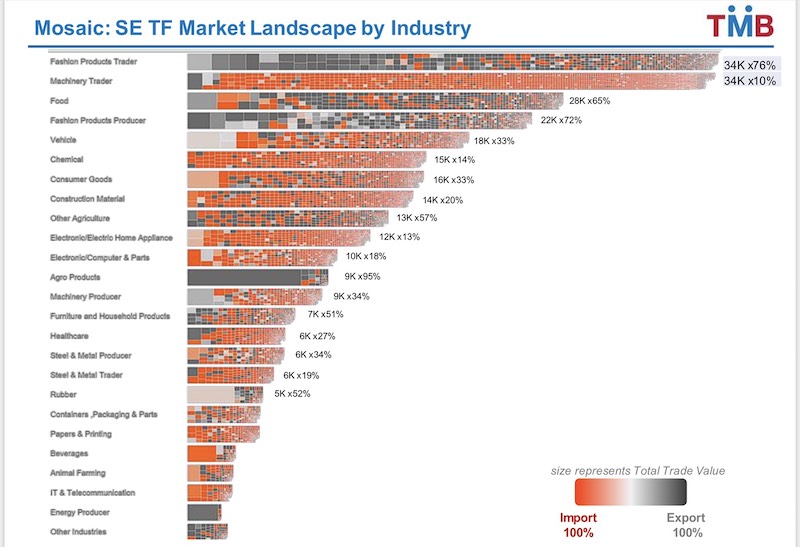
Furthermore, if we separate the import-export activities, we find that large businesses and multinational companies in Thailand mostly engage in both imports and exports and have substantial trade volumes. However, when examining the structure of Thai SMEs, it is found that they primarily focus on exports. If the currency strengthens, this group will face immediate issues as they do not have natural currency risk protection.
If we delve into small SMEs by business type, we find that small Thai businesses tend to import goods for sale, such as importing products from China, while Thai SMEs engaged in export businesses are limited to just two sectors: fashion clothing, both in buying and selling and manufacturing, and food businesses, with agricultural products being a notable exception as Thailand already exports a significant amount.
- “This means that the small Thai businesses that can truly access the global market are only in the fashion and food sectors, which are not connected to the EEC project at all. It feels like they are in completely different worlds, not linked at all. If the government can connect everything, large companies will benefit, but they should also pull Thai SMEs along. Right now, it feels like they are missing the boat.” Mr. Naris stated.
Recommending the Government to "Communicate and Engage" with SMEs
Mr. Naris continued, stating that “the first solution for SMEs or the government is to create awareness that SMEs have opportunities to benefit from the EEC project. It may start with a group that has potential in the EEC area, which is only a few thousand businesses. This is not distant because the data shows they have been operating for 3-4 years, are profitable, and have growth potential, indicating their efficiency and capability. If they can access the EEC project, they will also bring their supply chains along.”
The government may need to assist because most SMEs do not have time to focus on anything other than running their daily operations. They must do everything themselves, and accessing legal firms or consultants to help them enter the EEC is unlikely. It is the responsibility of the EEC office, which is currently progressing well in many areas, to consider dividing or finding channels for this group.
“I believe that SMEs are feeling quite frustrated. They enter a single account, enter the system, and then are told they will be taxed at 20% corporate tax. They need some solutions. The law is good in that it does not cut off opportunities for large or small businesses; it is designed to support SMEs as well. However, no one is connecting them. There should be stipulations, for example, if investing in the EEC, must SMEs be included in the supply chain? In the automotive sector, there is less concern because this group brings them along, and the supply chain is very clear. But for packaging, steel production, and construction materials, sometimes they are completely cut off. They do not belong to the supply chain directly and operate individually, which does not lead them to where they should be. How can they sustain themselves?” Mr. Naris stated.
However, regarding the changes for SMEs, Mr. Naris said, “It will be painful. Change will have significant impacts, similar to many countries that have already transitioned, such as the United States, Japan, and Australia, where SMEs hold a large share of the country and have been sustainable. For example, in Australia, 20 years ago, they only had dairy farms competing in milk sales. Later, they faced competition from New Zealand, encountering the same problems as Thailand with many retail businesses. The question is, how did Australia manage to change? They could not just stop doing it; the land has been there since the founding of the country. Australia took nearly 10 years to transition to producing higher-value products, such as processing various dairy products. This case may partly be due to the manufacturing industry having easier transition pathways.”
However, in Thailand, the structure of SMEs that engage in buying and selling and importing raises the question of how they will survive, especially in this era with e-Commerce, which has diminished their pricing power. This means that the 1.5 million SMEs engaged in buying and selling will face significant challenges. Today, we are starting to see clear signals of distress, such as NPLs in the commercial banking system totaling 460 billion baht, with 250 billion baht, or 50%, being SMEs, and many of these are in wholesale and retail.
“The picture has changed. It is not just about adapting; it is about finding a way out of how to proceed. While everything is still intact, the market continues to consume. I would like to say, do what Japan did; improve the quality of OTOP products. However, that is still a manufacturing industry; there are still products. But for buying and selling, there is no way forward. If the market is left to manage, it will ultimately force them out. They will have to close down. What plans do we have to support this? It is painful already, but what is more painful is that we still have no contingency plans and do not know what we can do. I believe that this group constitutes a significant portion of employment, though it may not be precisely reflected in the data. However, I think it could be nearly half of the 20 million people, and these will be self-employed.” Mr. Naris stated.
SOURCE : www.thaipublica.org