What Makes a Good Public Sidewalk?
Currently, there is a lot of criticism on social media regarding the Bangkok Metropolitan Administration's decision to demolish the beautifully constructed sidewalk in front of a famous hotel and replace it with a standard design. The reasoning given is that the private design is unsafe because it uses tiles, which can become slippery when it rains, posing a risk of accidents to the public. This raises the question of what a good sidewalk should actually look like.
The first thing to understand is that the sidewalks or footpaths according to the Bangkok Metropolitan Administration's standards do not use reinforced concrete as a structural base like that of houses or buildings. Instead, they use compacted sand topped with a rough concrete layer, and then they are paved with "cement tiles" that do not have internal reinforcement. The standard Bangkok sidewalk uses cement tiles in two sizes: 30 x 30 centimeters and 40 x 40 centimeters, both with a thickness of 3.5 centimeters.
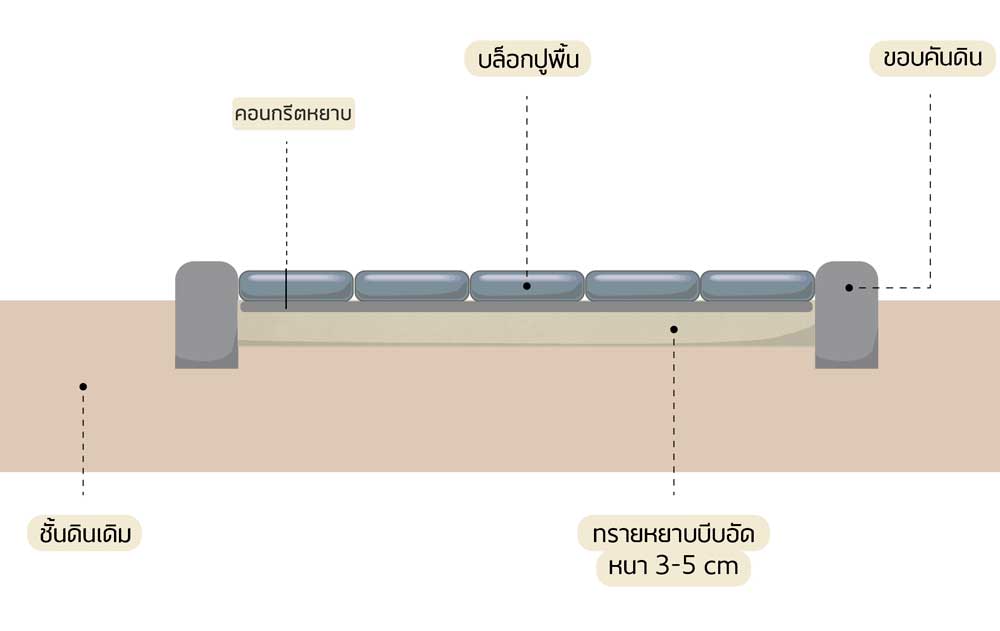
The use of such thin tiles for sidewalks can lead to issues where the tiles bounce when people walk over them, causing dirty water underneath to splash up and soil pedestrians' legs. In comparison, the commonly sold thick tiles for sidewalks can be as thick as 6 to 12 centimeters. The thicker the tile, the less likely it is for water to splash up from underneath, as each tile's weight keeps them locked together, minimizing movement.

Additionally, due to Bangkok's soft soil, sidewalks constructed with concrete tiles laid on compacted sand topped with rough concrete can sink when the ground settles. This causes the sand and rough concrete to also sink, leading to cracked and damaged tiles, creating holes and puddles that splash water on pedestrians.

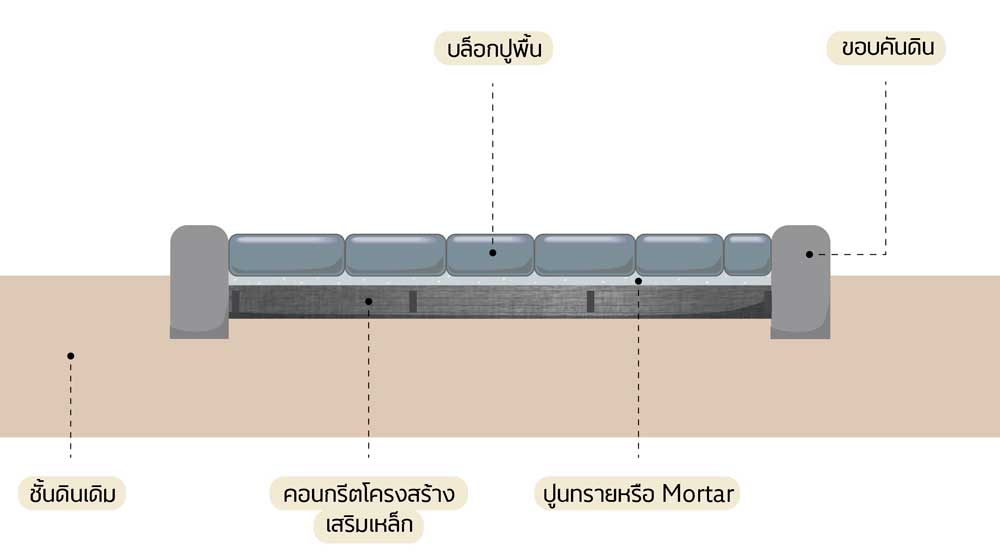
On the other hand, constructing the sidewalk with reinforced concrete as a base and then paving it with tiles, while also resting on the ground, results in less sinking. This is because the base slab is larger and thicker, and the internal reinforcement makes it stronger. The larger slab helps distribute the weight of the settling evenly, preventing bouncing and related issues.
Regarding the slipperiness of the surface, the Bangkok Metropolitan Administration's sidewalks use porous concrete tiles with a rough surface, making them less slippery than other materials, thus reducing the risk of slips and falls. However, if glazed tiles are to be used on sidewalks, certain conditions must be met: the tiles must meet the slip resistance standards referenced from the Australian AS/NZS 4663, which stipulates that outdoor walkway materials must achieve a slip resistance rating of R10 to ensure that the sidewalk surface is not slippery. Additionally, the sidewalk must be sloped at least 1:50 to allow water to drain off, preventing puddles that could cause slipperiness.
Finally, maintenance is crucial. The rough concrete surface of the Bangkok Metropolitan Administration's sidewalks makes it easy for dirt to accumulate, and standing water can lead to algae growth, making cleaning difficult. A good surface should be smooth, easy to clean, and sloped to prevent water accumulation and high moisture levels that can lead to stains and algae growth.
If these conditions are met, we can achieve a high-quality, durable, and safe sidewalk for everyone to use.
By: Winyu Wanichsiriroj
References
http://203.155.220.238/cdo/2020/attachments/article/57/L.SRD-12.pdf
http://203.155.220.238/cdo/2020/attachments/article/57/M.SRD-13.pdf
https://www.saiglobal.com/pdftemp/previews/osh/as/as4000/4600/4663-2004.pdf
Thanks for the information from www.baanlaesuan.com