Summary of Real Estate as a Key Economic Indicator for 2019
Summary of Real Estate as a Key Economic Indicator for 2019
At the beginning of the year, the direction of the real estate sector is crucial information for business planning. TerraBKK highlights key points from the annual seminar titled “Real Estate as a Key Economic Indicator for 2019”, held on January 30, 2019, at the Queen Sirikit National Convention Center, organized by the Thai Real Estate Association, the Thai Condominium Association, and the Housing Business Association. The main points are as follows:
Section 1: Economic Trends, Financial Markets, Capital Markets, and Their Impact on the Real Estate Market in 2019
For Thailand's overall economic outlook in 2018, it appears to be improving, reflecting better economic stability, with GDP growth occurring in every quarter, the latest being 3.3% in the third quarter. Certainly, for 2019, it is expected to continue in a positive direction as well. Factors influencing the overall Thai economy include the need to monitor global economic fluctuations, such as the shifting investments from China due to the Trade War, as well as domestic factors like the impact of rising interest rates, progress on the EEC project, and various public investments.
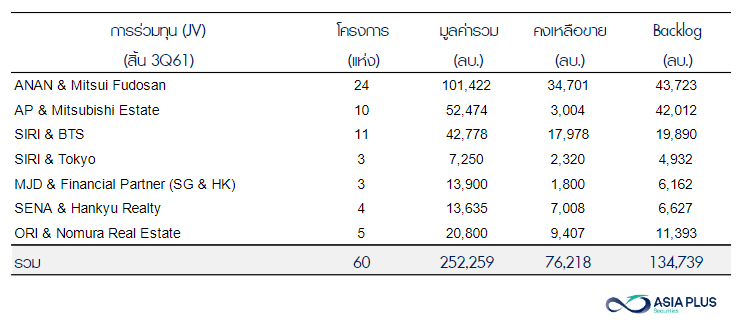
Regarding the capital market direction for the real estate business, it is observed that the performance of listed companies in the real estate development sector is not particularly vibrant. The overall profit growth is showing signs of slowing down. The profitability metrics for 16 companies in the third quarter of 2018 showed an average Gross Margin of 35.9% and a Norm Profit Margin of 15.7%. The annual pre-sales figures are increasingly coming from Joint Venture projects, with a backlog in the third quarter of 2018 totaling over 356 billion baht, divided into over 45 billion baht for horizontal projects, approximately 176 billion baht for vertical projects developed by the operators themselves, and over 135 billion baht for Joint Venture projects.
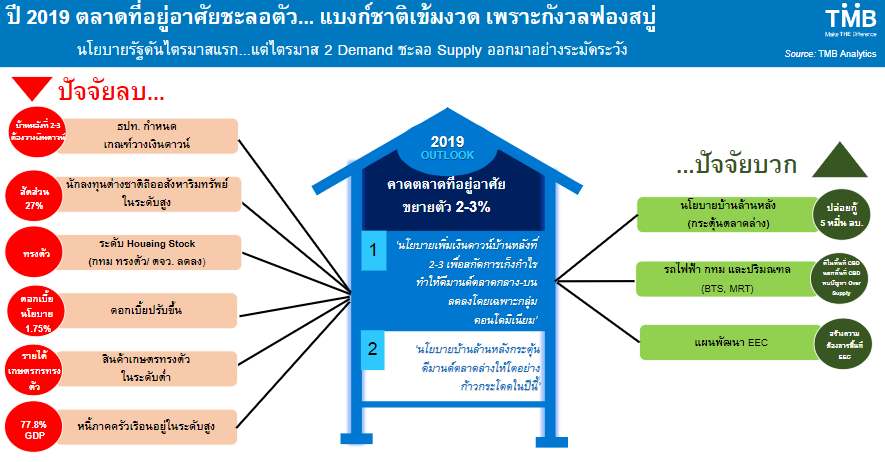
Three key considerations for Thai real estate developers include the rising NPLs for both developers and individual buyers, the Bank of Thailand's measures to reduce speculation (criteria for down payments on second and third homes), the declining purchasing power domestically, and the increasing proportion of foreign buyers, especially from China. The recommended adjustments suggest that projects should be developed cautiously, focusing on highly feasible projects or targeting the Real Demand customer segment, reducing the proportion of investment buyers, and emphasizing domestic buyers to mitigate risks from foreign clients.
Section 2: Policies, Laws, Regulations, and Obligations Affecting Real Estate Development in 2019
In terms of policies and laws that have been continuously discussed since 2018, including the draft Land and Building Tax Act, the Windfall Tax, and the draft Comprehensive City Planning Act, experts directly related to these laws provided information at this seminar. TerraBKK summarizes the key points from the seminar as follows:
Key points from the draft Land and Building Tax Act: The Land and Building Tax aims to reform the property tax structure to be more universal, enhance transparency, and encourage more efficient land use, with the tax base derived from the value of land and buildings.
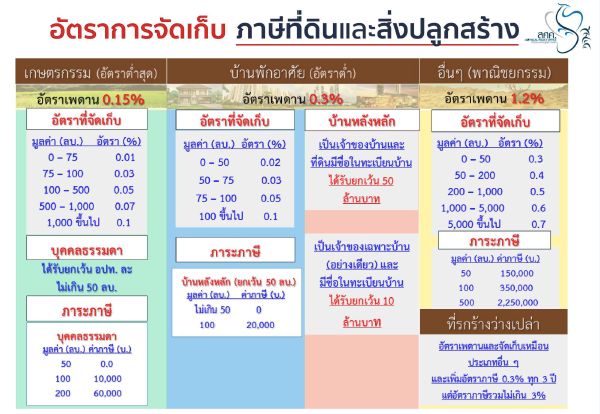
The Land and Building Tax has a ceiling of no more than 1.2% of the asset value and exempts residential properties, but only for homeowners registered in the household registry with a value not exceeding 10 million baht and homeowners registered in the household registry with land valued at not exceeding 50 million baht.
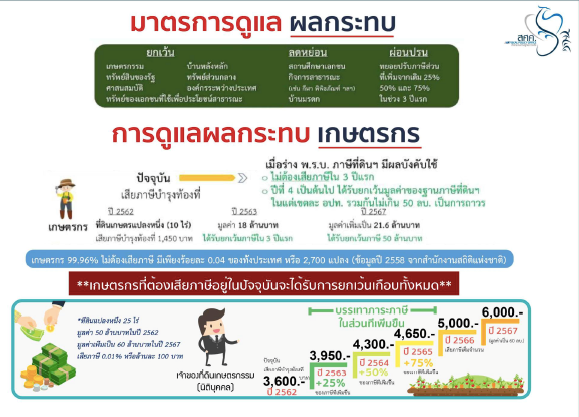
For farmers, who are key economic contributors, measures are in place to mitigate impacts by allowing exemptions from the Land and Building Tax for properties used for agricultural purposes, as primary residences, state properties, religious properties, and common assets. Additionally, they are exempt from tax for the first three years, and from the fourth year onward, the taxable value of land in each local administrative area is permanently exempted up to 50 million baht.
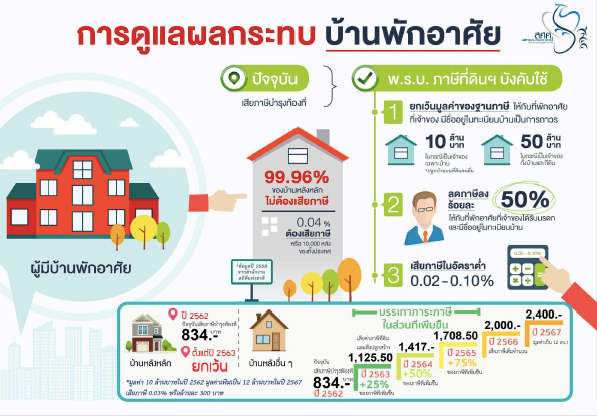
For residential properties, the previous local maintenance tax will be replaced with a permanent exemption of the taxable value for residences registered in the household registry, and a 50% tax reduction for inherited residences also registered in the household registry. Furthermore, the new tax ceiling will change according to the assessed asset value, with the first year exempting 25% of the asset value, the second year exempting 50%, and the third year exempting 75%.
Progress on urban planning policies and laws: The progress of the City Planning Act (No. 4) of 2015 has allowed the continuous enforcement of city planning ministerial regulations without expiration, specifying comprehensive and effective city planning requirements, reducing the announcement period from 90 days to 30 days, and improving the composition of the city planning committee by adding members and extending their term to 3 years, not exceeding 2 terms.
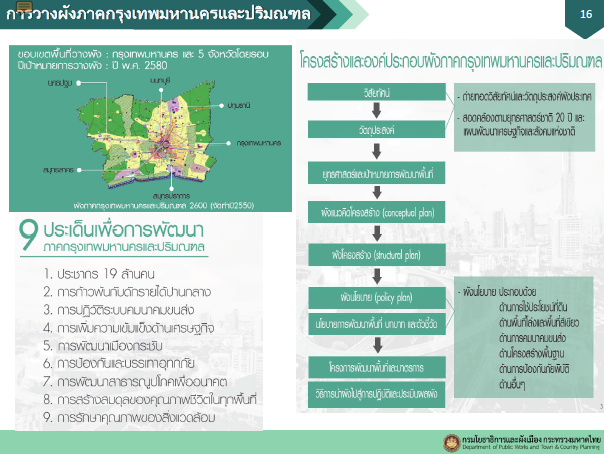
Additionally, the draft Bangkok Metropolitan and Surrounding Areas Plan has linked the comprehensive city plan and specific plans of each locality to ensure consistency between Bangkok and its surrounding areas, with over 33 plans across 8 provinces, including Bangkok, Nonthaburi, Samut Prakan, Pathum Thani, Samut Sakhon, Nakhon Pathom, Nakhon Nayok, and Chachoengsao.
Section 3: Trends in the Real Estate Market for 2019... Boom or Bust
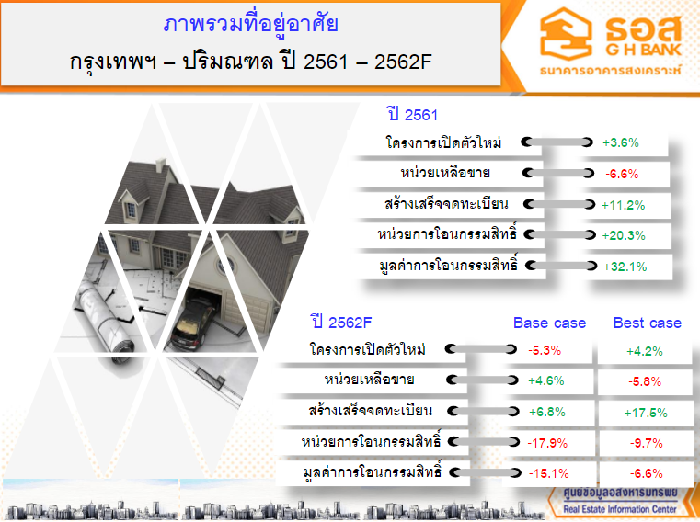
Dr. Wichai Wiratthakhan, the Bank Inspector and Acting Director of the Real Estate Information Center, revealed interesting figures about the Thai real estate market, stating that in 2018, the remaining supply in the market decreased significantly compared to 2017. In 2019, the remaining supply is expected to increase by approximately 4.6%, and he suggested that Thai real estate operators should reduce the launch of new projects and expedite the sale of remaining properties to create balance. He also mentioned that the Thai real estate market will be similar to that of 2017.
Dr. Apakorn Attaboonwong, President of the Thai Condominium Association, and Mr. Athip Pechana, President of the Housing Business Association, further stated that in 2019, the Thai real estate market should focus more on the Niche Market, emphasizing the creation of Super Fans for businesses to ensure sustainability and build a strong customer base. Importantly, Mr. Athip Pechana also revealed at the event that in 2019, the Leasehold property type will regain significance.
Meanwhile, Mr. Pornariss Chuanchaisit, President of the Thai Real Estate Association, encouraged developers and stakeholders in the Thai real estate market to be patient and to get through 2019 successfully. ---TerraBKK.com

Article by: TerraBKK Investment Tips
TerraBKK: Find good, valuable, and affordable homes