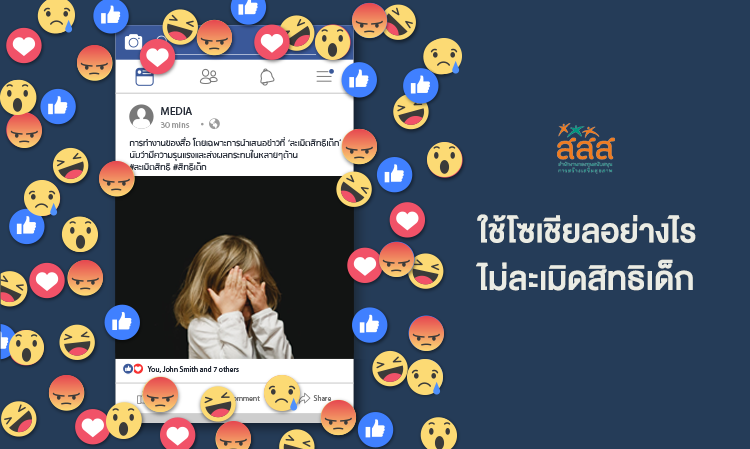
How to Use Social Media Without Violating Children's Rights
It has garnered as much attention as front-page news or online drama when various professional institutions or organizations overseeing media operations criticize or comment on the media's handling of news, particularly news that 'violates children's rights.' This is considered severe and impacts many aspects, including the children themselves, their families, and society as a whole.
In fact, we often see such news, leading many to become desensitized, resulting in neglect and ultimately normalizing the issue. However, the reality is that news about children has a tremendous impact, prompting various parties to rush to understand the situation, especially in an era of social media where, in addition to mainstream media, ordinary citizens can share and upload information on social media with just a mobile device and internet access, leading to increased rights violations.
Recently, discussions on this topic took place at a seminar titled "How to Report Children's News Legally and Without Violating Rights" at the Health Promotion Foundation (ThaiHealth), in collaboration with network partners, to find solutions for the public and media to understand the impacts and practices in reporting news about children to minimize negative effects on children and families.

Children refer to individuals who are still young, minors under the Civil and Commercial Code, who have not yet reached the age of 18 and have not attained legal capacity through marriage (Royal Institute Dictionary, 2011). The Convention on the Rights of the Child outlines four fundamental rights for children: the right to survival, the right to development, the right to protection, and the right to participation.
From the above definition, it is guaranteed that children must be protected and safeguarded. Therefore, reporting news related to children is much more sensitive than reporting other types of news.

Research on the role of user reactions on Facebook regarding news that violates children's rights by online news agencies, conducted by Pajaree Purintawarakul with funding from the Association of Radio and Media for Children and Youth, supported by ThaiHealth, found that the current reporting of children's news by the media, especially through social media, still reflects undesirable roles according to the Convention on the Rights of the Child (CRC), which includes failing to perform duties and performing duties incorrectly by violating children's rights. The top three issues identified were psychological abuse of children, neglecting children's interests, and disseminating information about children that could harm their mental health, reputation, and rights.

“Children may experience severe stress, anxiety, headaches, diarrhea, nausea, or in some cases, nightmares leading to depression, which could ultimately result in suicide,” said Prof. Dr. Ronchai Kongsakorn, President of the Medical Association of Thailand, discussing the impacts on children and families. Recovery for children is very challenging; once it occurs, children may not return to normal. It requires three steps: psychological therapy, which takes a long time to adjust thoughts and alleviate stress; medication; and finally, social healing processes that do not reinforce or repeat the trauma.

What to Do When Reporting News About Children?
Tientip Diewki has outlined ethical guidelines for citizen journalists reporting children's news through social media in four areas: content, images, sound, and news acquisition. This is based on research regarding the ethics of citizen journalists in reporting children's news on social media to ensure that citizen journalists adhere to appropriate ethical principles and codes of conduct, which include ten key points:
Content
1. In cases of negative news, use pseudonyms for the child's name. For positive news, information can be disclosed.
2. Present the child's address broadly, without details that could identify the child, such as sub-district, village, or house number.
3. Do not disclose the identity and information of relatives or anyone who could clearly identify the child. Use pseudonyms for names and provide broad address details.
4. Be cautious with the use of harsh language and avoid detailed descriptions that could embarrass the child.
5. Ensure that the content is accurate and avoid sensationalism.
Images
6. If it is negative news, do not publish direct images of the child or images that could cause embarrassment under any circumstances. Use representative images, camera angles, or other methods such as graphics or cartoons. For positive news, information and images of the child can be disclosed.
7. If it is negative news, conceal the face and information of relatives or anyone who could clearly identify the child.
Sound
8. Alter the child's interview voice so that it is not identifiable. Do not present the actual interview audio.
Regarding news acquisition
9. Avoid questions that pertain to the child's feelings or could emotionally impact them.
10. Seek the child's consent before the interview. If the child is of an age unable to make decisions, seek consent from the guardian.
In using social media or various types of media, media literacy is crucial. In today's world, with an overwhelming amount of information, posting and sharing require mindfulness and consideration of the potential consequences. We hope that the media will work together to protect and not violate children's rights by presenting constructive and beneficial content, avoiding sharing and disseminating images or information that could negatively impact children and families in the future. By doing so, you contribute to creating a better society and using social media happily.
Thank you for the information from www.thaihealth.or.th