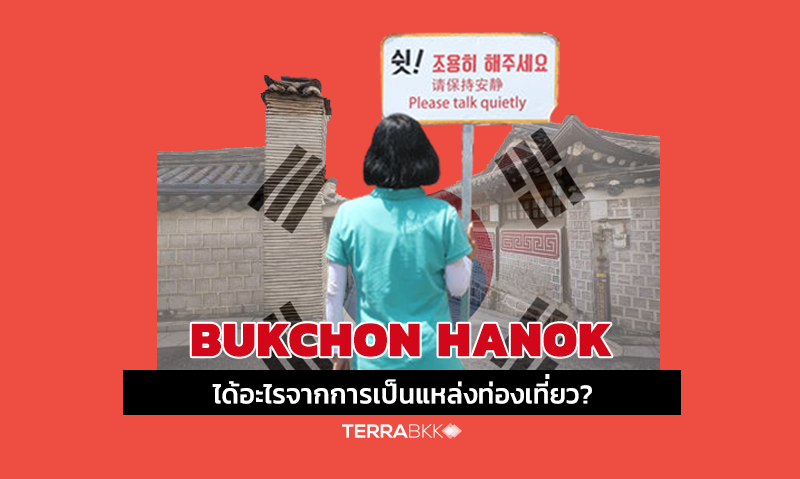
What Does Bukchon Hanok Gain from Being a Tourist Destination?
Bukchon Hanok Village is a famous tourist attraction in Seoul, South Korea. It is a preserved village that retains Korean architecture from the 1930s to 1940s, a period marked by war. Currently, Bukchon Village still has residents living there and has opened its doors to the public as a tourist destination without any entry fees, making it popular among many tourists, especially for activities like wearing traditional Korean clothing (hanbok) while taking photos during their visit.
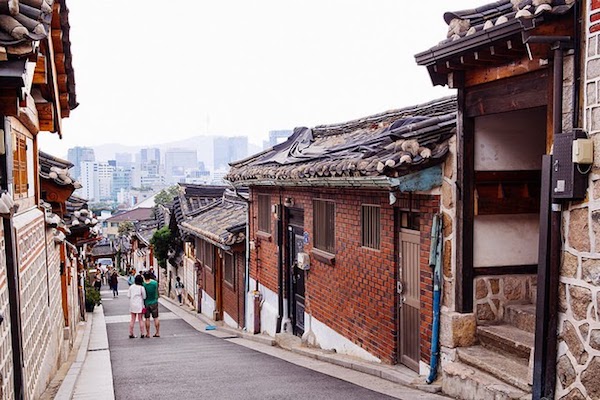
Image courtesy of: http://www.korea108.com
However, in July 2018, South Korean media reported on a protest by the Bukchon community, where residents raised signs stating “WE’RE JUST MONEY MAKERS FOR SEOUL CITY”, as they faced disturbances from tourists, including noise, litter, and even public urination due to the lack of public restrooms in the area.
Why does the Bukchon community have to endure such a fate?
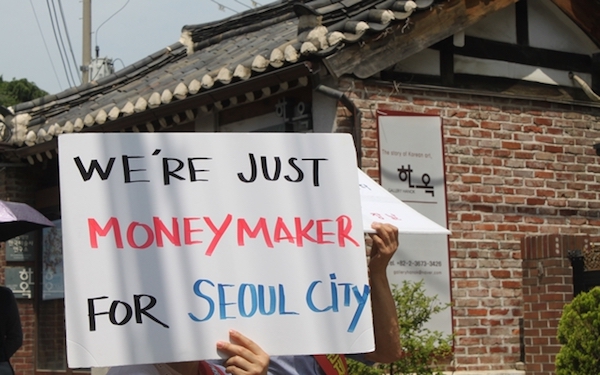
Image courtesy of: http://english.hani.co.kr
Originally, the location of Bukchon Village was home to the elite during the Joseon Dynasty due to its proximity to two royal palaces. However, during the Japanese occupation of Korea (1930-1940), Bukchon was established as a residential area due to a housing shortage in Seoul, which is why the architecture of Bukchon has remained similar to this day.
In 1983, the government began implementing building regulations in Bukchon, controlling the size and style of buildings to maintain its status as a preserved village and prevent new constructions that could disrupt its character. However, this effort has not been very successful, as modern buildings continue to emerge. Additionally, these regulations led to a decline in the population of Bukchon, which dropped to 3,800 residents by 1995.
Recognizing the problem, the government included Bukchon in the plan for ‘Seoul’s Urban Regeneration Cultural Restoration and Tourism Development’ from 2001 to 2004 (initial phase) and 2004 to 2006 (subsequent phase). The plan began with registering conservation households, establishing design guidelines, and increasing the height limit from one to a maximum of four stories (not exceeding 16 meters), along with improving the landscape, with a total budget of $62.88 million from 2002 to 2017.
The results were clear: the number of tourists visiting Bukchon skyrocketed from 14,000 in 2006 to 1,049,351 in 2014, and land values increased by 35.5%, from $1,600 per square meter in 1996 to $4,500 per square meter.
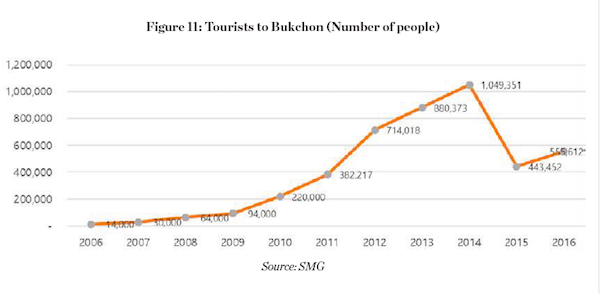
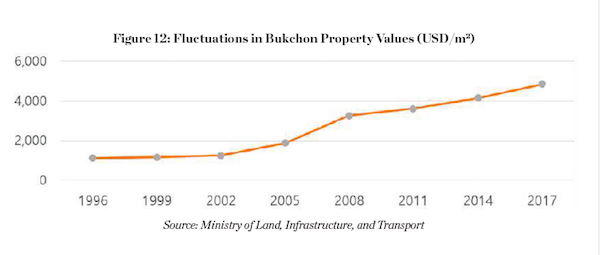
From the report: Seoul's Experience in Cultural Heritage, Sustainable Tourism and Urban Regeneration
Most of the benefits seem to fall to the local area rather than the community itself. So what does the community gain?
The first clear benefit is a land tax reduction of 0.7/1,000 for residential areas, which has improved living conditions and the environment in the village through government support. In terms of benefits from developing Bukchon as a tourist destination, it is said that Bukchon generates over $1.77 billion from tourism.
With such a massive amount of money... why is the community still opposing tourism?
The soaring land values have also driven up rental prices. An interview with a Bukchon resident revealed that a shop located on the main street (before entering the Bukchon community) had a rent of only 2.5 million won but could earn up to 7.5 million won overnight. However, for the Bukchon community, tourists do not spend that much. Moreover, there are 0-won tours from Chinese tourists that do not add any value, only causing trouble. Some shops invested 100-200 million won in their businesses but still had to close down due to rising rents, while selling prices have reached 250 million won.
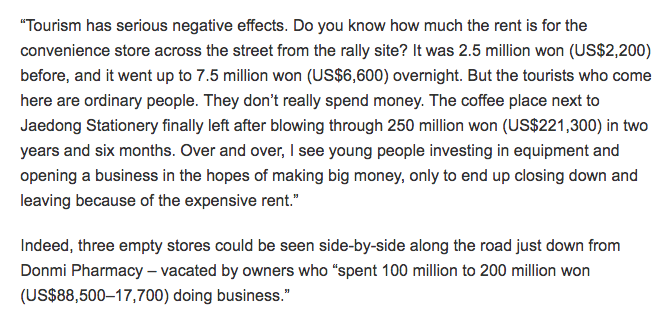
From: http://english.hani.co.kr
These seem like business opportunities that are too far out of reach for the Bukchon community. Besides the high costs, the residents cannot make any improvements to their homes (due to preservation restrictions) and must endure the troublesome behavior of tourists. The solution is to sell or rent out their homes and move elsewhere, leading to a 14% decrease in the Bukchon community's population over the past five years.
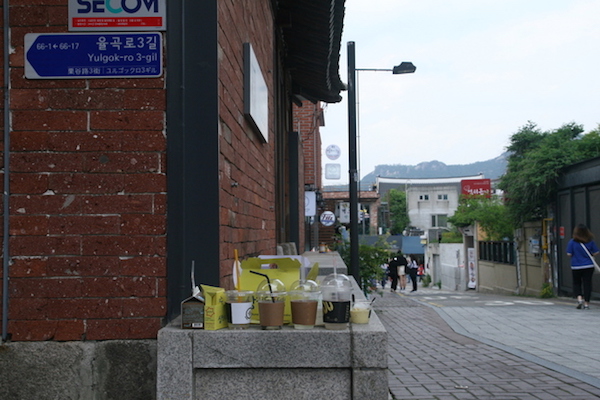
Image courtesy of: http://english.hani.co.kr
Bukchon Village reflects that while tourism policies have been remarkably successful, real estate speculation poses a significant obstacle to efforts to maintain it as a heritage village. Additionally, the residents receive only minimal benefits while facing daily hardships. If we were to compare this situation to Bangkok, it would be somewhat similar to buildings in the Yaowarat area, which have high values but cannot be significantly altered.
Article by: TerraBKK Investment Tips
TerraBKK Find Good, Worthwhile, Affordable Homes