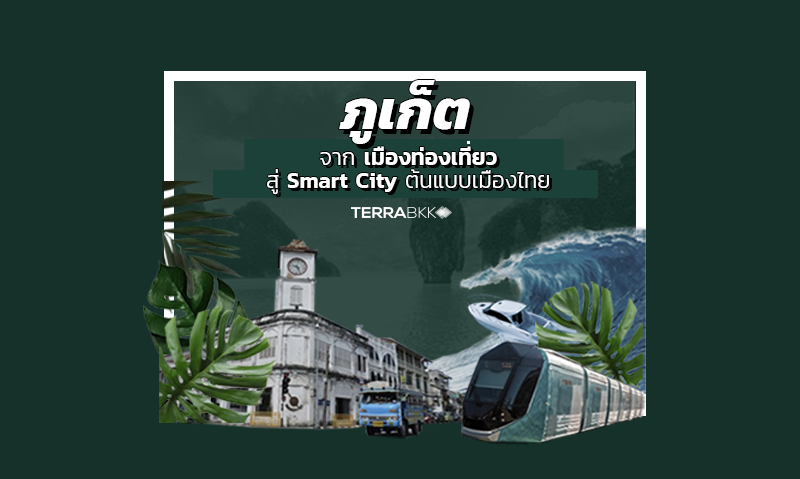
Phuket: Advancing from a Tourist City to Thailand's Smart City Model
The pearl of the Andaman, “Phuket”, continues to attract the attention of tourists and investors alike. The city experiences significant annual growth in both the economy and tourism, which enhances its investment potential. When comparing Phuket to other regional tourism and economic hubs, TerraBKK believes that Phuket has high potential, comprehensive development across all dimensions expected of a major city, and unique characteristics that other Thai cities lack.
To explore the mentioned potential, TerraBKK will outline the key factors as follows:
Looking Back: A 5-Year Timeline of Development in Phuket as an Investor Destination
The first key factor that strongly confirms that Phuket is ready for investment can be measured by the value of various development projects from both the public and private sectors. TerraBKK's review of Phuket's development over the past five years, from 2013 to 2018, shows a total investment budget of approximately 63 billion baht. Most of this investment has gone into transportation infrastructure, such as road improvements, underpasses, intersections, and airport expansions to enhance tourist capacity, as well as the development of large shopping centers by the private sector.
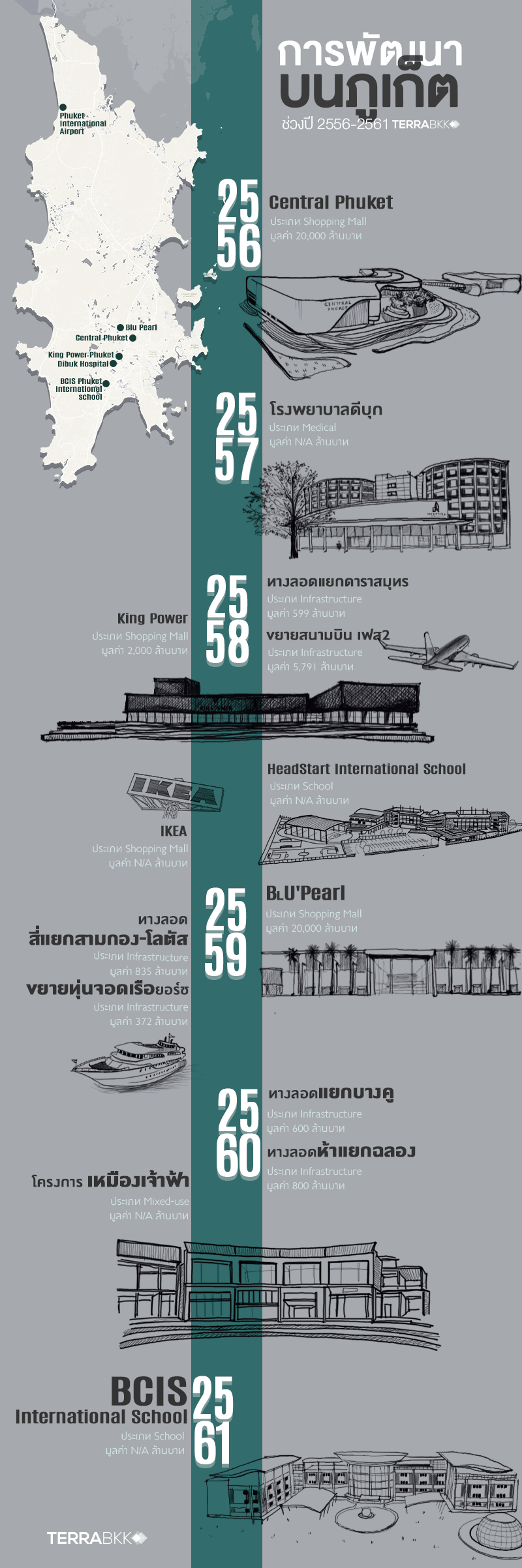
The interesting aspect of the various public and private projects developed in the past five years is the aim to make Phuket a World Class Tourism Destination. This includes not only comprehensive infrastructure such as roads, ports, hospitals, and international schools but also facilities that are on par with those in Bangkok. For example, the development of Central Phuket, covering over 111 rai with an investment value of 20 billion baht, follows the opening of Central Festival Phuket and Central Festival Phuket East. Recently, CPN has developed Central Floresta, the final building in the original plan, which serves a role comparable to Central Embassy, a flagship project of Central, focusing on high-end customers. Additionally, the establishment of IKEA Pickup & Ordering Point in Phuket, the only tourist city chosen for this service, demonstrates the confidence of major investors in Phuket's potential and purchasing power.
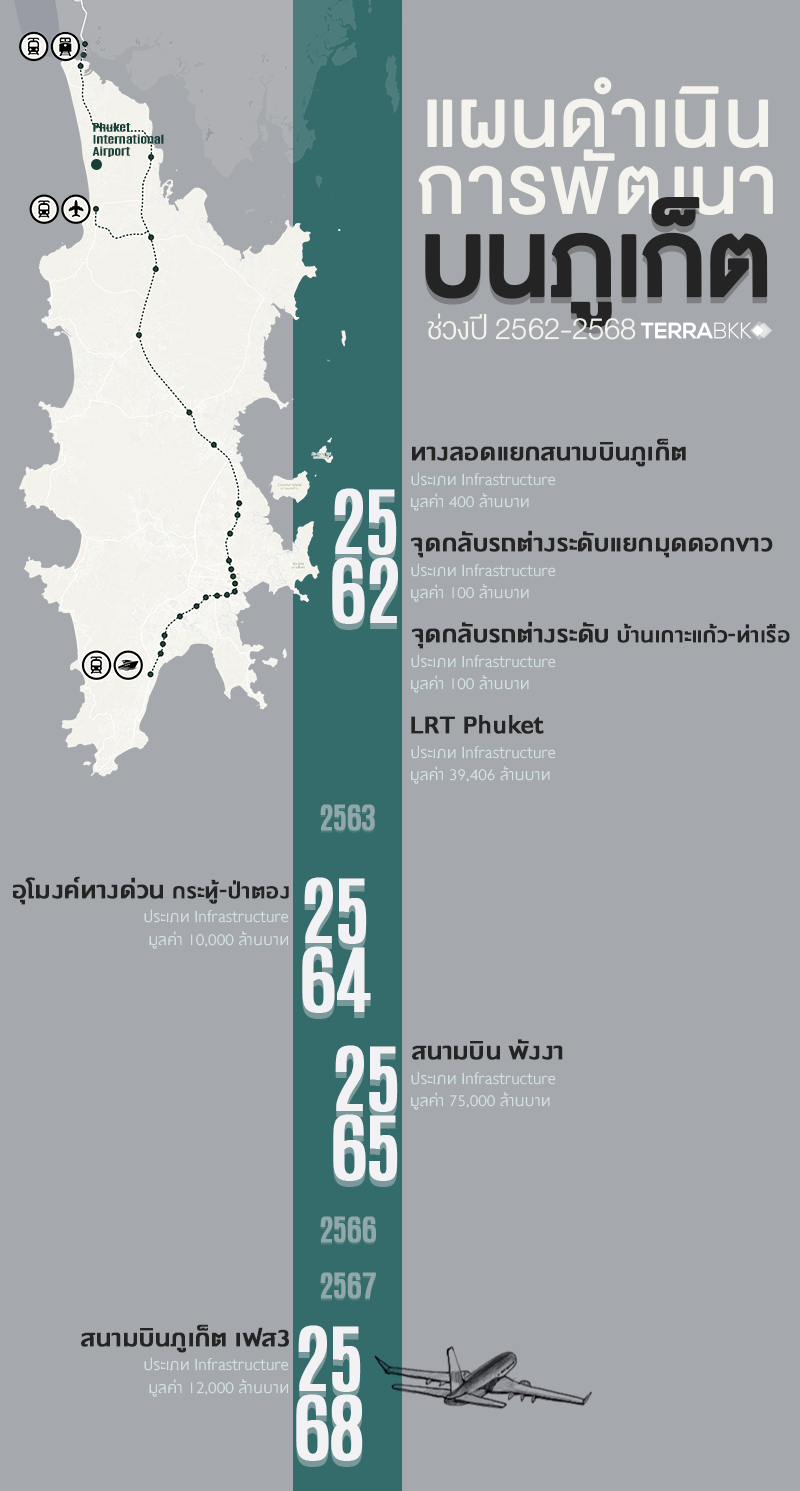
Furthermore, there are ongoing plans for various projects in Phuket until 2025. For the public sector, the focus remains on expanding tourist capacity through land, water, and air transport, as well as facilitating local residents. This includes the development of underpasses, expressway tunnels, elevated U-turns, and the expansion of Phuket and Phang Nga airports, with an investment budget exceeding 97.6 billion baht. This will enable Phuket to accommodate tourist traffic of up to 10-16.5 million people annually.
It is evident that the developments occurring in Phuket are all aimed at supporting the city's and tourism's expansion, which is a strong indicator that Phuket is ready to be a World Class Tourism Destination and continues to advance without pause.
Moving from a World Class Tourism Destination to a Smart City
In addition to infrastructure development projects aimed at enhancing its tourism potential, Phuket is taking another step forward from the national development plan. TerraBKK refers to this as the Phuket city development plan, which is more about moving forward than just urban development; it is about transitioning to a Smart City (เมืองอัจฉริยะ) that will be ready in all dimensions, including technology, safety, public transport systems, environment, energy efficiency, and urban planning. Here, we will highlight two significant development projects: Phuket Smart City and Phuket Urban Development and Phuket Light Rail Transit (LRT) to help TerraBKK readers understand why Phuket is more than just a tourist city and what it has that other major Thai provinces do not.
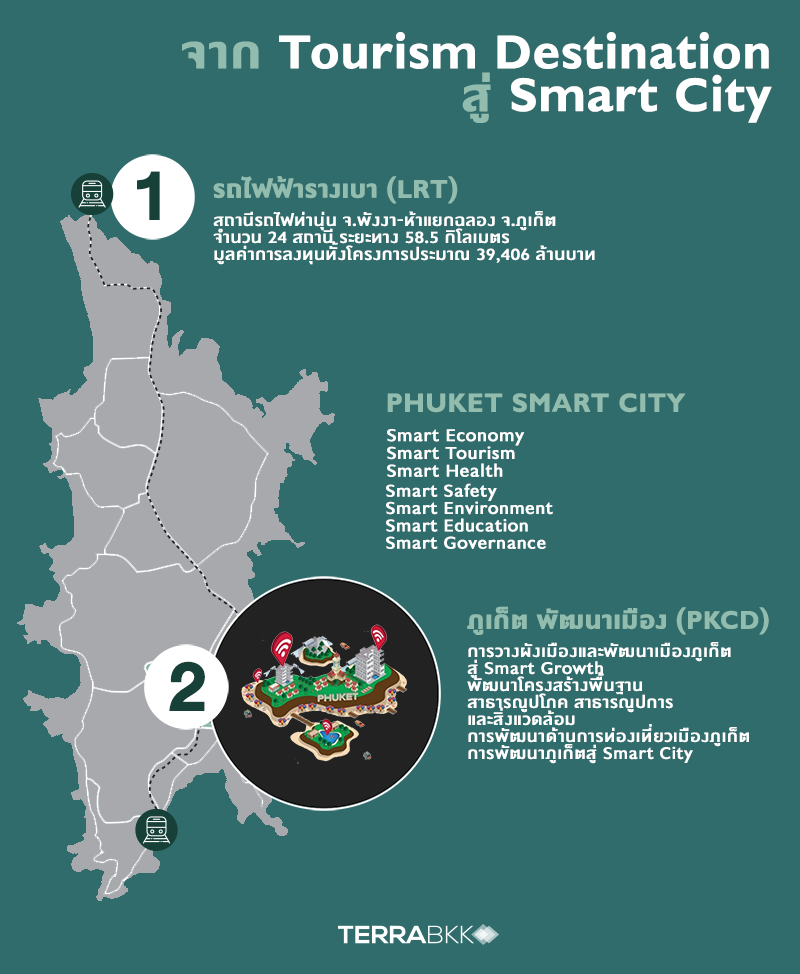
Phuket Light Rail Transit (LRT)
The Phuket Light Rail Transit (LRT) project is another development that will fully propel Phuket into a Smart & Livable City. The route starts at the Thanu train station in Phang Nga and ends at the northern area of Chalong Intersection in Phuket, with a total of 24 stations covering approximately 58.5 kilometers, and an estimated project investment of 39.406 billion baht through a PPP investment model.
The latest progress, as of mid-August 2018, was shared by the Governor of the Mass Rapid Transit Authority of Thailand (MRTA), indicating that it could be presented to the Cabinet within this year. If approved, bidding could commence in 2019, making Phuket the first province in Thailand to construct a light rail system.
Phuket Smart City
The Phuket Smart City project is supported by the National Software Industry Promotion Office (SiPA) and the Digital Economy Promotion Agency (depa), aiming to develop Phuket into a Smart City across seven areas: Smart Economy, Smart Tourism, Smart Health, Smart Safety, Smart Environment, Smart Education, and Smart Governance. The principle behind the development of Phuket Smart City is to utilize the Internet of Things (IoT) for managing urban development in all aspects, based on the establishment of a City data platform, with pilot areas being Patong Municipality and Phuket Municipality, aiming for completion by 2020, with private companies like Phuket City Development (PKCD) collaborating with the government to achieve these goals.
Projects from Phuket City Development (PKCD)
Phuket City Development Co., Ltd. was established by local entrepreneurs in Phuket with government collaboration, aiming to plan the development of Phuket as a Social Enterprise. The development goals are divided into four areas: urban planning and developing Phuket towards Smart Growth, infrastructure development, public utilities, and environmental management, tourism development in Phuket, and advancing Phuket into a Smart City. The operational goals of Phuket City Development will align with the government, with interesting projects already underway, such as Phuket Smart Bus, a public transport service between Phuket Airport and Rawai Beach, which accepts Rabbit LINE Pay cards, features a control room in the bus, and is equipped with GPS, Wi-Fi, USB ports, and lifts for wheelchair users. Passengers can also check the arrival times at each station through an application.
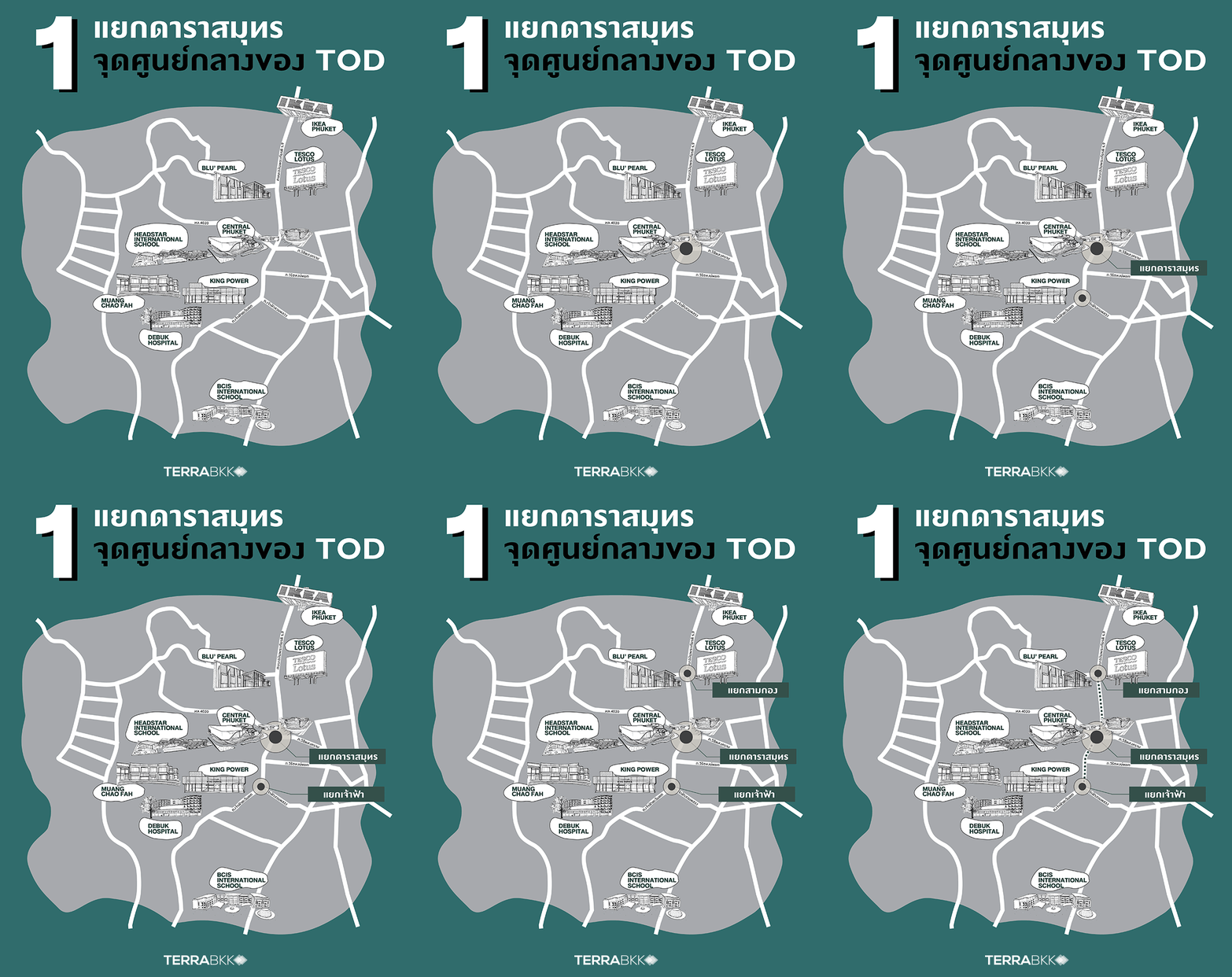
The most interesting operational plan that TerraBKK sees as having a tangible impact on Phuket's development is the development of the area around the transport station (TOD), covering from Sam Kong Intersection - Dara Samut Intersection - Chao Fa Intersection, which is a location with dense facilities, considered the CBD of Phuket. The central development area will be around Dara Samut Intersection, with plans for a Walkway Linkage connecting all locations to create dense activities in the CBD and the light rail station.
Exploring the CBD of Phuket with New Area Development to Make Phuket a Model City for the Country
Although Phuket is a small province with an area of only 543 square kilometers, numerous mega-projects have emerged in just a few years. When looking at the overall picture of these projects, TerraBKK Research sees that the most interesting and visibly growing location in Phuket is around Dara Samut Intersection. Why does TerraBKK Research think so? Let's take a look.
In the Future, Dara Samut Intersection Will Be the Center of TOD
As mentioned by TerraBKK Research regarding the projects from Phuket City Development Co., Ltd., the area from Sam Kong Intersection - Dara Samut Intersection - Chao Fa Intersection will be the first location chosen for the development of the area around the station (TOD), particularly at Dara Samut Intersection, which is clustered with major projects like Central Festival Phuket, Central East, and soon Central Floresta (which is set to be comparable to Central Embassy). Additionally, its position as a connection point between the old town and Patong Beach makes Dara Samut Intersection the central point for TOD development.
Phuket City Development Co., Ltd. has partnered with HUBBA Co-Working Space to create the most modern co-office space in Phuket, covering approximately 2,200 square meters, and develop a Walkway Linkage connecting all TOD development areas from Sam Kong Intersection to Dara Samut Intersection to Chao Fa Intersection, making Dara Samut Intersection fully equipped with job opportunities, facilities, and public transport, thus becoming the complete CBD of Phuket.
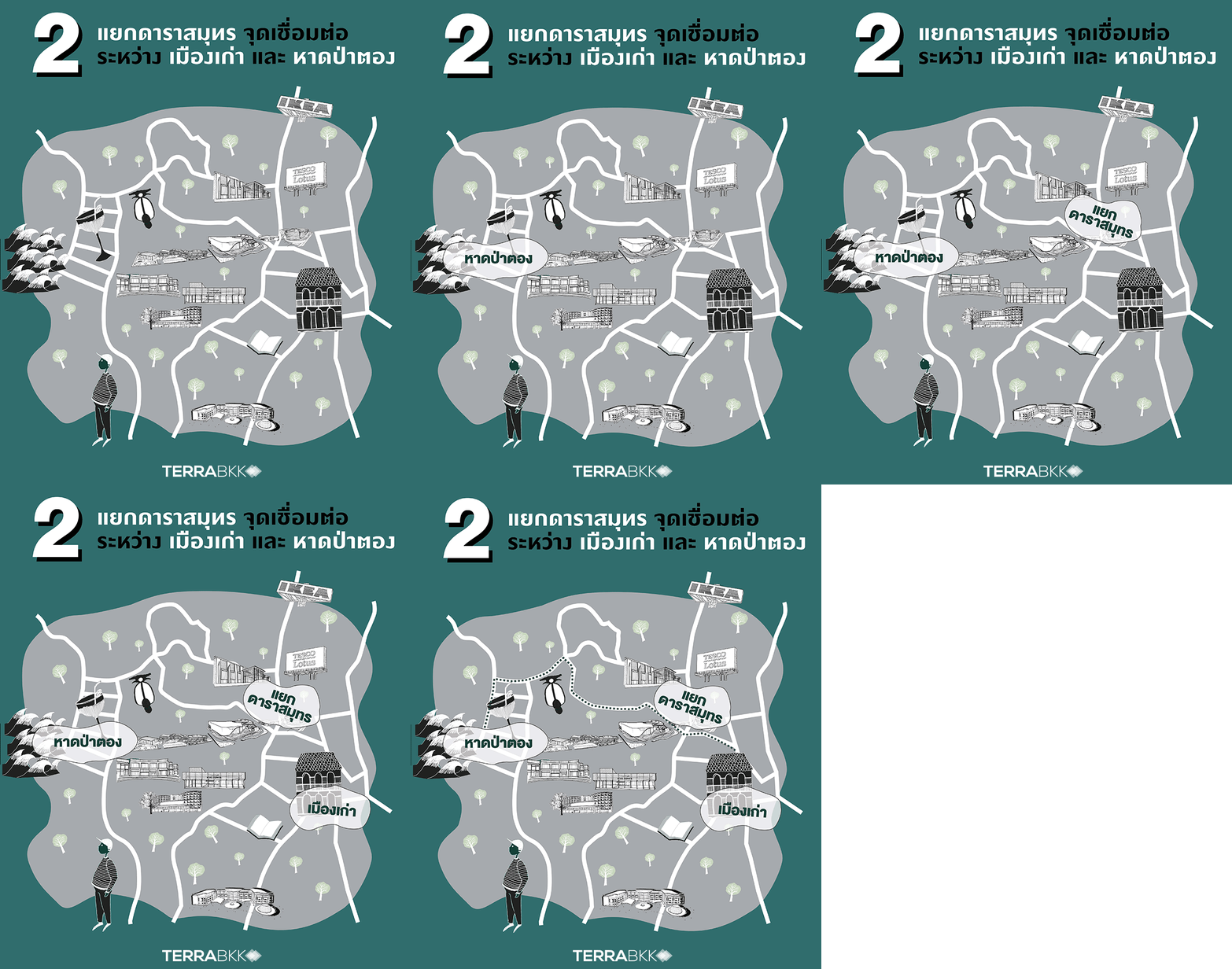
Dara Samut Intersection is the Connection Point Between the Old Town and Patong Beach
The potential of the Dara Samut Intersection location is its role as a connection point between the old town and Patong Beach, a must-visit destination for every tourist coming to Phuket. Traveling through Vichit Songkram Road makes the Dara Samut Intersection the best location to serve as a central hub connecting important places in Phuket.
From Dara Samut Intersection, Access to Comprehensive Facilities is Possible
With the transportation routes at Dara Samut Intersection, which is the intersection of important roads in Phuket, such as Vichit Songkram Road and Chao Fa Road, it can connect to other important locations in Phuket.
From Dara Samut Intersection, the northern side connects to Yaowarat Road at Sam Kong Intersection, home to Tesco Lotus Extra, Blu Pearl, QSI International School, Kachornkiat International School, Bangkok Phuket Hospital, and in the future, Vana Nava Water Park. The southern side connects to Chao Fa Suan Luang Road at Chao Fa Intersection, where King Power and Dibuk Hospital are located. The eastern side connects to the old Sino-Portuguese town, and the western side connects to Patong Beach.
This central location allows Dara Samut Intersection to access facilities in every dimension, whether shopping centers, tourist attractions, schools, and hospitals, and it also provides direct access to public transport in Phuket, such as the airport bus (Phuket Airport - Old Bus Terminal) at Central Phuket.
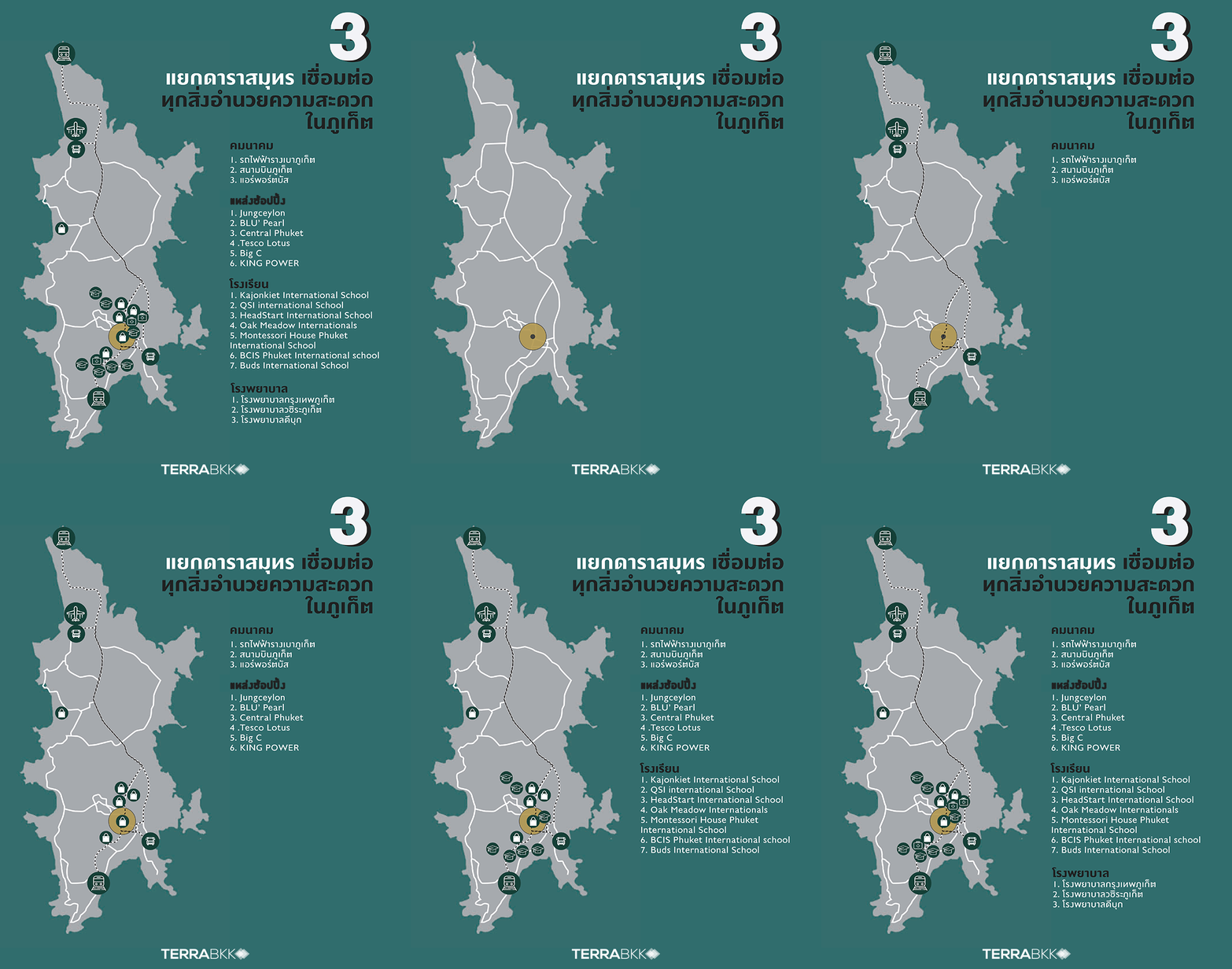
However, TerraBKK Research is confident that once the various projects in Phuket are completed, it will not only transform Phuket Town but will also encompass the entire province. Coupled with Phuket's tourism prominence, TerraBKK Research sees the growth of various demand statistics for “Phuket” as follows:
Phuket Welcomes Foreigners for Both Tourism and Work
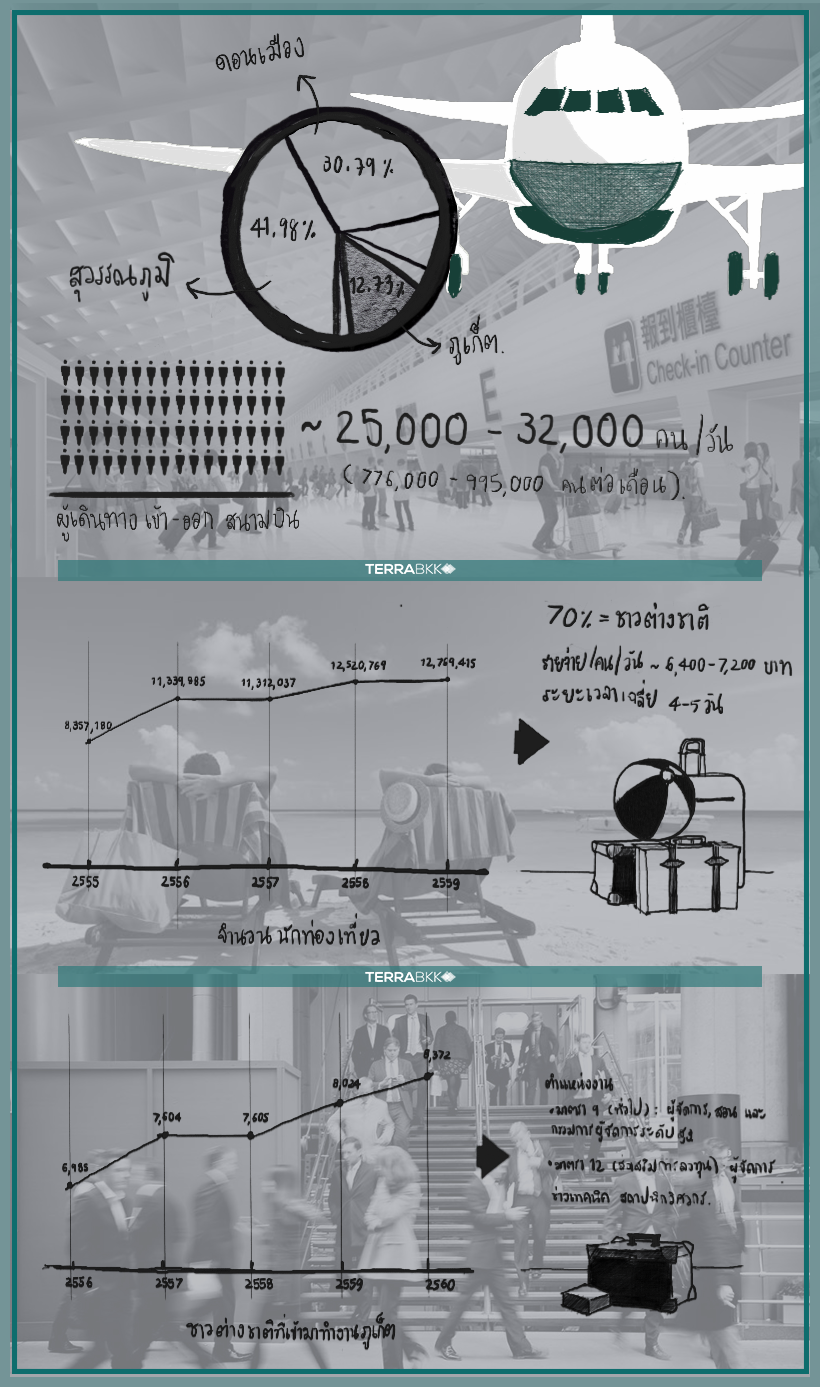
In 2017, Phuket Airport recorded a total of 823,574 flights, with 12.73% of these being from “Phuket Airport,” ranking first in the region and third in Thailand, behind Suvarnabhumi Airport and Don Mueang Airport. In the past year and a half (January 2017 - June 2018), Phuket Airport accommodated between 776,000 and 995,000 travelers per month, averaging about 25,000 to 32,000 people daily.
Each year, “Phuket” welcomes over 12 million tourists, generating economic revenue of over 377 billion baht annually. More than 70% of these tourists are foreigners, who typically spend an average of 6,400 to 7,200 baht per person per day and stay in Phuket for an average of 4-5 days, resulting in an average occupancy rate of 70%.
The highest number of foreign tourists visiting “Phuket” is attributed to “Chinese tourists,” the only nationality exceeding one million visitors per year (2.54 million), followed by Russians (807,000) and Australians (535,000). Additionally, there are significant numbers of Germans, British, Koreans, Malaysians, and Japanese, with New Zealanders dropping out of the Top 10 two years ago.
According to data from the Chinese real estate media Juwai.com, Chinese investors view Phuket as the second most desirable real estate investment destination in ASEAN, citing Thailand's proximity to China, travel times of no more than six hours, its appeal as a vacation home during holidays, comprehensive tourist attractions, low living costs, the friendliness of Thai people, and Thailand's excellence in healthcare.
In addition to tourist numbers, many foreigners also come to work in “Phuket.” Statistics show that foreign workers legally entering the city under Section 9 (General) and Section 12 (Investment Promotion) totaled 8,372 foreign workers in Phuket in 2017, averaging an annual increase of 4.7%. The top three occupations for foreign workers under Section 9 (General) are managers, educators, and senior executives. For Section 12 (Investment Promotion), the most common positions are managers, various technicians, and architects/engineers. These figures reflect the genuine demand for housing in Phuket's real estate sector.
Phuket Condominiums Cap Gain 5.5-10% and Rental Yield 5-8%
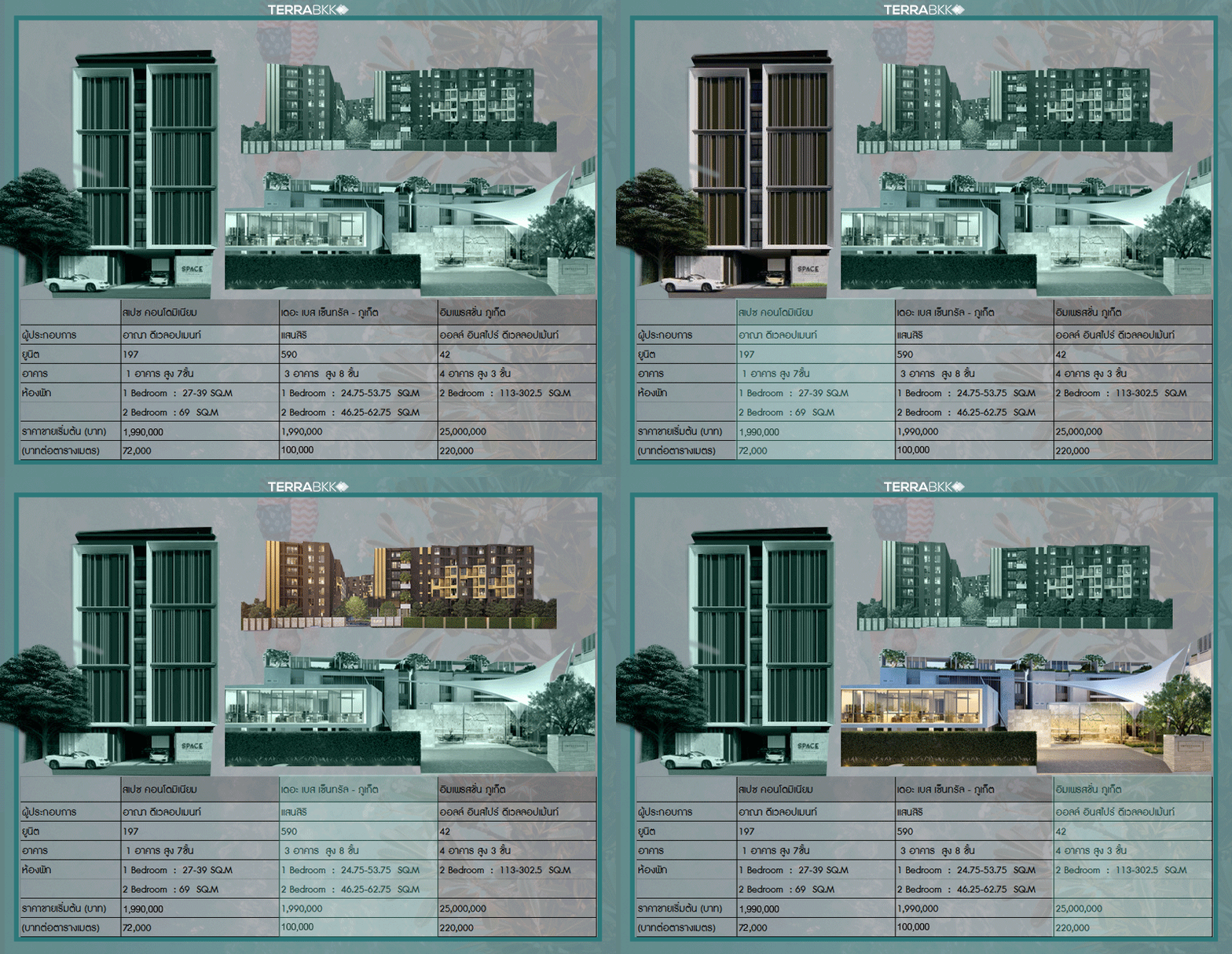
“Phuket” has seen the emergence of no less than 35 condominium projects, totaling at least 11,745 units from both private and public developers over the past five years. The average launch price of condominium projects in the past was around 33,000-45,000 baht per square meter (in 2012), which has steadily increased. In 2018, three condominium projects were launched, all located in Phuket Town, including Impression Phuket with an average price of 220,000 baht per square meter from All Inspire Development, and two projects in the Dara Samut Intersection area, which is set to be the central hub for Phuket's TOD development: The Base Central - Phuket with an average price of 100,000 baht per square meter from Sansiri, which is now sold out, indicating strong demand for condominiums in this area. Additionally, there is Space Condominium with an average price of 72,000 baht per square meter from Ananda Development, expected to launch soon.
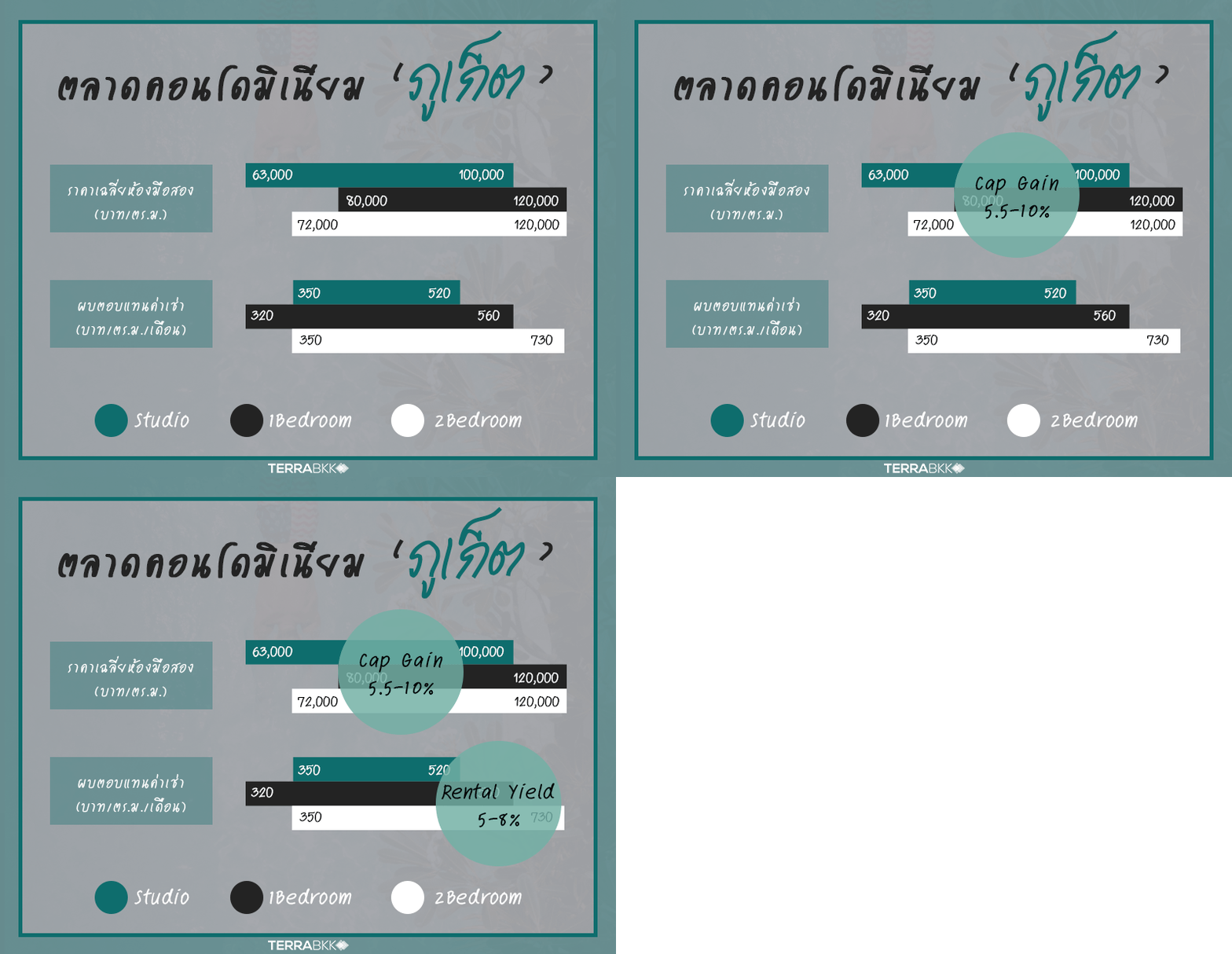
Currently, Phuket condominiums can be rented out at an average of 320-730 baht per square meter per month, resulting in rental prices ranging from tens of thousands to hundreds of thousands of baht per month per unit. This can yield Rental Yield averaging around 5-8% per year, and for long-term holdings, Phuket condominium prices have increased on average (Cap Gain) by 5.5-10% per year. Currently, the average price for second-hand units is between 63,000-120,000 baht per square meter, which is quite reasonable.
Phuket Residents Have the Highest GPP Per Capita in the South
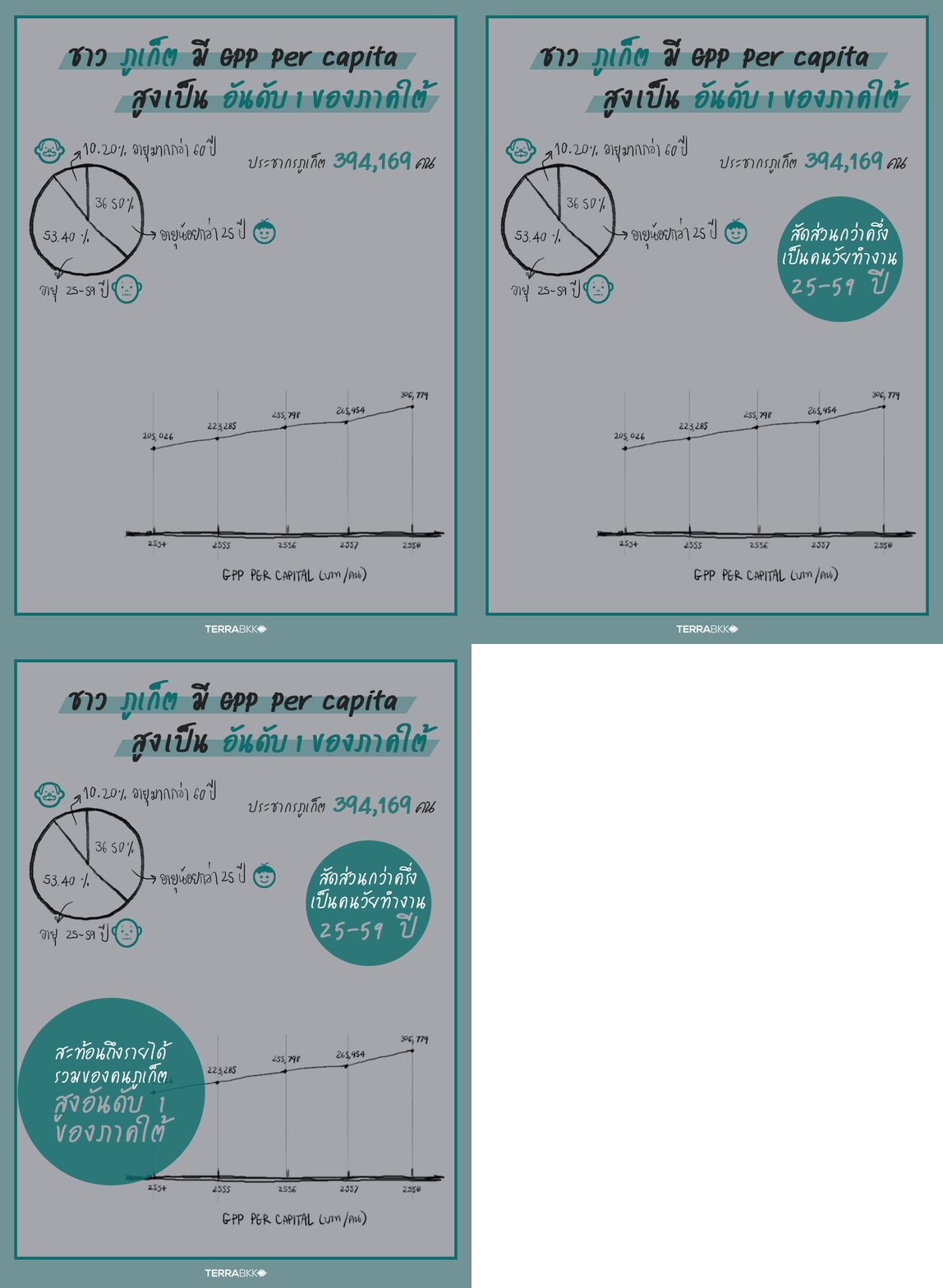
Looking back at the numbers, “Phuket's population” shows that over half, 53.4%, are working-age individuals aged 25-59, who are crucial for driving Phuket's economy. Following this, 36.5% are students aged under 25. Overall, Phuket's population has grown by an average of 2.2% per year, with the latest figure in 2016 at 394,000. Meanwhile, the Gross Provincial Product (GPP) per capita reflects the total income of Phuket residents, which has consistently grown by around 12% per year, with the latest figure at 306,779 baht per person, ranking first in the South.
In conclusion, TerraBKK Research believes that the changes about to occur in “Phuket” are not coincidental but rather the result of careful planning and genuine intentions from various local organizations and the government, recognizing that “Phuket” can develop into a city that keeps pace with the digital age. As the clarity of various projects, such as road construction, airport expansions, and the establishment of Smart City systems, progresses and becomes a reality, it will lead to economic growth, an increase in Phuket's population, and an influx of foreign workers. All of these factors present opportunities for investment in real estate for housing and enhance confidence in private sector investments, leading to the emergence of major retail hubs. In addition to being a top tourist destination in Thailand, this moment marks a new chapter in Thailand's history where a “Smart City” can truly emerge here in “Phuket.”