A Small Dream of Making Bangkok Like Seoul
The Cheonggyecheon Stream that we have mentioned in two previous articles further emphasizes that the dream of seeing a Cheonggyecheon-like stream in Bangkok is unlikely to come true (in the near future). However, TerraBKK would like to continue dreaming a bit longer. In this article, I will share my thoughts and imagination on where a Cheonggyecheon-like stream could potentially be developed in Bangkok and how it could benefit the city.
Exploring Bangkok's Public Space Development Plans
Some may argue that Bangkok lacks public space and green areas like other cities, but one should look at the Master Plan for Green Space Networks in Bangkok Metropolitan Area, City Planning Department, Bangkok. There are plans for developing green space networks according to the Urban Planning Measures 2013, which designates open spaces in categories 1-6. These spaces are intended for flood prevention, riverside or canal areas, drainage support, or coastal areas. However, the category that directly relates to urban living is recreational open spaces and environmental quality maintenance or 1, which are scattered throughout Bangkok.
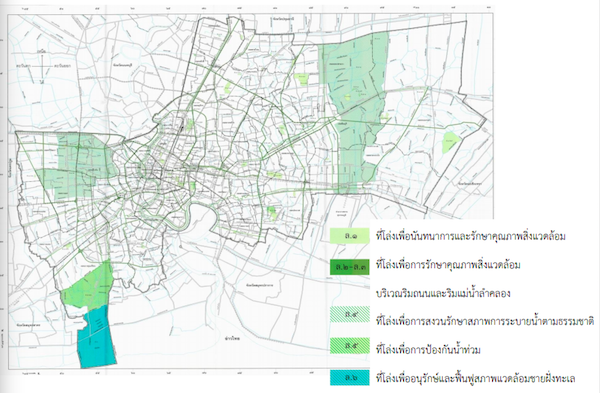
When asking why the government would develop these already existing recreational spaces, the answer is that although there are open spaces, there are still issues with unequal access to public areas. Additionally, the existing open spaces may not be environmentally beneficial or adequately serviced, nor do they make the city attractive. This is why the master plan for green space networks was created, to seek connections between open spaces that can ensure access for everyone in the future.
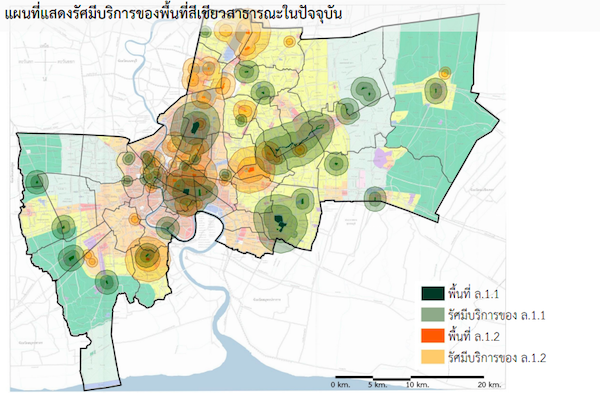
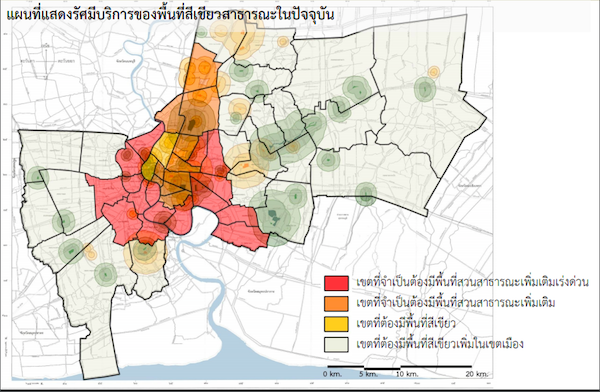
Furthermore, the open spaces are categorized further from type 1 into types 1.1-1.4, where the spaces that can be developed by government management are 1.1 Major Public Parks and 1.2 Open Spaces for Recreational Activities of Other State Agencies. Upon examining the accessibility radius of these two types of open spaces, it is found that there are many areas that cannot access open spaces at all. Shockingly, the densely populated inner city areas lack public spaces.
Looking at Narathiwat Canal: Potential Beyond Public Space
Recognizing the scarcity of public spaces in urban areas leads to the realization that urban spaces need to be more than just sidewalks or open areas; they must also create economic value. This is a potential that the Cheonggyecheon Stream has already demonstrated, showing that urban spaces can provide more benefits than expected.
TerraBKK imagines that if a Cheonggyecheon-like stream were to be developed in Bangkok, suitable areas that could add economic value and improve the quality of life for the city would be identified. Our answer is “Narathiwat Canal”.
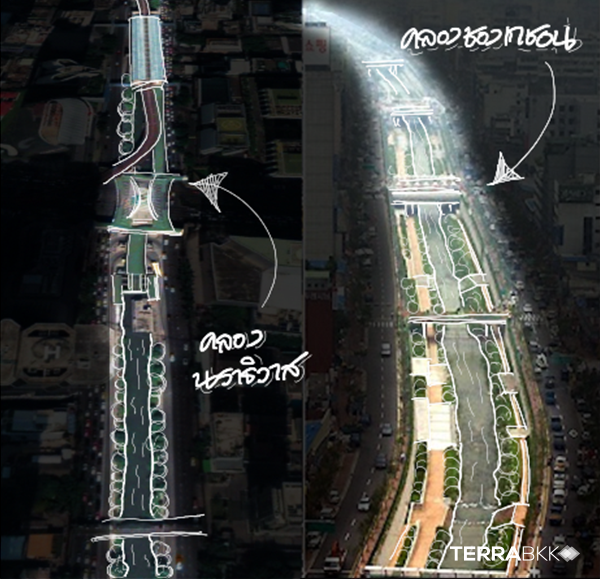
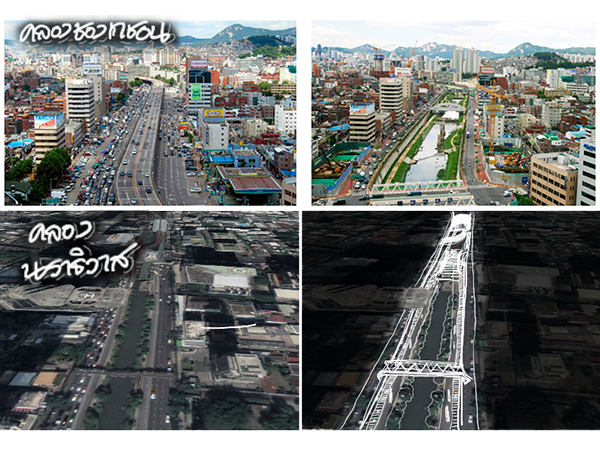
With similar physical characteristics between Cheonggyecheon and Narathiwat Canal, the distance from the start to the end of the canal is approximately 5 km. The Cheonggyecheon Stream is 5.8 km long and 35-40 meters wide, while Narathiwat Canal is about 5 km long and approximately 20 meters wide. Both canals are located in the city's CBD with heavy traffic.
The reason Narathiwat Canal has suitable potential is due to the Silom-Sathorn area, which sees a daily influx of over 93,000 people. Additionally, more than 70,000 people use private cars and public transport along this route daily. There is likely no other location in Bangkok with such high traffic density as Silom-Sathorn.
Furthermore, an important factor in creating economic value for developing Narathiwat Canal into a Cheonggyecheon-like stream is its recognition and familiarity among tourists and foreign businesspeople, along with easy access to public transport and convenient connections to major tourist attractions in Bangkok.
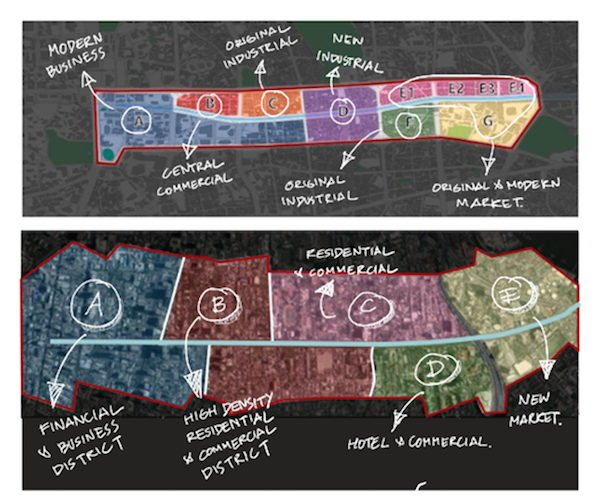
In terms of zoning for land use around Narathiwat Canal, it should focus on intensive activities, possibly requiring urban planning incentives for developers to align their projects with the intended land use. For instance, between 2003 and 2015, the Cheonggyecheon area saw 56 new buildings constructed in zones A-B, which is the economic center (CBD) of the Cheonggyecheon development project, 172 major renovations, and over 301 changes in building use. This reflects that the location in the Cheonggyecheon development project has genuinely attracted investors and has a continuous turnover of new operators. Additionally, urban planning incentives such as a high Floor Area Ratio (FAR) have led to rising land prices in this area every year, while also reducing urban heat by 3.6% and air pollution by 33%, generating over $750,000 annually for the government. It would be wonderful if city dwellers in Bangkok could have such places to relax. - เทอร์ร่า บีเคเค
Article by: TerraBKK Investment Tips
TerraBKK: Find Good, Affordable Homes