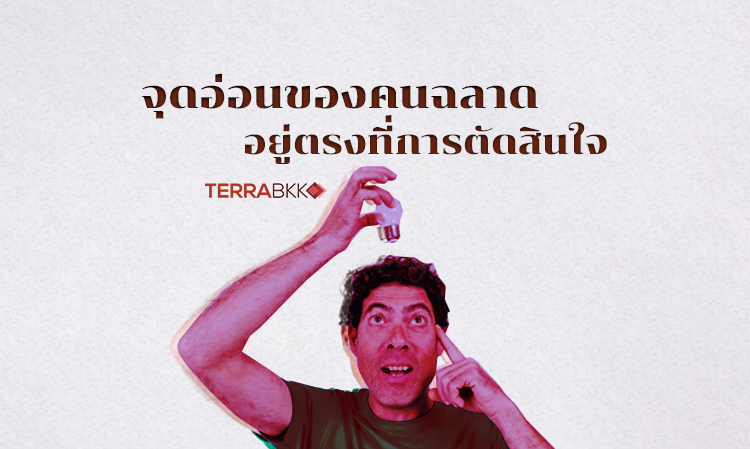
The Weakness of Smart People Lies in Decision-Making
Even the most intelligent can make mistakes, just like a four-legged creature can stumble. No matter how brilliant one may be, when faced with the challenge of decision-making, it's natural to falter at times. This is due to a phenomenon known as cognitive biases, which are limitations that arise in our thinking and decision-making processes, sometimes leading us away from sound principles and reasoning.
Among the many biases that exist, let's examine four key cognitive biases that can turn someone who once appeared smart into someone who suddenly seems foolish.
1. Risk Aversion in psychology refers to the tendency to prioritize preventing losses over seeking gains. To illustrate, people are more inclined to avoid losing 500 baht than to make an effort to earn 500 baht.
Daniel Kahneman, a researcher and author of the book Thinking, Fast and Slow, explains that this is because losses have a psychological impact that is twice as significant as gains. As the saying goes, “A bird in the hand is worth two in the bush.”
The negative consequences of this bias lead many to decide to give up even when opportunities remain, viewing the abandonment of high-risk pursuits as a way to prevent loss. In reality, deciding to forgo opportunities today is what truly leads to a game over.
2. Availability Heuristic refers to making decisions based on the information that comes to mind most readily, rather than considering multiple perspectives. People often rush to decide based on the information or viewpoints they have, without seeking new data or perspectives that could lead to more careful and thorough decision-making. For example, when reading news about unrest in Syria, many may envision living in a time filled with violence, even though they are actually residing in a peaceful area.
The mental imagery created from recent experiences can significantly influence our decisions, often without us realizing it. Therefore, for businesspeople and entrepreneurs, it is crucial to avoid this bias by constantly reminding themselves to base decisions on data, not memory.
3. Survivorship Bias is a cognitive bias that occurs when too much importance is placed on those who have survived or succeeded in a particular situation, while neglecting those who did not succeed simply because they are less visible.
A popular example is Ryan Gosling, the famous actor who dropped out of school at 17 and moved to LA to pursue his acting dreams. His story has inspired many, while the stories of thousands of high school students who followed the same path but did not achieve their dreams are forgotten. Similarly, Steve Jobs, the late genius, did not graduate but became a billionaire, earning admiration, while many other young people who dropped out of college and faced failure are seldom mentioned.
The problem with clinging to this bias is that it creates a trap that leads many to make poor decisions. One must always remind themselves that everyone has their own path to success; there is no one-size-fits-all formula. Even if your finish line is the same, individuals have different strengths and weaknesses.
Confirmation Bias refers to the tendency to seek out information that confirms one’s existing beliefs or theories while avoiding information that contradicts them. For instance, whenever you believe that customers like your new product, you tend to focus on the positive feedback while ignoring negative comments, leading to a one-sided reception of information.
The best way to avoid this bias is to strive to draw conclusions from all the information received, rather than focusing solely on the praise that aligns with your expectations. Try to keep an open mind to delve deeper into what customers are reflecting. When you have a comprehensive understanding of the information, you will be able to make better decisions.