10 Years of Development in Seoul
In a previous article, TerraBKK discussed The Development of Seoul and the Price to Pay? (Part 1), concluding with a promise to elaborate on the management and development of the Cheonggyecheon Restoration Project, and what lessons it offers to industrial cities like Bangkok.
The Journey of the Cheonggyecheon Stream
Looking back to the year 2000, it was hard to imagine how over 60,000 shops and 220,000 vendors, along with 3,000 street vendors, could be relocated along the Cheonggyecheon revitalization route. However, Mayor Myuk-bak Lee and the government held discussions with approximately 42,000 vendors over 43,000 meetings to negotiate the relocation. Interestingly, no compensation was offered to the vendors; instead, the government provided indirect financial support through business loans, funds for shop renovations, and scholarships. The vendors agreed to relocate upon learning that their new locations would be in newly constructed shopping malls alongside the Cheonggyecheon development. The state’s compensation budget was only $70 million from a total of 2,331 proposals, leaving unanswered whether this was an acceptable and worthwhile offer for the vendors.
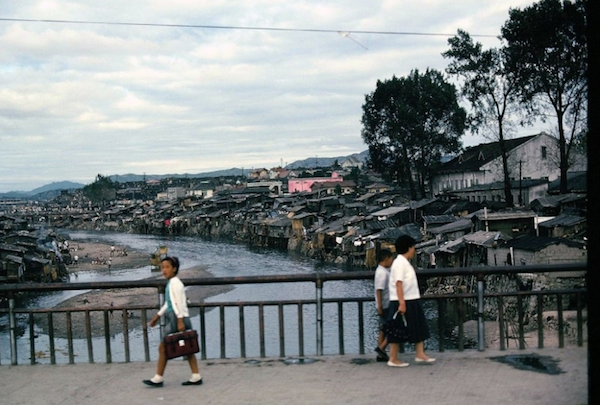
(Photo of Cheonggyecheon approximately 50 years ago)
The Unassessed Outcomes of Cheonggyecheon
After the Cheonggyecheon Restoration Project marked its 10th anniversary in 2015, evaluations and reviews of the results from this massive development project were conducted. Undoubtedly, Cheonggyecheon excelled in creating a large public space in the city that accommodates up to 90,000 users daily, reducing urban heat by 3.6% and air pollution by 33%, while generating over $750,000 annually for the government. However, for the vendors who relocated to the new shopping malls, the outcome was disappointing, as the costs of moving exceeded what the government offered, and the new malls struggled to succeed as anticipated.
Although the government stated that the impact assessment of the Cheonggyecheon restoration project could not be fully evaluated yet due to the long-term changes in urban form, the small shops—over 100,000 of them—that had to relocate due to skyrocketing land prices around the project remain merely a representation of the project's success.
Building Control Planning and Land Use
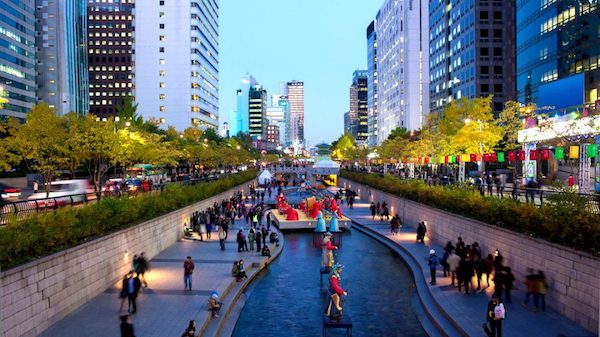
The developed Cheonggyecheon stretches 5.8 km long and is about 40 meters wide, starting from Cheonggye Plaza, near Gyeongbokgung Palace, Changgyeonggung Palace, and Bukchon Hanok Village, popular tourist destinations in Seoul, and ending at the Dongdaemun area, which features the Dongdaemun Plaza, a major shopping center designed by a world-renowned architect. This 5.8 km stretch showcases distinct neighborhoods and is accessible via public transportation.
The land use planning around the Cheonggyecheon project is divided into seven groups, labeled A-G, based on the Seoul CBD Development Plans regarding the Cheonggyecheon Restoration Project. Zone A is a modern business district, Zone B is a commercial center, Zone C is traditional industry, Zone D is revitalized industry, Zones E/G are traditional markets integrated with modern commerce, and Zone F is traditional industry.
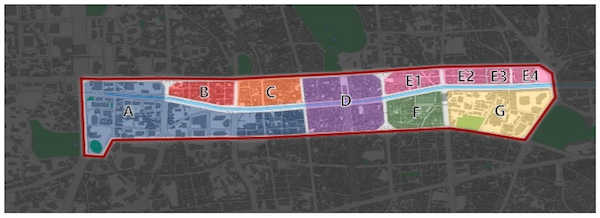
After 10 years of the Cheonggyecheon restoration project, by 2015, a summary of building growth in the Cheonggyecheon project area revealed that 49 new buildings were constructed and over 140 renovations took place (based on construction permit applications). In Zones A-B, there was intense building development, with high-rise buildings making up 82.6% of all buildings and an average FAR of 345.5%, while the roads were only 5-7 meters wide, making it an attractive proposition for investors.
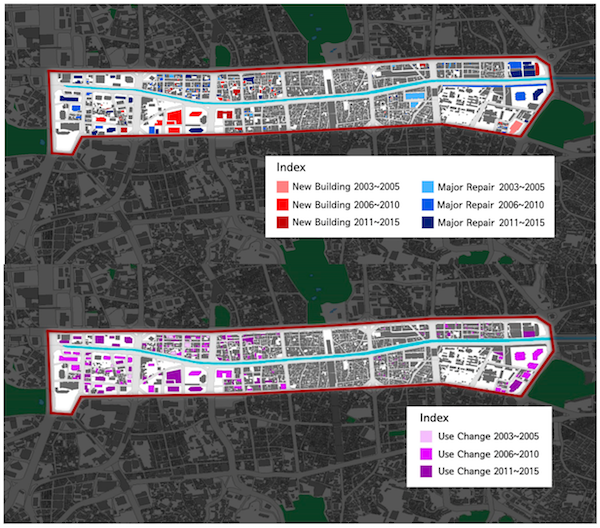
Between 2003 and 2015, 56 new buildings were constructed in Zones A-B, the economic center (CBD) of the Cheonggyecheon development project, with 172 major renovations and over 301 changes in building use, reflecting genuine interest from investors in the project area, with a continuous turnover of new operators. Additionally, the urban planning incentives provided by offering a high FAR made it unsurprising that land prices in this area have been rising every year - เทอร์ร่า บีเคเค
Article by: TerraBKK Investment Tips
TerraBKK: Find good, valuable, and affordable homes