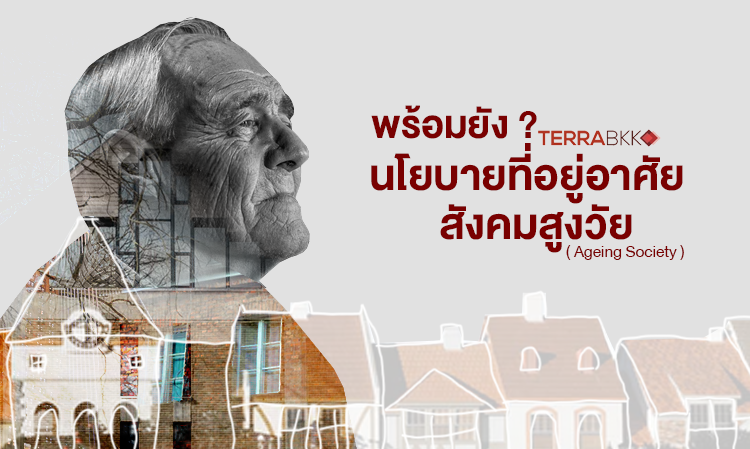
Are We Ready? Housing Policies for an Ageing Society
Ageing Society has become a recurring trend, and TerraBKK views this trend as a real issue cloaked in considerable concern. What will happen in the future if the Ageing Society increases alongside a decline in the working-age population, which is a crucial driver of the country's economy? Promoting the use of technology or AI to assist in work is a good idea, but will Thailand reach that capability? It's worth asking ourselves.
Case Study: Singapore
In terms of interesting national development, one country that TerraBKK highlights is Singapore. Back in 1960, Singapore was not a livable place; about two-thirds of the population (1.6 million people) lived in slums. However, through the housing organization of the Housing and Development Board (HDB), it has now managed to provide housing for 84% of the population, with the remaining 16% being privately built. Certainly, Singapore has advanced further in housing to accommodate the Ageing Society, not just by creating housing but also by implementing policies that delve into communal living for the elderly and promoting cohabitation among parents and children. Here are the details:
Housing Promotion Policies for the Ageing Society
• Senior Priority Scheme is a policy that promotes housing for the elderly, ensuring at least 40% of the building is designated for seniors. They can register to wait for a lottery to select a two-bedroom unit built by HDB in order.
• Multi-Generation Priority Scheme encourages families to live together, allowing them to choose locations and larger living spaces, such as 2-3 bedroom units.
Housing Promotion Policies for Families
• Married Child Priority Scheme promotes newly married children to separate from their families and allows them to enter a lottery for housing close to their parents' residence.
• Parenthood Priority Scheme allows married couples with children under 16 years old to enter a lottery for housing.
• Third-Child Priority allows families with a third child under 16 years old to enter a lottery for larger housing.
• Assistance Scheme for Second-Timers (Divorced/Widowed Parents) allows divorced or widowed parents with children under 16 years old to enter a lottery for suitable housing.
As for Thailand, we still do not have a clear policy promoting housing for the Ageing Society. According to the National Elderly Plan, Version 2 (2002-2021) from the Ministry of Social Development and Human Security, which is responsible for monitoring and updating the elderly plan to align with changing social circumstances, it has been found that there are still many challenges for Thailand's Ageing Society, such as:
1. Poverty among the population
Most elderly people are unemployed and lack financial security in the form of savings or pensions. With more people living alone, they lack financial support, making poverty among the elderly potentially more severe.
2. Declining working-age population
The current trend in Thai families is a decrease in birth rates, differing from traditional Thai families where children played a significant role in supporting the elderly. Additionally, the working-age population tends to migrate to Bangkok or work far from home, causing many elderly people with children not to live with them. In summary, relying solely on children in old age is becoming increasingly difficult.
3. Increased need for long-term care
Elderly people are living longer, and the incidence of illness or inability to care for themselves is also increasing with age. With the difficulty of relying on children today, the elderly will require more long-term care. It is estimated that by 2020, there will be over 700,000 elderly people needing long-term care due to disabilities or dementia.
4. Lack of opportunities to utilize the potential of the elderly
Many elderly individuals still possess work potential and accumulated knowledge and skills but lack opportunities to demonstrate their potential for the benefit of society and the country. Furthermore, related organizations have not effectively communicated and coordinated with each other.
In conclusion, TerraBKK believes that as we are Thai citizens who will eventually grow old and become elderly, wouldn't it be better if we took more responsibility for ourselves and planned our lives for retirement without being a burden on our children and Thailand? Before demanding anything from the nation, let’s reflect on how we can contribute to the country as Thailand fully transitions into an Ageing Society --- TerraBKK
#Exploring Thailand's Readiness for a Complete Ageing Society
#Download Free Elderly House Designs
#8 Ideas for Elderly Products
#6 Standards for Elderly Housing
Article by: TerraBKK Investment Tips
TerraBKK: Find Good, Affordable Homes