The Future of Lumpini Park Area in the Mixed-Use Project
The Future of Lumpini Park Area in the Mixed-Use Project
When discussing the trending real estate development in 2017, the mixed-use development stands out, with an overall investment value exceeding 450 billion baht. The project timeline spans from 2018 to 2025, comparable to the mega-projects initiated by the government. Why are developers flocking to the mixed-use market at this time? Primarily, it's due to the dwindling availability of high-potential land in the city center, which has consequently driven up development costs. Mixed-use development maximizes land utilization more effectively than solely residential or commercial projects. Successful examples of mixed-use developments that have positively impacted urban areas can be seen in Singapore and Hong Kong.
In Bangkok, particularly in the CBD areas like Lumpini-Silom-Sathorn, which also includes Ratchadamri and Witthayu Road, these locations are highly suitable for mixed-use project development. This time, TerraBKK will elaborate on why mixed-use projects are important and how they can create positive urban impacts.
Why is having mixed-use projects in the CBD beneficial?
When we talk about the CBD, it is not just about the dense clustering of activities and job opportunities that serve as the business hub of the city. The readiness and completeness of infrastructure are key factors that promote the effective development of mixed-use projects. This includes the population density and the public transportation system. Mixed-use projects can intensively utilize land, creating urban spaces without requiring government investment, and can connect to other forms of urban development in areas such as economy, public spaces, infrastructure, and transportation systems. This can be described as a “Combine multiple uses within a single development”.
To illustrate this, TerraBKK will highlight cities with clear mixed-use project developments, such as Singapore, which has been developing mixed-use projects alongside urban development since 1985. The details of these projects are similar to those that will soon emerge in Bangkok.
Singapore: The City of Mixed-Use (Marina Bay)
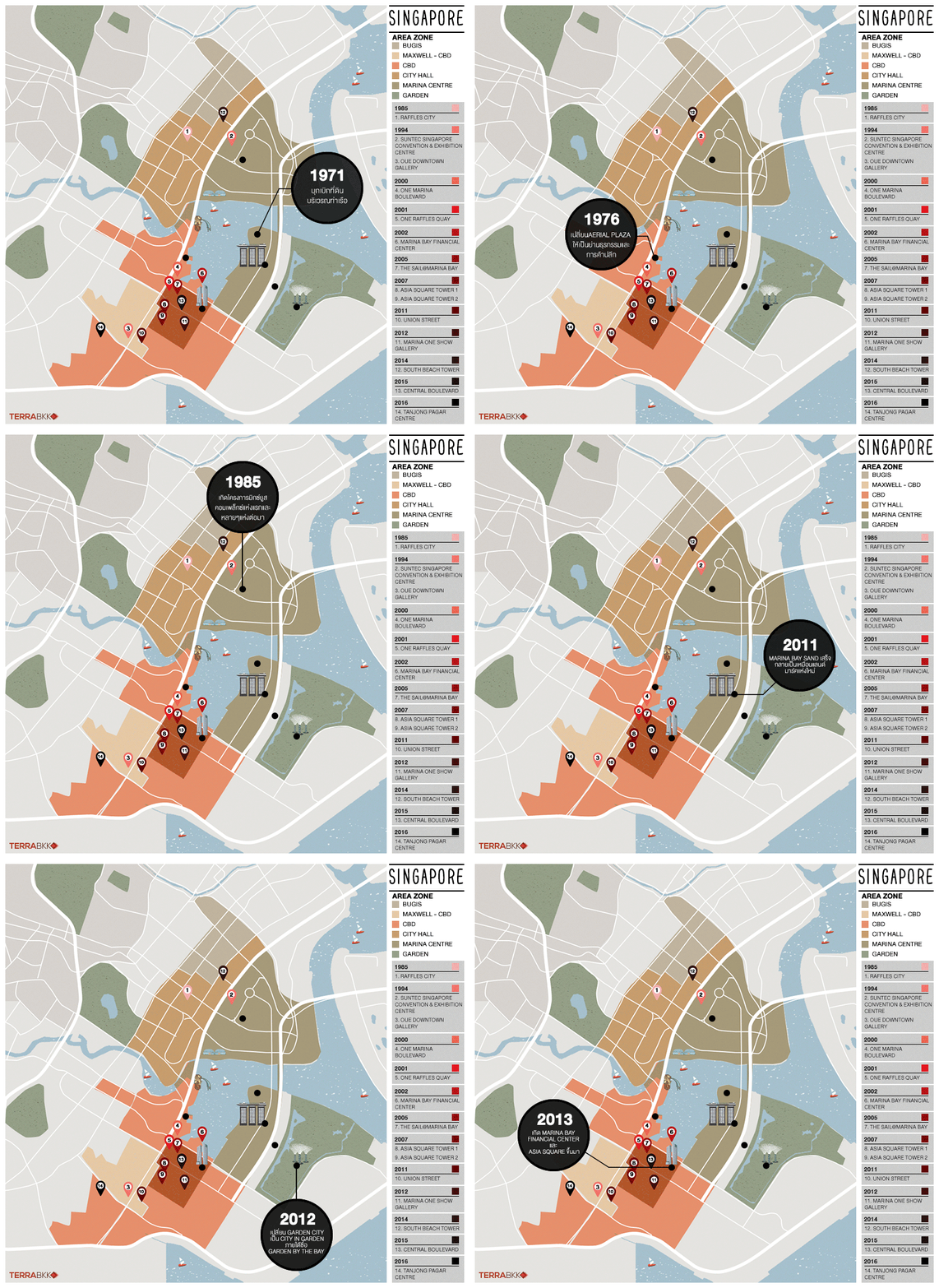
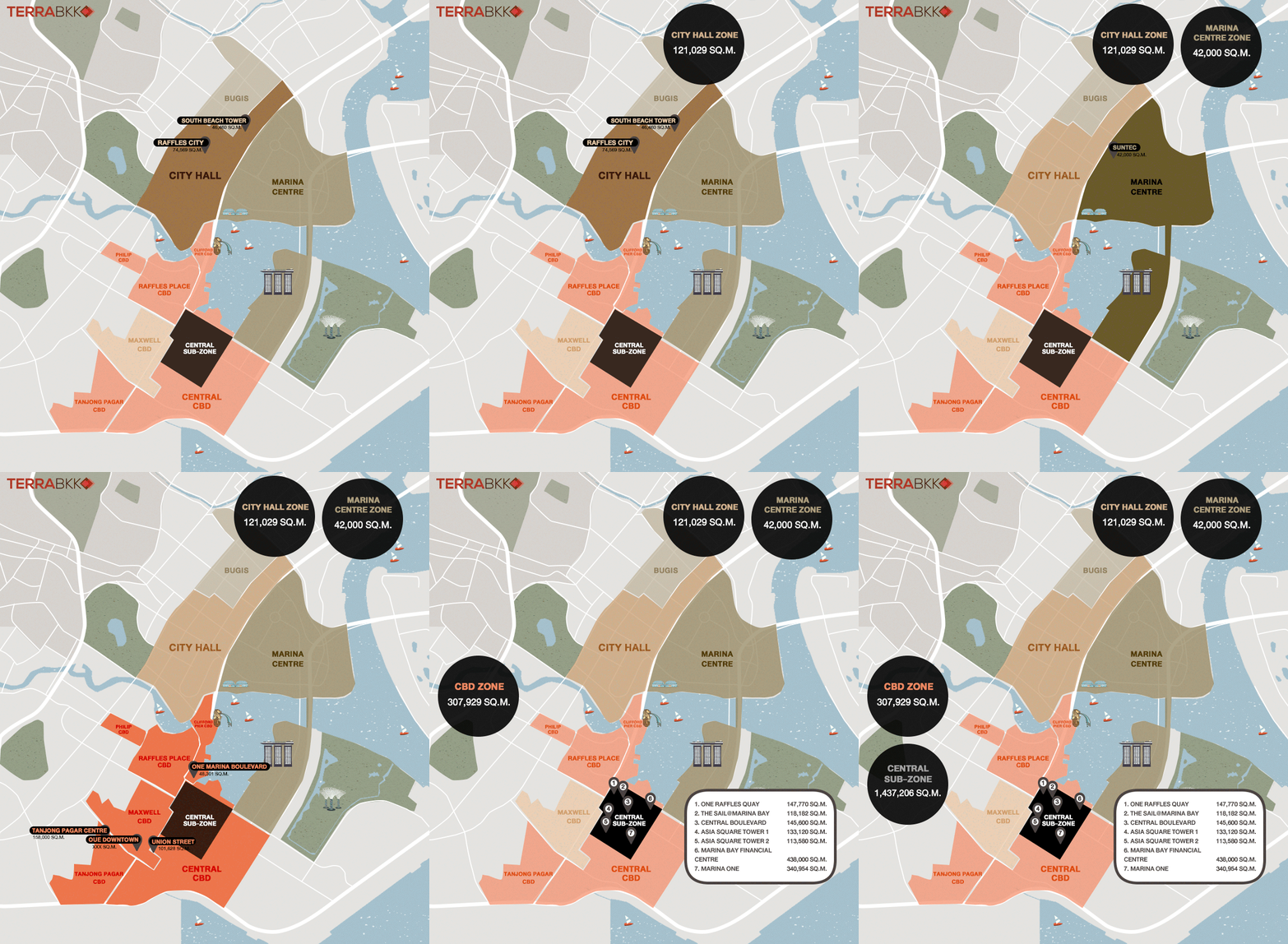
The Marina Bay project has transformed the image and enhanced the quality of life for Singaporeans. It began with government oversight under the Urban Redevelopment Authority (URA), which set guidelines for land use (GLS) within the project. The concept originated from land reclamation at the port area (East Coast Parkway) in 1971, with implementation starting in 1976, transforming Aerial Plaza into a business and retail district, culminating in the complete land reclamation by 1985. The first mixed-use complex, Marina Center, was established, followed by other mixed-use projects like Suntec City, Marina Square, and Milenia Walk.
In 2003, the vision for land development became clearer with the announcement of the Marina Bay project at the 2003 Master Plan exhibition, which included the development of a business and financial center, new city landmarks, and a 3.5 km waterfront promenade, continuing until 2010.
In 2011, the Marina Bay Sands was completed, becoming a new landmark for Singapore. In 2012, the project that transformed Singapore from a Garden City to a City in a Garden was completed under the name Garden By The Bay. Subsequently, in 2013, the government aimed to position Singapore as a financial hub comparable to London or New York, leading to the development of Marina Bay Financial Center and Asia Square.
The large-scale mixed-use developments like Marina Bay in Singapore also include Marina One and Marina South, which aim to promote the economy and living standards for Singaporeans. Additionally, the Marina Bay plan is a long-term initiative extending until 2030.
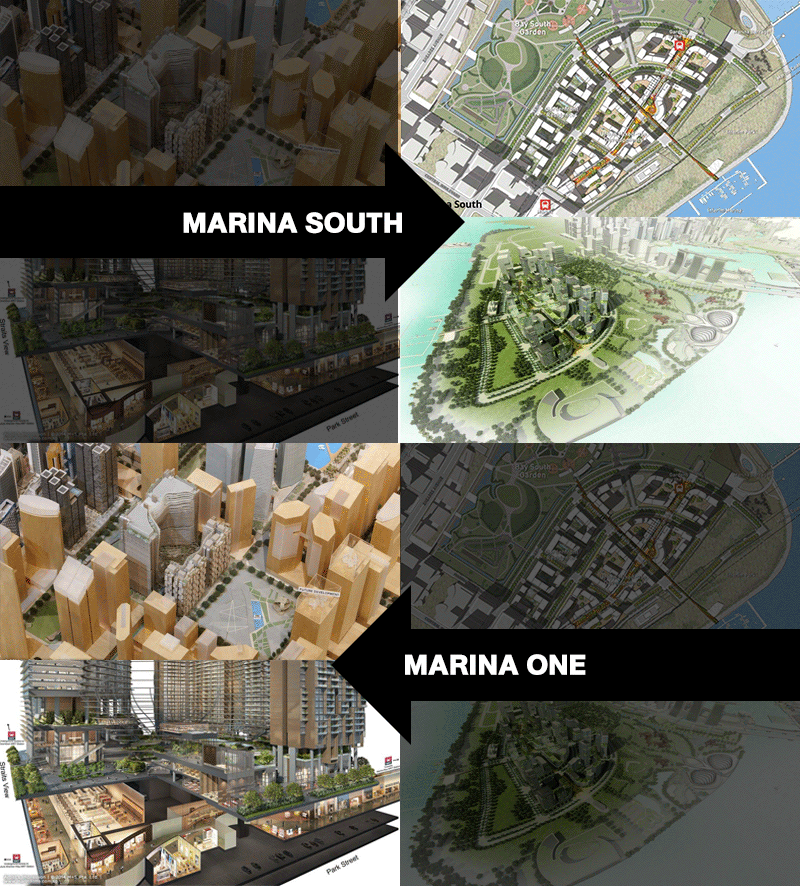
It is evident that the new mixed-use projects initiated by the URA and funded by private sectors in Singapore are located in the CBD and Central Sub-Zone, which is part of the Singapore government’s land development plan aimed at creating a full urban center cluster. This has led to a concentrated economic grouping in the city center, increasing land value and driving urban development in a unified direction. The 15 projects mentioned above cover a total area of 1.9 million square meters, capable of accommodating up to approximately 477,000 people at full capacity.
Bangkok's CBD and the Emergence of Mixed-Use Projects
When asked where Bangkok's CBD is located, the answer remains Lumpini-Silom-Sathorn, which has maintained its prosperity for over 50 years since the economic center shifted from Charoen Krung Road to Silom and Sathorn Roads, respectively. However, the Lumpini-Silom-Sathorn area, which has long been recognized as a CBD, has not seen many exciting new projects for a long time, unlike the New CBD and Core CBD areas like Asoke-Rama 9-Ratchada, where numerous office rentals, shopping centers, and mixed-use projects have emerged over the past decade.
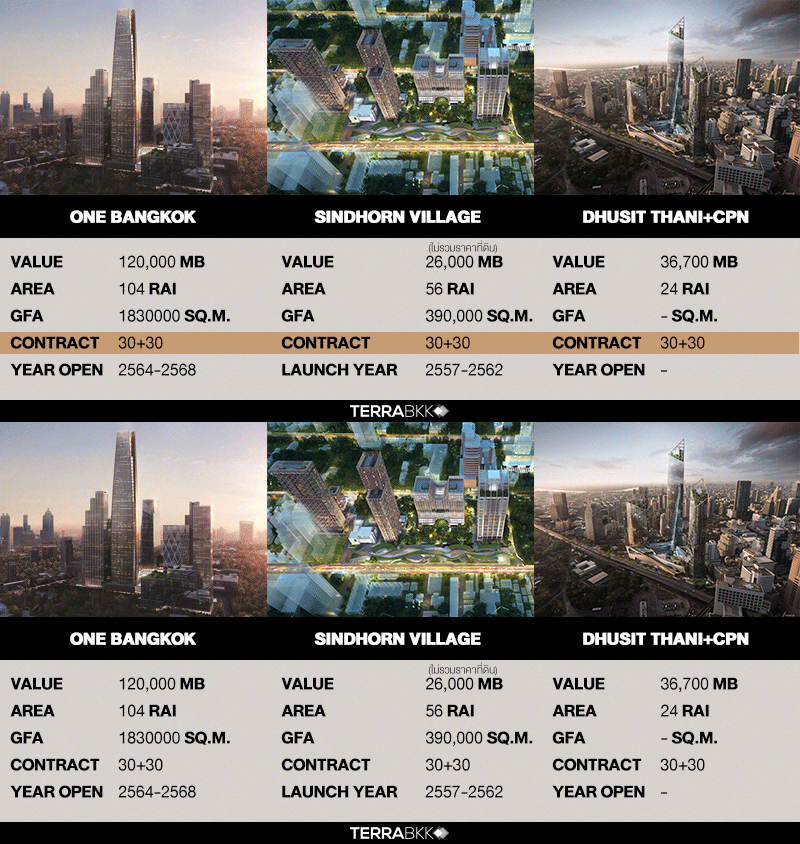
In the near future, the Lumpini-Silom-Sathorn area around Lumpini Park will see the emergence of two mixed-use projects: One Bangkok and SINDHORN VILLAGE. Although both are labeled as mixed-use projects, they have distinct characteristics and address different needs. Both projects can create significant impacts on the city.
Besides One Bangkok and SINDHORN VILLAGE, there is also a project resulting from the collaboration between Dusit Thani Group and Central Group, which is developing the land of the former Dusit Thani Hotel into a mixed-use project comprising office buildings, hotels, retail spaces, and residential areas, although detailed project information is still limited.
“One Bangkok” Workplace & Urban Space
The details of the One Bangkok project include five Grade A office buildings (total area of 500,000 sq.m.), retail spaces, five luxury hotels, three 30-story ultra-luxury condominiums (Leasehold), a combined green space of 50 rai, and a cultural activity center of 10,000 sq.m.
With its location adjacent to the CBD and close to the Lumpini subway station, the One Bangkok project has significant potential to become a vibrant urban activity hub. The project's land use ratio emphasizes urban functionality, such as large office buildings totaling 500,000 sq.m. that can attract newcomers like new businesses or large startups, along with over 50 rai of green space and open areas that can accommodate urban activities, further attracting daytime populations. It is estimated that the project will see a daily footfall of over 60,000 people.
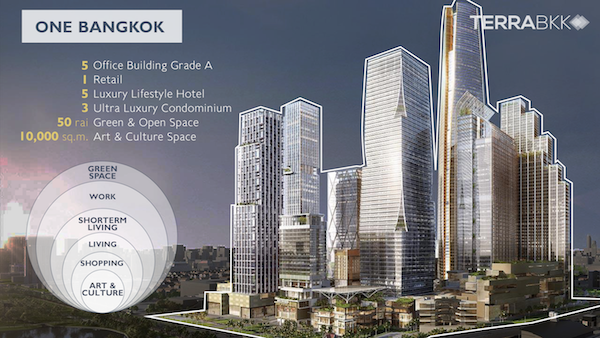
One Bangkok serves as a Workplace & Urban Space that supports urban populations and revitalizes the potential of the CBD as a business and employment center once again.
“SINDHORN VILLAGE”
The details of the SINDHORN VILLAGE project include two Super Luxury (Leasehold) condominiums (Sindhorn Tonson / Sindhorn Lumpini), three Luxury condominiums (Sindhorn Residence / Sindhorn Langsuan and a Low Rise condominium), three buildings of hotels and serviced apartments, and retail spaces (Walking Street).
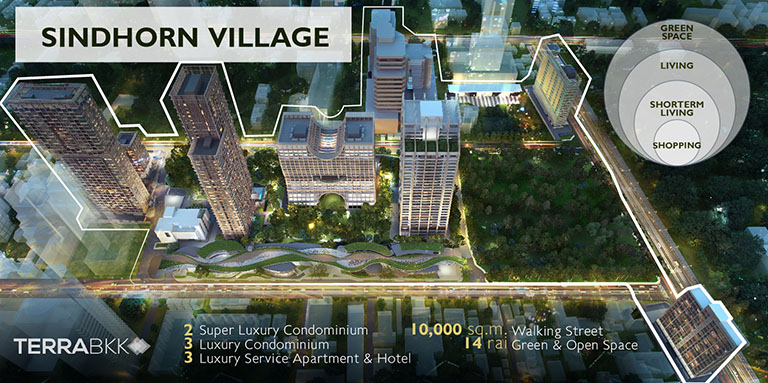
The land use ratio of the SINDHORN VILLAGE project focuses on residential and serviced apartment spaces, totaling eight buildings. TerraBKK believes that the emergence of the SINDHORN VILLAGE project is not only a mixed-use project addressing urban needs but also supports high-quality living in the Lang Suan area, which currently lacks lifestyle spaces. With a 14-rai green area near Lumpini Park and a 10,000 sq.m. walking street, it will enhance the Lang Suan area, providing a comprehensive living and lifestyle experience without overcrowding, ensuring a quality living environment suitable for relaxation and residence. This will further increase the value of the Lang Suan area, which is already a Super Prime Area and a hub for luxury residences, making it even more exclusive.
As land in the city center, especially in the CBD, becomes increasingly scarce and expensive, we can expect to see more Leasehold projects, particularly in mixed-use developments like One Bangkok, Dhusit Thani+CPN, SINDHORN VILLAGE, and other mixed-use projects emerging throughout Bangkok.
While this may be a new concept for many Thais, TerraBKK believes that in a few years, Leasehold projects will become more popular, especially as the government has indicated a willingness to consider extending residential leasehold rights to 50 years, which is a positive sign that could stimulate the Leasehold real estate sector.