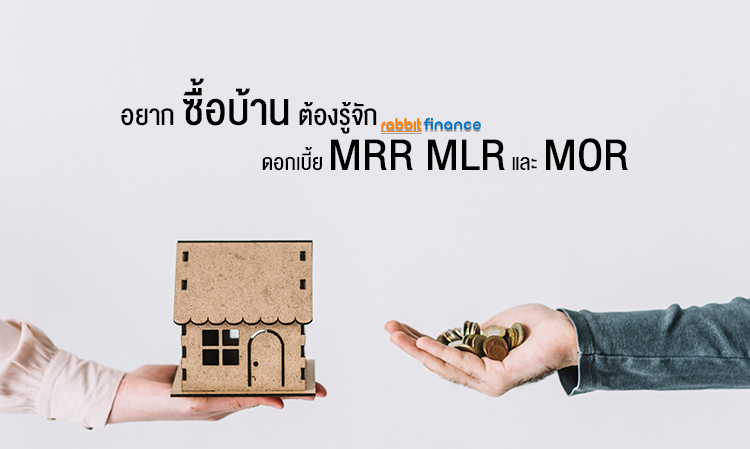
Want to Buy a House? Understand MRR, MLR, and MOR Interest Rates
Many people planning to buy a house may have encountered confusion when trying to secure a loan due to MRR, MLR, and MOR interest rates. What do these terms mean, and how do they affect our home loan applications? Rabbit Finance will help you understand these interest rates.

Understanding Interest Rates Before Buying a House
Loan interest is the amount that lenders, whether banks or financial institutions, charge as compensation for providing loans, usually expressed as a percentage. Interest rates are divided into two types:Fixed Rate Interest
This refers to an interest rate that is set at a specific number and does not fluctuate based on the financial institution's costs. It remains constant throughout the loan term or for a specified period.
Floating Rate Interest
This refers to an interest rate that changes according to the financial institution's costs. The institution will announce any changes, and MRR, MLR, and MOR fall into this category.

Get to Know MRR, MLR, and MOR Interest Rates
These three types of loan interest fall under the floating interest category, each serving different purposes and suitable for various borrowers. Let's see which one suits you best.
MRR (Minimum Retail Rate)
This is the interest rate that banks charge small borrowers or good retail borrowers, such as for credit cards, home purchase loans, and personal loans.
The adjustment of the MRR interest rate can increase or decrease depending on market competition and the bank's costs, so there is always a chance for interest rate adjustments.
The longer the borrower takes out a loan, the more risk the bank bears regarding future interest rates. Thus, MRR adjustments depend on the bank's rising costs.
Borrowers paying MRR should continuously monitor changes in the MRR rate to plan their finances and manage their monthly repayments effectively.

MLR (Minimum Loan Rate)
This is the interest rate that commercial banks charge large, good borrowers, such as those with a solid financial history and sufficient collateral. It is typically used for long-term loans with a fixed term, such as business loans or housing loans.
Although it is mentioned as an interest rate for large borrowers with good history, some banks may offer MLR to general borrowers as well, but only for long-term loans with a fixed term.

MOR (Minimum Overdraft Rate)
This is the interest rate that banks charge large, good borrowers who have an overdraft facility or overdraft loans.
When applying for this type of loan, banks consider various factors, such as the customer's qualifications and the collateral provided. After that, they will make an agreement and set a maximum amount. When customers wish to withdraw overdraft funds, they can do so using checks through their current accounts.
Banks will charge MOR interest on the principal amount starting from the day the borrower withdraws the overdraft. This loan has no fixed repayment term, allowing borrowers the freedom to deposit money into the account without a minimum limit or repay the entire amount at once.
This is the information about MRR, MLR, and MOR interest rates that Rabbit Finance shares with readers planning to borrow money to buy a house, so you can plan your finances and choose the interest rate type that suits you best. Remember, once you buy a house, manage your finances well to ensure comfortable repayments.
Thank you for the information from rabbitfinance.com